Endangered
Western hoolock gibbon
Hoolock hoolock
The western hoolock gibbon (Hoolock hoolock) is a small, tailless ape of the forests of northeast India, Bangladesh and western Myanmar. Males are black, females buff, and mated pairs sing duets from the canopy. The IUCN Red List assessed it as Endangered in 2019, with numbers still falling.
How to recognise it
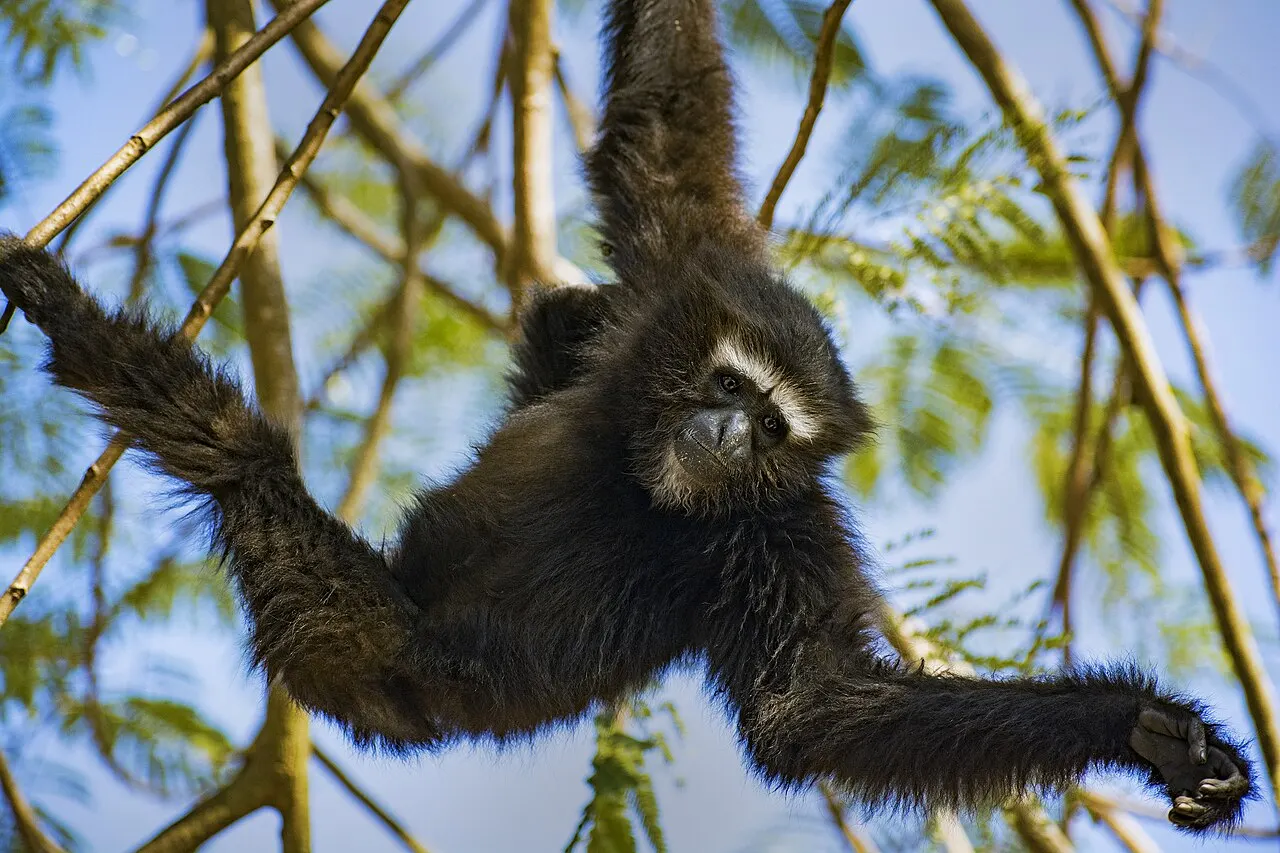
Hoolocks are India's only apes, and like all gibbons they lack a tail. Adults stand about 81 cm tall and weigh roughly 6 to 7 kg, males a little heavier than females. The two sexes look quite different. Males are black or blackish with a white brow stripe above the eyes, while females range from pale buff to tan.
Babies are born nearly white or pale grey, with black faces, hands and feet. They darken with age and are fully black with clear brows by about two years old. Females only switch to the paler adult coat at around 5 to 8 years, when they reach sexual maturity.
Where it lives
The species lives in the forests of northeast India (including Assam, Mizoram and Meghalaya), eastern Bangladesh and Myanmar west of the Chindwin River. A population in southeastern Tibet, China, may be this species, but its identity has not been established. It needs forest with a continuous, broad-leaved canopy, from lowland moist forest up to montane forest. The Red List gives an upper elevation limit of 2,500 m, and gibbons are also recorded using plantations and rural gardens near forest.
Pins are Wikidata “endemic to” fields. Orange dots, when present, are GBIF occurrence tiles — survey bias included.
How it lives
A typical group is a mated pair with their young, averaging about three animals and usually two to six. Gestation lasts 6 to 8 months, and a female commonly gives birth about every two years, though some researchers estimate three to four. Ripe fruit, especially figs, makes up most of the diet. Hoolocks also eat leaves, shoots, flowers, insects and birds' eggs, and they help spread forest seeds.
Pairs advertise their territory with loud duets, usually in the morning. The female's great call speeds up as the bout goes on and the male joins partway through, which sets hoolocks apart from some other gibbons. Captive animals are estimated to live up to about 40 years.
Why it is in trouble
Gibbons live in the treetops and rarely come down, so forest that is cut, fragmented or opened up quickly strands them. The Red List threat record lists housing and urban expansion, small-holder and industrial farming, shifting cultivation and mining, plus hunting for food and folk medicine. The assessment text also names live capture for the pet trade. The 2019 assessment suspected a population reduction of at least 50 percent over three generations (a window running from 2001 to 2045), with a generation taken as 12 to 15 years.
Counts are patchy and estimates conflict. A 2021 news report put the world total at about 3,000, yet the Red List record cites a 2005 estimate of more than 12,000 for northeast India alone. In Bangladesh, a survey between March 2019 and February 2020 found 468 animals in 135 groups in forests of Sylhet and Chattogram, and a news report on it cited about 3,000 in the 1980s. A later total-count programme, described in a 2025 preprint, confirmed at least 816 gibbons in at least 254 groups in 42 forest fragments, although only 10 of those fragments held more than 20 animals.
What is being done
The species is on CITES Appendix I, which bans international commercial trade, and on Schedule I of India's Wildlife (Protection) Act of 1972. The Red List record counts about 30 protected areas in India where it occurs (a 2001 tally). In Bangladesh, the survey team recommended declaring Patharia and Rajkandi forests as hoolock sanctuaries, and found larger groups in reserve forests than in unprotected ones.
In Assam's Hollongapar Gibbon Sanctuary, a colonial-era railway line splits the forest in two. Since 2006 the conservation group Aaranyak has overseen the planting of about 3,000 saplings of 71 plant species along the track to rebuild a canopy link. The first gibbon crossings were recorded in 2019, and in April 2021 a family of four moved from the smaller block to the larger one.
Sources
Written for this catalog in our own words from the sources below, checked against them on 12 November 2026. Population figures are estimates and carry the year they were made. Status and assessment year: IUCN. 2026. The IUCN Red List of Threatened Species. Version 2026-1. iucnredlist.org.




