Critically Endangered
Korean skate
Hongeo koreana
The Korean skate (Hongeo koreana) is a flat, egg-laying ray of the seabed off southern Korea, with a few records from Japan. It's the only species in its genus. The IUCN Red List assessed it as Critically Endangered in 2020 and records a decreasing population, with fishing as the threat.
How to recognise it
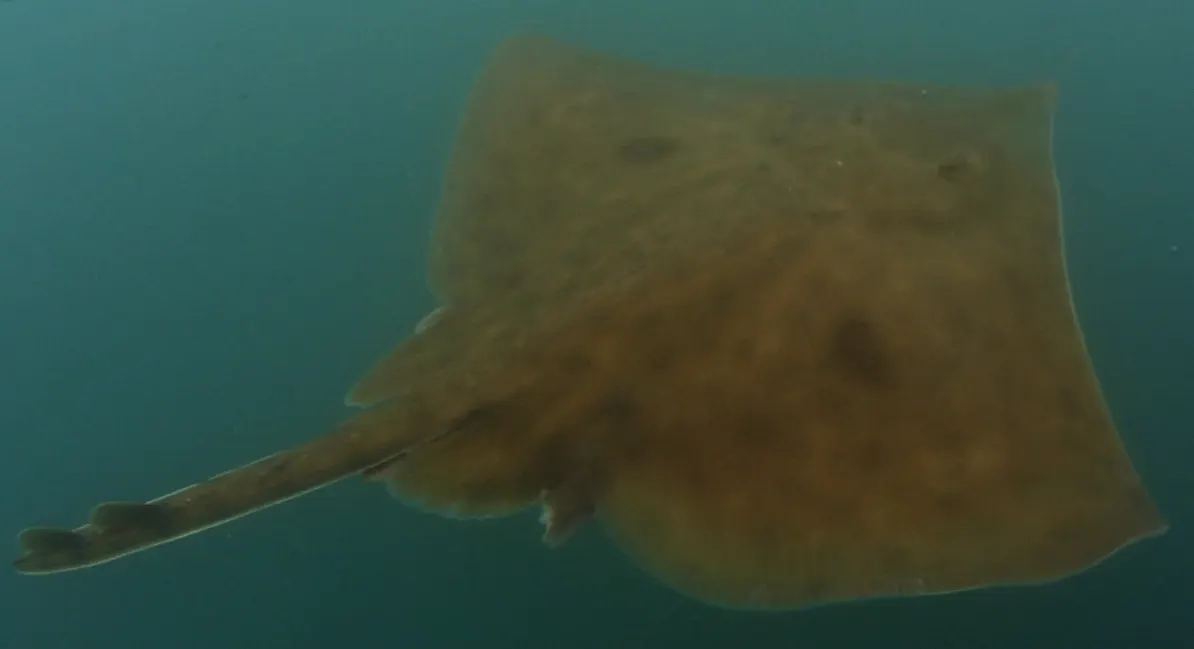
Like other skates, it has a flattened body with broad wing-like fins. The snout is short, deep and slightly blunt, and the mouth is large, with about 51 rows of teeth. It has five pairs of gill slits, two dorsal fins close to the tip of a tail that is shorter than the body, and a small low tail fin.
Males are blacker overall than females. Females are brown above with dark brown spots and blackish below, with grey around the nostrils and gill slits. A row of thorns, mostly pointing forward, runs along the middle of the tail in both sexes. Reference works give a maximum length of about 76 cm for males and 73.5 cm for females.
Where it lives
The core range is the southern and south-western coast of the Korean Peninsula, including the Jeju Strait, the Heuksan Islands and Cheongsando. Records off Japan, near Tsushima and the Goto Islands, are less common. The Red List counts Korea and Japan (Kyushu) as its range.
It stays on the bottom, on sandy, sandy-mud and muddy seabed. Off Korea it has been recorded at roughly 30 to 110 m, and off Japan down to 180 m. The Red List gives a depth range of 30 to 80 m.
Pins are Wikidata “endemic to” fields. Orange dots, when present, are GBIF occurrence tiles — survey bias included.
How it lives
Skates lay eggs rather than giving birth to live young. This species lays paired egg cases on muddy or sandy bottom, and the embryos live on yolk alone. A 2009 description in the Korean Journal of Ichthyology, based on two capsules taken from a female caught off the south-west coast, found them bright brown, about 12 to 13 cm long with their four short horns, and covered in sticky silky fibres.
Its life history leaves little room for error. FishBase rates its resilience as low, with a population doubling time of 4.5 to 14 years, and the Red List uses a generation length of 10 years. The Red List also describes the remaining population as severely fragmented.
Why it is in trouble
The Korean skate is a relatively valuable catch in southern Korea. Skates are used for hongeo-hoe, a fermented raw dish with a famously sharp smell, though any skate can go into it, so not every serving involves this species.
The Red List names harvest as the threat, both as accidental catch in large-scale fisheries and in small-scale fishing, and records a decreasing population.
What is being done
The Red List lists harvest management, trade management, species recovery and site protection as conservation actions for the species. At the 2020 assessment none was in place: no recovery plan, monitoring scheme, protected area or harvest management plan was recorded.
Sources
Written for this catalog in our own words from the sources below, checked against them on 12 November 2026. Population figures are estimates and carry the year they were made. Status and assessment year: IUCN. 2026. The IUCN Red List of Threatened Species. Version 2026-1. iucnredlist.org.




