Endangered
Hong Kong grouper
Epinephelus akaara
The Hong Kong grouper (Epinephelus akaara) is a red-spotted reef fish of the north-western Pacific, found from southern Japan and Korea to southern China. It is prized as live food, and decades of fishing have cut its numbers. The Red List rated it Endangered in an assessment published in 2018.
How to recognise it
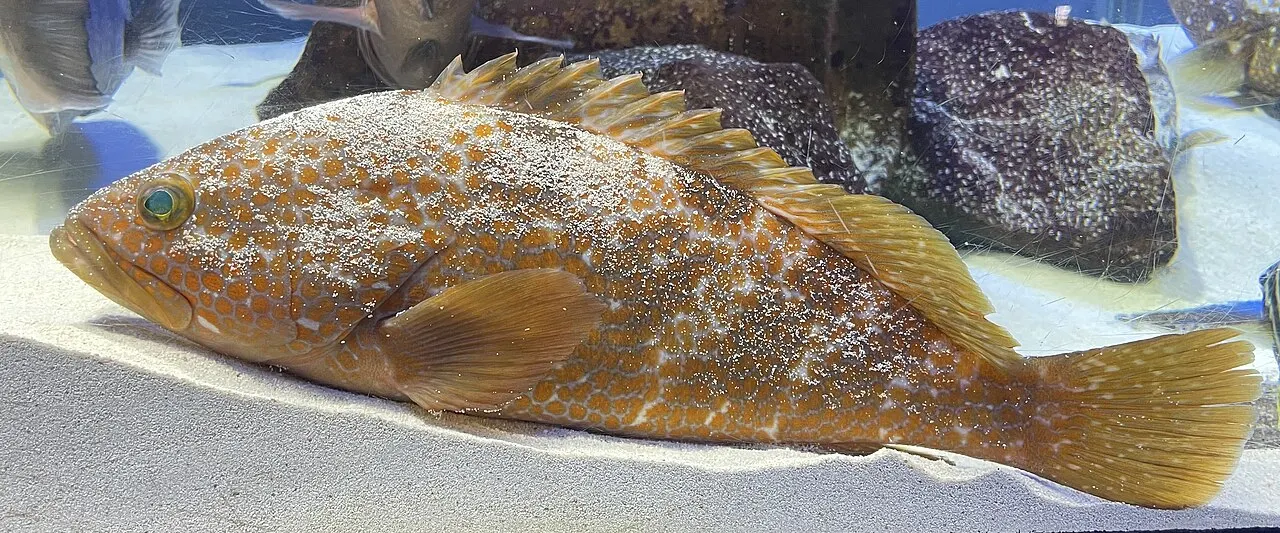
The body is pale brownish grey, covered in small red, orange or gold spots, and the belly is spotless. Six faint dark bars slant across the sides, and the third runs through a dark blotch at the base of the rear dorsal spines. The dorsal fin edge is yellow or orange.
It is a modest grouper. The largest recorded length is 58 cm and about 2.5 kg, but 30 cm fish are far more usual.
Where it lives
Temminck and Schlegel described it in 1842 from Nagasaki. It ranges along both coasts of southern Japan, around Korea, Taiwan and southern China as far as the Gulf of Tonkin. The IUCN lists China, Hong Kong, Macao, Taiwan, Japan, South Korea and Viet Nam. FishBase says the Viet Nam record may actually belong to a different species, and records from India and the Philippines are unsubstantiated.
It lives on shallow rocky and coral reefs from the surface down to at least 55 m. Young fish stay in the shallowest water, often above 10 m.
Pins are Wikidata “endemic to” fields. Orange dots, when present, are GBIF occurrence tiles — survey bias included.
How it lives
Fishers in Hong Kong report spawning adults at depths of 27 to 55 m, and off Korea's Byeonsan Peninsula spawning has been seen in late July and early August. Divers in Hong Kong have reported summer groups of up to 50 fish, though no spawning gathering has been confirmed. Fish about 23 cm long start to mature. Off Korea, hermaphrodite fish have reportedly measured 28 to 32 cm and males about 40 cm. The IUCN estimates a generation at about 11 years.
Why it is in trouble
Fishing is the threat the IUCN names, both large commercial catches and small-scale use. The fish is a high-value food, usually caught by handline over rocky ground and often sold alive, which fetches a higher price. By the mid-1990s the wild stock had reportedly been fished down until it could no longer support a proper fishery. The assessment records a decreasing population under criterion A2d, a decline based on actual or potential levels of exploitation.
The Red List text says no stocks are known to be effectively managed. China restricts some fishing gear. Hong Kong's fisheries department points to a trawling ban and other measures introduced from 2012, yet fishing there has been described as largely unregulated apart from one small no-take area where the species may be increasing.
What is being done
Hatchery-raised young are released in Japanese waters. Hong Kong's Agriculture, Fisheries and Conservation Department has done the same in the north-east of the territory: about 12,000 fingerlings across two releases in 2019, starting with about 6,000 in June. The fish came from hatcheries with South China Sea broodstock, and some carried tags so they could be tracked. A year of diver surveys found the groupers moved little and hid in crevices of the artificial reef. Acoustic tracking of released fingerlings, not only groupers, still picked up some tagged fish near the reefs ten months on.
The IUCN assessment lists harvest management, site protection and habitat restoration as actions needed. It found no recovery plan, no monitoring scheme and no harvest management plan in place, although the species occurs in at least one protected area. Raising the fish in aquaculture is possible, but survival of hatched larvae is low.
Sources
Written for this catalog in our own words from the sources below, checked against them on 12 November 2026. Population figures are estimates and carry the year they were made. Status and assessment year: IUCN. 2026. The IUCN Red List of Threatened Species. Version 2026-1. iucnredlist.org.