Critically Endangered
Home's hinge-back tortoise
Kinixys homeana
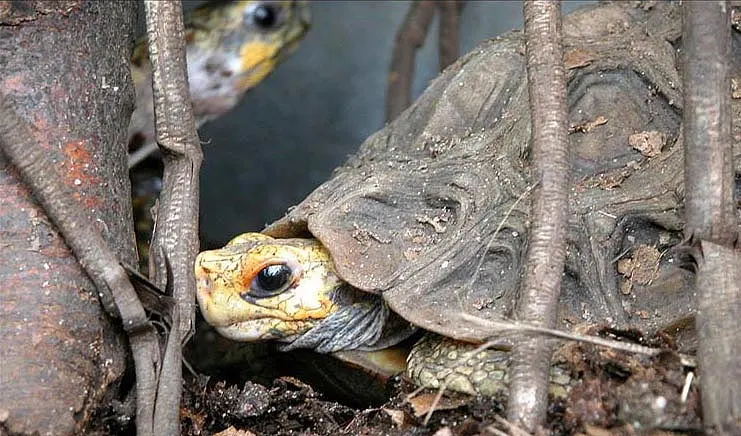
Home's hinge-back tortoise (Kinixys homeana) is a forest tortoise of West and Central Africa, with a hinge at the back of its shell that lets it close off its rear legs and tail. The IUCN Red List rated it Critically Endangered in 2021 after heavy hunting and habitat loss.
How to recognise it
It is a medium-sized tortoise. The Smithsonian's National Zoo gives a length of 15 to 30 cm and a weight of roughly 800 to 1,100 g, with females larger than males. Males have longer, thicker tails. The upper shell is tan to dark brown and slopes steeply at the back. The lower shell is yellow with a black spot centred on each plate, and the skin ranges from brown to yellow.
The hinge is the giveaway. A joint across the rear of the upper shell lets the tortoise drop that section and close off its tail and hind legs. It can also pull its head partly in and block the gap with its scaly front legs. Bell described the species in 1827, and it is reportedly named for the English surgeon Everard Home.
Where it lives
It lives along the Gulf of Guinea. The Red List records it as present in Benin, Cameroon, Ghana, Ivory Coast, Liberia, Nigeria and Togo, and possibly present in Equatorial Guinea. Other accounts add the Central African Republic, and some mention the Democratic Republic of the Congo and northern Gabon, while the Reptile Database says it is not known from Gabon. The edges of its range are not settled.
Its habitat is moist lowland forest and swamp forest. It also turns up in plantations such as cocoa and coffee farms, though the Red List treats plantations and swamp forest as marginal habitat. It needs humidity, prefers shade and rarely basks.
Pins are Wikidata “endemic to” fields. Orange dots, when present, are GBIF occurrence tiles — survey bias included.
How it lives
Most of its diet is insects, which is unusual for a tortoise. It also eats mushrooms, seeds and other plant matter, worms, snails, slugs, spiders, frogs and carrion. It is most active in the wet season and nearly dormant in the dry season, and it has been seen floating on floodwater, which may carry it to new areas. Males are territorial and drive off rivals.
Mating has been seen in southern Nigeria from mid-March to late May. Females lay one to four eggs, each about 46 by 35 mm, mostly between December and January, in forest litter or burrows. Incubation in the wild is thought to take about five months. Lifespan is likely around 50 years, though data are incomplete.
Why it is in trouble
The 2021 assessment estimates a population reduction of about 90 percent, over three generations (a generation here is 15 years) that run from the past into the future. It names intentional harvest of the animal itself as the main driver, scored high impact, affecting most of the population and causing very rapid declines. Tortoises are used for food, traditional medicine and as pets, and the assessment records both national and international use.
Habitat loss adds to the pressure. Recorded threats include farming, plantations, mining, roads, expanding towns and armed conflict, with roads scored at medium impact.
A 2018 study in the Herpetological Journal interviewed more than 2,000 rural people in Cote d'Ivoire, Togo and Nigeria about Home's and the serrated hinge-back tortoise. Respondents saw heavy declines in Togo and Nigeria and less decline in Cote d'Ivoire, and many named snail gatherers as the main suppliers of tortoises to the bushmeat trade.
A 2022 survey in Ghana, funded by the Rufford Foundation, questioned ten traders at the Kumasi fetish market, who reported selling about 4,800 Kinixys tortoises a year, mostly as shells. The project put the figure at more than 4,000, with Home's the most traded species.
What is being done
The species is on CITES Appendix II, so international trade needs permits. The Red List notes that conservation sites have been identified over part of its range and that it occurs in at least one protected area, but it records no recovery plan and no systematic monitoring scheme. Trade and harvest management, site protection and habitat restoration are among the actions the assessment lists as relevant.
Sources
Written for this catalog in our own words from the sources below, checked against them on 12 November 2026. Population figures are estimates and carry the year they were made. Status and assessment year: IUCN. 2026. The IUCN Red List of Threatened Species. Version 2026-1. iucnredlist.org.
- IUCN Red List assessment, Kinixys homeana (2021)
- Smithsonian's National Zoo, Home's hinge-back tortoise
- Home's hinge-back tortoise, encyclopedia entry
- GBIF species match, Kinixys homeana
- The Reptile Database, Kinixys homeana
- Luiselli et al. 2018, Herpetological Journal 28(4)
- Rufford Foundation project report 28034-B (Kumasi market, 2022 survey)




