Endangered
Heterogen
Heterogen longispira
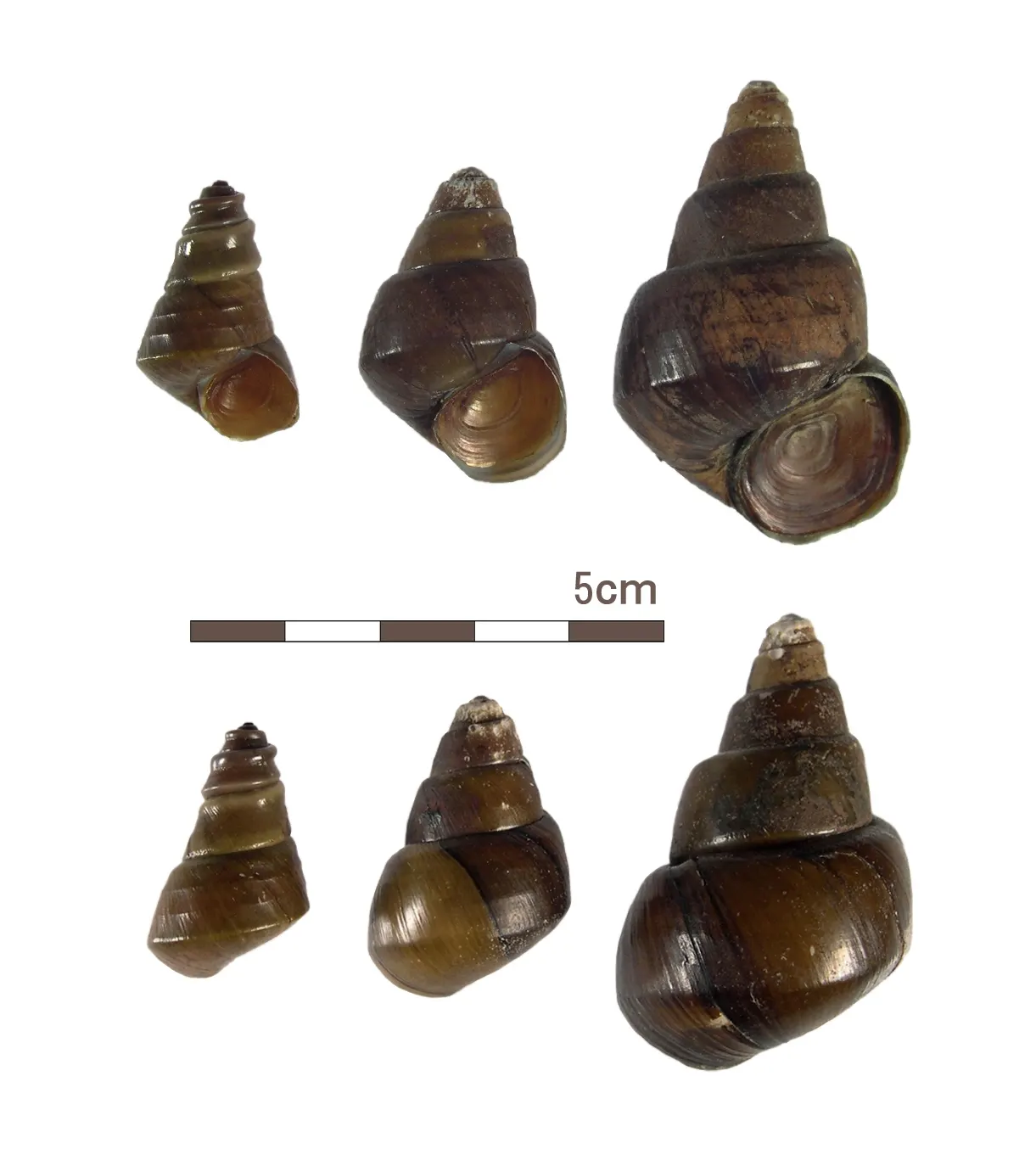
Heterogen longispira, called naga-tanishi in Japan, is a freshwater snail found only in the Lake Biwa drainage of central Honshu. The IUCN Red List rated it Endangered in 2011, with a decreasing population confined to a single location. Its adult shell is very thick, with a deep suture and strongly shouldered whorls.
How to recognise it
Adults have a moderately large, very thick, subconical shell. It is dark brown or greenish brown and is often crusted with growths. The surface shows growth lines and several spiral ridges. The suture between whorls is deeper than in any other viviparid snail in Japan, and the whorls are strongly shouldered.
Young snails look different. Their shells are small, relatively thin, bright olive and glossy, with strong spiral ridges on the upper spire. Newborns are bigger than the newborns of any other Japanese viviparid.
It belongs to the Viviparidae, the live-bearing river snails. A 2020 study by Saito and Kagawa treats six viviparid species or subspecies as present in Japan and counts three of them as endangered. Specimens from southern Lake Biwa and the Seta River look intermediate between this snail and Heterogen japonica.
Where it lives
E. A. Smith described the snail in 1886 from Lake Biwa. It is considered endemic to the Lake Biwa drainage: the lake, the river that flows out of it, Lake Yogo and the Lake Biwa Canal. The IUCN assessment gives its habitat as permanent freshwater lakes over 8 hectares and estimates its extent of occurrence at 660 square kilometres, at a single location.
Its naming history is tangled. Annandale described the same snail as Heterogen turris in 1921. A 1919 museum catalogue also listed naga-tanishi shells from Lake Kasumigaura and Lake Suwa, but the 2020 re-examination found those lots held other snails. Genuine H. longispira in the collection came only from the Biwa drainage.
A fossil relative, Heterogen praelongispira, lived in the southern Lake Biwa area between about 1.2 and 0.8 million years ago and resembles the living species.
Pins are Wikidata “endemic to” fields. Orange dots, when present, are GBIF occurrence tiles — survey bias included.
Why it is in trouble
The Red List assessment (criteria B1ab(iii)) records a continuing decline in the area it occupies. Its threats include sewage, nutrient loads, sedimentation, pesticides and herbicides, run-off, dams, and the drawing of surface and ground water. Most apply to the whole population, though the assessment could not rate how severe each one is. Recreation is listed as a further pressure.
Some local populations have already gone. According to the 2020 study, the snail is extinct or almost extinct in southern Lake Biwa and the Seta River. Shells from those areas looked intermediate between H. longispira and H. japonica, and the study suggests hybridisation may be the cause, though it is not proven.
What is being done
The assessment reports that all of the population lives inside protected areas. It lists no species-specific conservation actions and no research programme.
Sources
Written for this catalog in our own words from the sources below, checked against them on 12 November 2026. Population figures are estimates and carry the year they were made. Status and assessment year: IUCN. 2026. The IUCN Red List of Threatened Species. Version 2026-1. iucnredlist.org.




