Critically Endangered
Hemibagrus punctatus
Hemibagrus punctatus
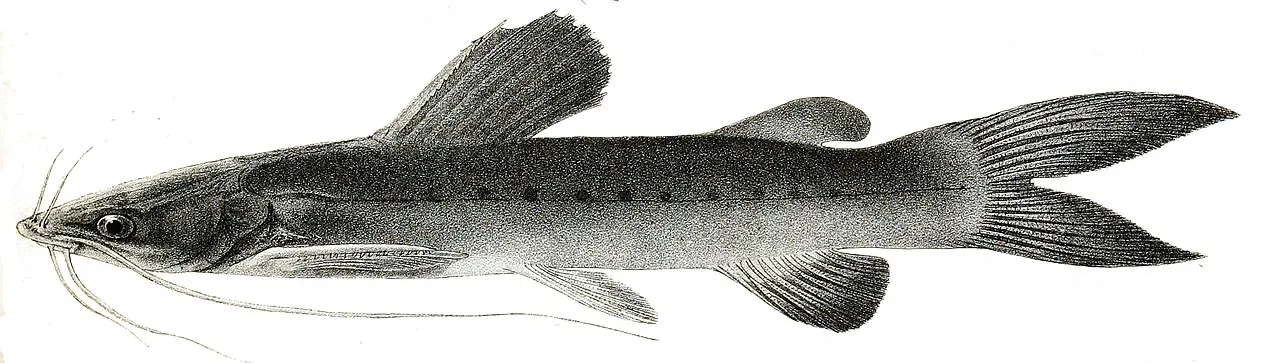
The Nilgiri mystus (Hemibagrus punctatus) is a bagrid catfish found in the Cauvery River system of southern India. It went unrecorded for years and was assessed as Critically Endangered, possibly extinct, in 2011. Fresh specimens turned up from 2012, showing it hangs on at low numbers.
How to recognise it
It's a river catfish with two spines and seven soft rays in the dorsal fin and 12 to 13 soft rays in the anal fin. Maximum length is about 45 cm. Fish caught in 2012 ranged from 18 to 27 cm in standard length.
Identification has been a problem. Jerdon described it in 1849, and it is a sibling species of Hemibagrus menoda, from which it differs by about 4 percent in the DNA marker cox1. Reports of huge 'Nilgiri mystus' of 25 to 35 kg (up to 120 kg) from the Tungabhadra Reservoir are regarded as misidentified fish of another species, Hemibagrus maydelli.
Where it lives
The species belongs to the Cauvery drainage of Tamil Nadu and Karnataka, with historical records from the Bhavani, Moyar, Hemavathy and Kabini rivers. Records from the Krishna system are thought to be a different catfish (Hemibagrus maydelli), and records from west-flowing rivers in Kerala lack voucher specimens and are considered doubtful.
It uses fast-flowing rivers and streams, and reservoirs. One 2012 site, at Athikadavu on the Bhavani, was a fast stream with deep pools over bedrock, submerged logs and a thick canopy on one bank, shared with fish such as the snakehead Channa marulius. In March 2018, ten fish were collected at Stanley Reservoir on the Cauvery.
Pins are Wikidata “endemic to” fields. Orange dots, when present, are GBIF occurrence tiles — survey bias included.
How it lives
Little has been recorded about its life. Related catfishes eat animals and plants, and the diet is presumed similar. A 320 mm fish reported in 1955 from the Bhavani headwaters held an adult Garra fish.
Around Stanley Reservoir, locals call it 'Kallu Keluthi', roughly 'stone catfish' in Tamil. It makes up only a small part of the catch, is caught in gill nets, and is usually sold and eaten dried.
Why it is in trouble
Historical records were sparse, usually single fish, and the last validated record was from about 1998 until November and December 2012, when four males were collected in Tamil Nadu and Karnataka. The 2011 IUCN assessment rated it Critically Endangered under criterion A2ac and flagged it as possibly extinct.
The IUCN lists sewage, soil erosion and silt, small dams and large-scale harvest as threats, and notes 11 locations with a severely fragmented, still declining population. Other studies add pollution, barrages and indiscriminate fishing, along with gill-net catches, lost nets that keep fishing, farm pesticides and introduced tilapia and African catfish at Stanley Reservoir.
What is being done
Conservation action is thin. The IUCN assessment records that part of the range lies inside protected areas, but no recovery plan, monitoring scheme or harvest management plan. It lists a genome resource bank and resource and habitat protection as actions that are needed rather than in place.
The scientists who reported the 2012 rediscovery proposed reassessing the fish as Vulnerable rather than Critically Endangered, noting at least a 30 percent average decline across sites. The Red List category has not been changed.
Sources
Written for this catalog in our own words from the sources below, checked against them on 12 November 2026. Population figures are estimates and carry the year they were made. Status and assessment year: IUCN. 2026. The IUCN Red List of Threatened Species. Version 2026-1. iucnredlist.org.




