Endangered
Heliogomphus lyratus
Heliogomphus lyratus
Heliogomphus lyratus is a Sri Lankan dragonfly, a clubtail in the family Gomphidae, found at shaded rainforest streams in the island's wet zone. The IUCN Red List rated it Endangered in 2021, down from Critically Endangered in 2006. A 2016 paper called it one of the rarest dragonflies in Sri Lanka.
How to recognise it
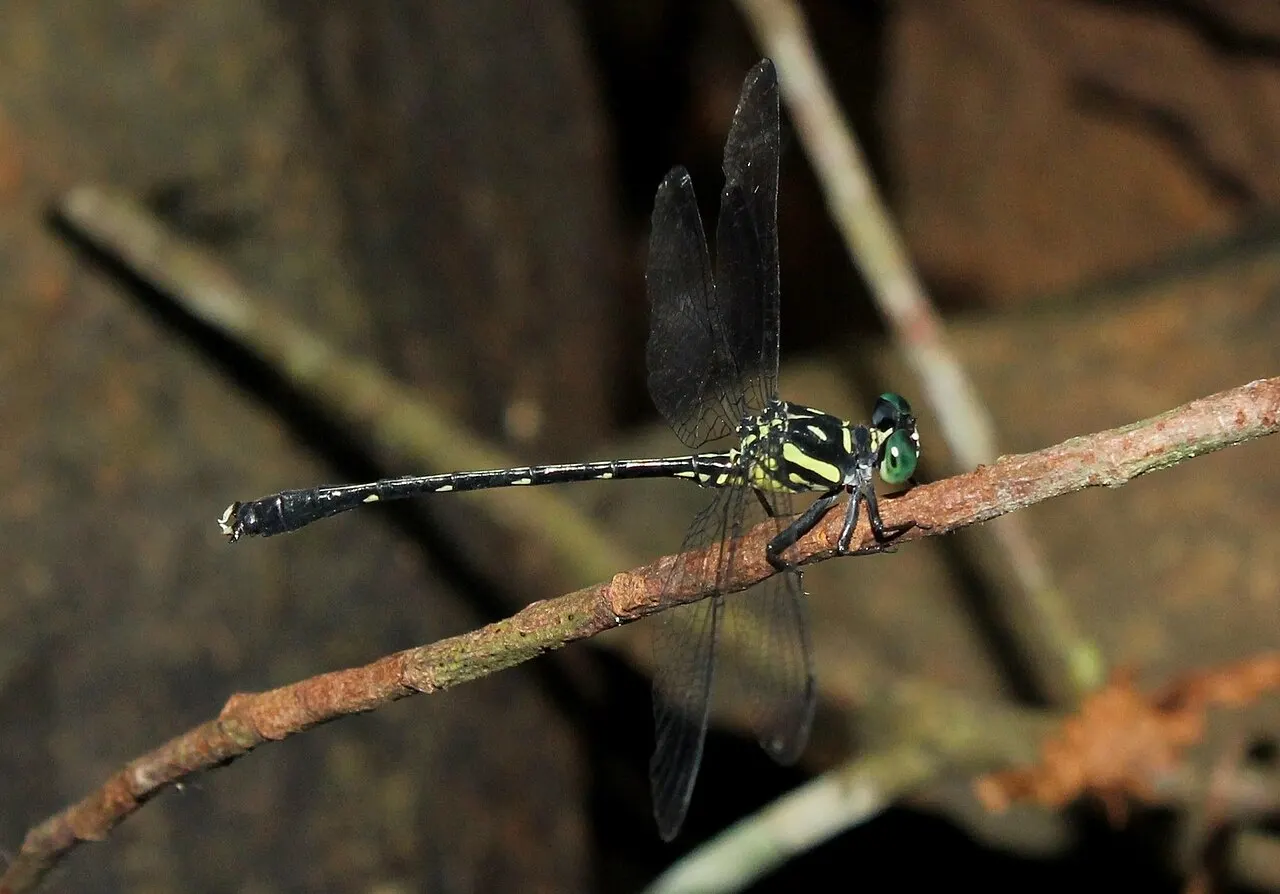
Fraser described the species in 1933. Adults have clear wings and a dark pterostigma, the small coloured cell near each wing tip, and the eyes are emerald green. Freshly emerged individuals look different, with a pale grey pterostigma and reddish-brown eyes.
Both sexes carry an isolated yellow spot on the thorax below the wing base. Males have a large side spine on the upper anal appendages, the claspers at the tip of the abdomen. Females show a pair of short yellow stripes on the middle of the abdomen and a more continuous yellow stripe along the back.
Where it lives
It is endemic to Sri Lanka. Until 2016 it was known from only three places: Haldumulla in Ratnapura District, where G. M. Henry collected it in 1926, Kitulgala in Kegalle District, and Diyadawa in Matara District. A 2016 paper in the Journal of Threatened Taxa by Amila Sumanapala and Himesh Jayasinghe added five more localities, including Yagirala and Meethirigala forest reserves, the Peak Wilderness Sanctuary and Kudawa. By the time of the 2021 IUCN assessment, about 25 scattered sites and clusters of sites were on record, some inside protected areas such as the Sinharaja Forest Reserve.
The IUCN gives an elevation range of about 50 to 1,250 m and estimates the area occupied at 100 to 500 square kilometres, within a range of roughly 4,703 to 7,452 square kilometres. The lowest record in the 2016 paper is 62 m, at Meethirigala.
Pins are Wikidata “endemic to” fields. Orange dots, when present, are GBIF occurrence tiles — survey bias included.
How it lives
The dragonfly favours small to medium streams, 0.3 to 3 m wide and shallow, with good shade from forest or from dense stands of the bamboo Ochlandra stridula on the banks. Beds are mostly rocky or pebbly, though the Meethirigala stream was sandy. Adults usually perch on twigs or leaves 5 to 40 cm above the ground. When disturbed they fly up to higher vegetation, and males often return to the same perch.
The flight season seems to start in April, peak in May and fade after June. A female was seen laying eggs in a shaded, shallow, rocky stream. No larvae have been reported.
Why it is in trouble
The IUCN records a decreasing population, a severely fragmented range and a shrinking habitat. The threats it lists are changes to the habitat and the taking of surface water from streams. Sumanapala and Jayasinghe noted in 2016 that its localities are isolated from one another, which raises the extinction risk if forest and streams are lost. They also expected the wider known range to lead to a milder status in future, and the IUCN did later move it from Critically Endangered to Endangered.
What is being done
The species occurs in at least one protected area, and several of its records come from forest reserves, the Peak Wilderness Sanctuary and Sinharaja. The IUCN names site protection and management, habitat protection and restoration, and awareness among relevant actions. The 2016 paper called for further surveys of potential habitat, best done from April to June.
Sources
Written for this catalog in our own words from the sources below, checked against them on 12 November 2026. Population figures are estimates and carry the year they were made. Status and assessment year: IUCN. 2026. The IUCN Red List of Threatened Species. Version 2026-1. iucnredlist.org.




