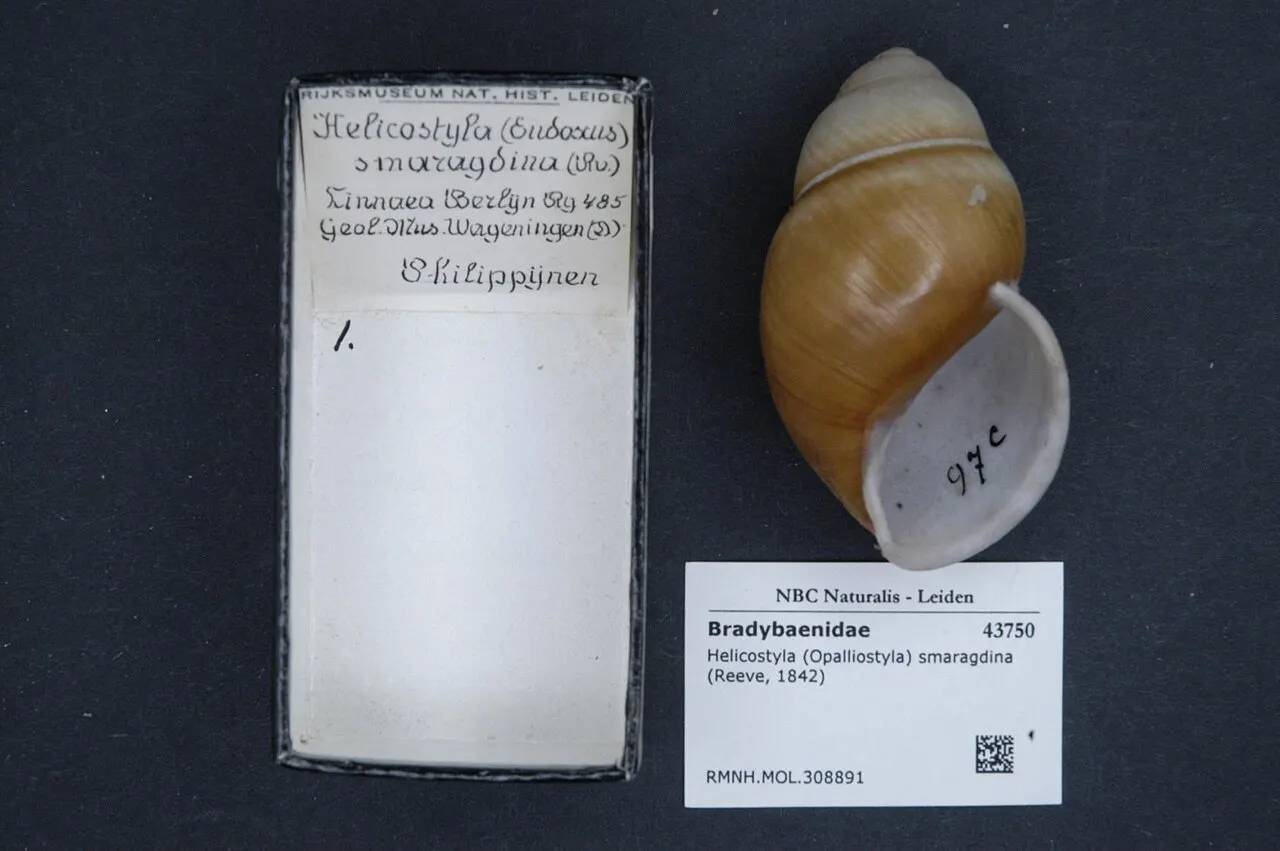
Critically Endangered
Cochlostyla smaragdina
Helicostyla smargadina
Cochlostyla smaragdina, listed on the Red List as Helicostyla smargadina, is a green-shelled land snail found only in the Philippines, with most located records from eastern Mindanao. The IUCN rated it Critically Endangered in 1996, and that assessment has not been updated. Field information on its habits is scarce.
How to recognise it
This is a member of the Camaenidae, a large family of snails from tropical East Asia and Australasia. Lovell Reeve described the species in 1842, originally under the name Bulimus smaragdinus. The Latin name smaragdina comes from the word for emerald and refers to the bright green of mature shells. In 1877 Carl Semper named several varieties, among them lutea, nigrescens, striata and zonifera, which the GBIF database now folds into the species.
The name causes confusion. The spelling smargadina, with the letters swapped, is a long-running error that has spread through several databases, and the IUCN record still carries it. The species also moves between two genera, Cochlostyla and Helicostyla, depending on the source. Cochlostyla was named by Férussac in 1821.
Where it lives
The Red List gives the Philippines as the only country and lists no habitat, elevation or population figure. Museum records in the Global Biodiversity Information Facility (GBIF) fill in some of the picture. The 183 records there date from 1877 to 2025, and nearly all are preserved specimens in collections around the world.
Where a record names a place, it is usually in eastern Mindanao: the Agusan and Surigao areas of the Caraga region, Siargao, and the Davao region including Mount Apo. A few labels name other islands, such as Palawan, Mindoro and Samar. Four research-grade iNaturalist observations from Agusan del Sur, dated 2013, 2023, 2024 and 2025, show the snail is still being found on Mindanao.
In a 2023 survey of Mount Banahaw on Luzon, researchers sampled 868 land snails of 33 species in 36 plots, and this snail was not among those they listed.
Pins are Wikidata “endemic to” fields. Orange dots, when present, are GBIF occurrence tiles — survey bias included.
Why it is in trouble
The 1996 assessment used criteria A2c and B1+2c, which rest on a shrinking range or declining habitat quality. It records no population trend, threats or conservation actions in structured form.
The wider context is forest loss. The Mount Banahaw study reports that Philippine forest cover fell from 57.3 per cent to under 20.5 per cent over about 90 years. It also states that this snail was the only Philippine land snail on the Red List's critically endangered tier, citing a 2006 listing, and that roughly 2,000 land snail species and subspecies have been described in the country.
No recent assessment exists for this snail, so its current status is not known.
Sources
Written for this catalog in our own words from the sources below, checked against them on 12 November 2026. Population figures are estimates and carry the year they were made. Status and assessment year: IUCN. 2026. The IUCN Red List of Threatened Species. Version 2026-1. iucnredlist.org.




