Endangered
Helicina rostrata
Helicina rostrata
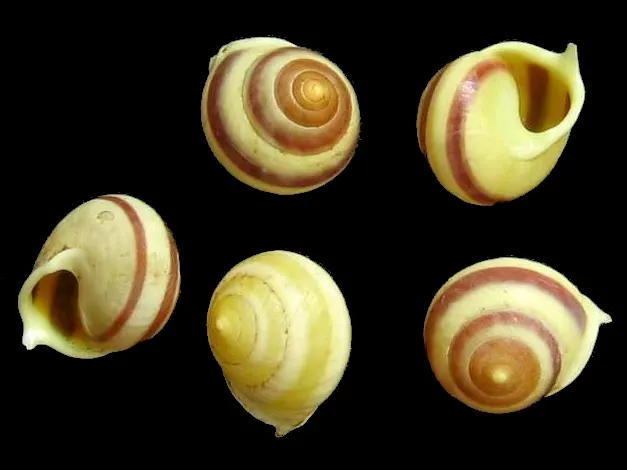
Helicina rostrata is a small tropical land snail with a trapdoor-like cover (operculum) on its shell, in the family Helicinidae. The IUCN Red List lists it as Endangered, but that rating dates from 1996 and names only Guatemala and Nicaragua. Museum records show it across a wider part of Central America.
What kind of snail it is
It belongs to Helicinidae, a family of small land snails found mostly in the tropics and subtropics. Each snail has an operculum, a trapdoor-like cover that closes the shell opening. Despite a passing resemblance in shell shape, the family is not closely related to the common air-breathing garden snails.
The species was described by the naturalist Arthur Morelet. Sources give 1849 (the Global Biodiversity Information Facility, GBIF) or 1851 (the encyclopedia entry) as the date, so the year is not settled.
Where it has been found
The IUCN assessment lists two countries, Guatemala and Nicaragua. GBIF, which pools museum and observation records, holds 177 records under this name. By country, 81 are from Guatemala, 45 from Honduras, 25 from Belize, 12 from Nicaragua, 6 from Mexico and 1 from Colombia (San Andrés Island).
Nearly all are preserved museum specimens. Most of the Honduran ones were collected between 1991 and 1995 and the Mexican ones in 2002, in Chiapas at about 224 to 265 m. Many of the Guatemalan ones come from Tikal in the Petén, mostly collected in 1956, with a few as recent as 2009 and 2018. Two photographed observations logged on iNaturalist in Belize (2010 and 2020) are the only records that are not specimens.
Pins are Wikidata “endemic to” fields. Orange dots, when present, are GBIF occurrence tiles — survey bias included.
Why it is listed
The Endangered rating dates from 1996 and used the older version 2.3 of the Red List system, under criteria for a restricted range (B1+2c). The published entry gives no population estimate, no habitat description and no list of threats, so the reason for concern is not spelled out. It is the only assessment on record.
Because the IUCN entry names only two countries, the wider spread seen in museum collections is not reflected in the rating. Land snails in this family are poorly studied, and a fresh assessment would need new surveys.
Sources
Written for this catalog in our own words from the sources below, checked against them on 12 November 2026. Population figures are estimates and carry the year they were made. Status and assessment year: IUCN. 2026. The IUCN Red List of Threatened Species. Version 2026-1. iucnredlist.org.




