Endangered
Helicella stiparum
Helicella stiparum
Helicella stiparum is a land snail with a shell up to about 20 mm across, found only on the dry coastal plains of Almería, in southeastern Spain. The IUCN Red List lists it as Endangered (2025). Spanish land-use mapping shows greenhouses had destroyed or badly altered about 57 percent of its range by 2004.
How to recognise it
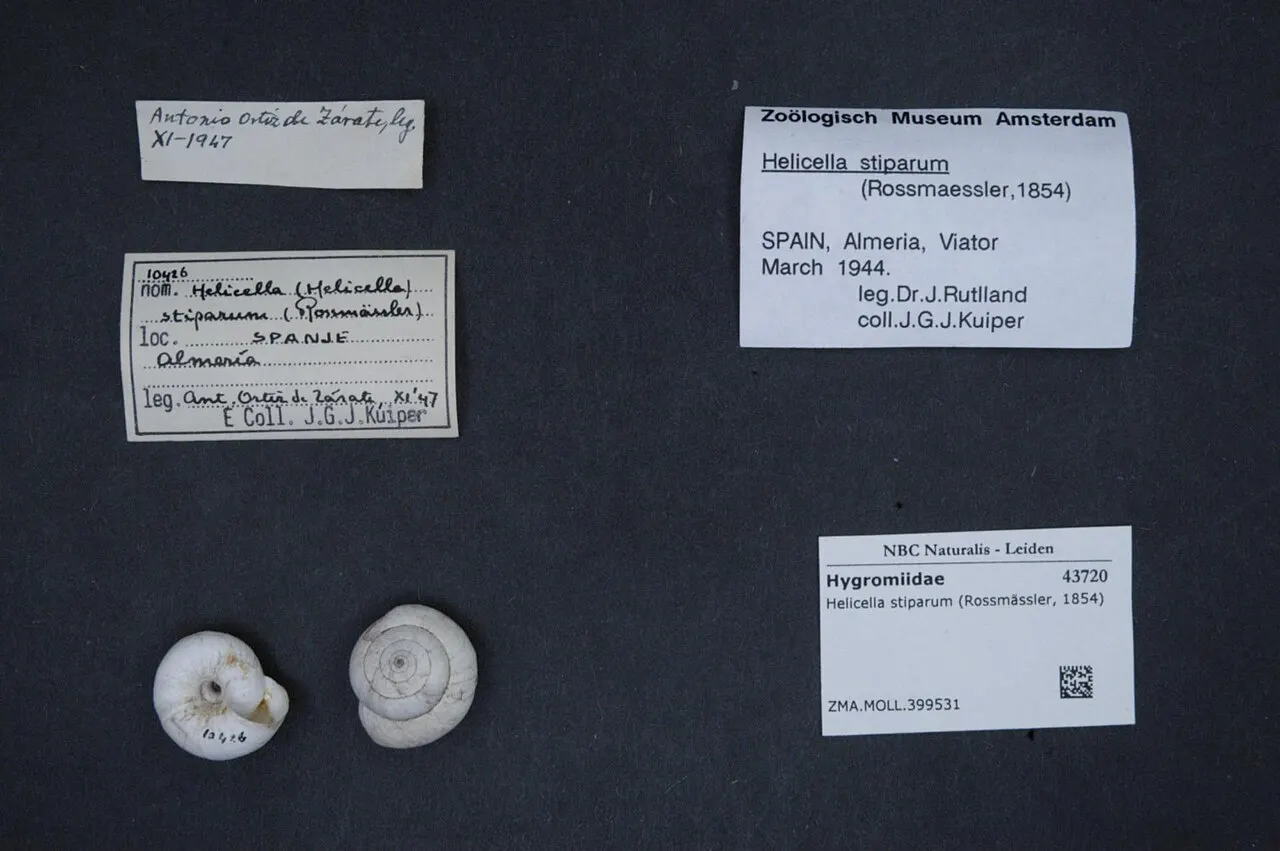
The shell is solid and opaque, either plain white or marked with spots on top and darker bands underneath. It is low and conical, with a round, deep, open umbilicus that takes up about a sixth of the shell's width. The edge of the last whorl ranges from slightly angled to keeled, and fine, dense radial lines cover the surface.
Adults have 5.75 to 6 whorls and measure 15.5 to 20 mm across and 9.4 to 12.6 mm high, according to the national atlas of threatened Spanish invertebrates.
Where it lives
It is endemic to Spain, in the Almería sector of the southeast. It occupies the Campo de Dalías plain and the southwestern part of the Níjar depression. It has not been found west of the mouth of the Río Adra or east of the Rambla de Morales, and it lives on limestone-derived ground no higher than about 150 m. The IUCN gives an elevation range of 0 to 200 m.
Records come from Cabo de Gata-Níjar Natural Park, the Punta Entinas-Sabinar nature reserve and the municipalities of Almería, El Ejido, Viator, Benahadux and Berja. The largest populations form two separate coastal patches, one from Roquetas de Mar to Guardias Viejas and one from the Almería airport area to Cabo de Gata.
Estimates of its range differ with method. The Spanish atlas puts its extent of presence at about 493 km2, while the IUCN gives an extent of occurrence of 791 km2 and an area of occupancy of 56 km2, across five locations.
Pins are Wikidata “endemic to” fields. Orange dots, when present, are GBIF occurrence tiles — survey bias included.
How it lives
This is a snail of hot, sunny steppe with very dry soil and low, sparse shrubs. It shelters under big limestone rocks. It also turns up on small sandstone sea cliffs and coastal dunes, where it hides in grass and scrub. It avoids salty soils and plants that tolerate salt, and it does not climb into the surrounding Sierra de Gádor or Sierra Alhamilla.
Its life cycle has not been studied. Other snails of the same dry habitats spend May to October dormant and breed in autumn with the first rains, and the atlas suggests this one probably does the same. Densities are noticeably higher on steppe than in dunes.
Why it is in trouble
Greenhouses are the main problem. Land-use mapping cited in the atlas shows that spreading greenhouses had destroyed or badly altered nearly 280 km2 of steppe, about 57 percent of the snail's range, by 2004. Coastal building adds to the loss. Between 1999 and 2002 the Almerimar development shrank the habitat in its area to little more than Punta Entinas. The area the snail actually occupies is only 28.3 percent of its range.
Drought makes populations swing, and pumping water from aquifers for farming worsens dry spells. Farm chemicals reach snails living near crops. Where the habitat is altered, common species such as Rumina decollata and Theba pisana take over. The IUCN also lists tourism and recreation areas among current threats and gives its population trend as unknown.
What is being done
The snail occurs in at least one protected area, and the IUCN estimates 30 to 40 percent of the population lies within protected land. There is no species recovery plan or systematic monitoring scheme in place, and none is bred in captivity. The atlas reports that protected areas covered only 27.6 percent of the area the snail occupied in 1999, and it recommends a recovery plan for the western Almería coast. At the Castillo de Guardias Viejas, the survival of the local population is tied to the upkeep of the castle and its surroundings.
Sources
Written for this catalog in our own words from the sources below, checked against them on 12 November 2026. Population figures are estimates and carry the year they were made. Status and assessment year: IUCN. 2026. The IUCN Red List of Threatened Species. Version 2026-1. iucnredlist.org.




