Endangered
Hasselt's bamboo shark
Chiloscyllium hasseltii
Hasselt's bamboo shark (Chiloscyllium hasseltii) is a small, egg-laying shark that lives on shallow seabeds and reefs around Southeast Asia, from the Andaman Sea to Indonesia. The IUCN Red List rated it Endangered in 2020, mainly because of fishing pressure and coastal development.
How to recognise it
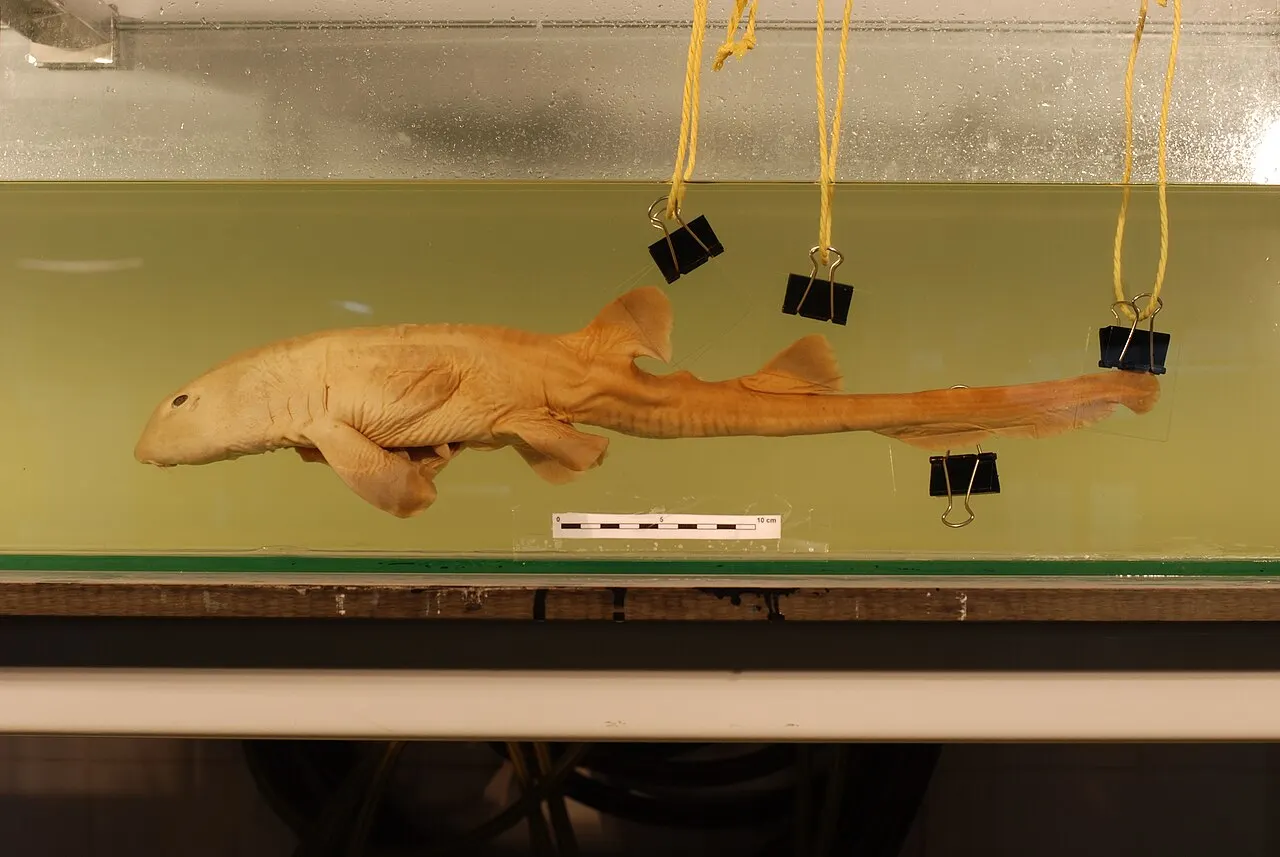
It's an elongated, bottom-dwelling carpet shark that grows to about 60 cm, with a pronounced notch near the tip of the tail fin and no lower lobe on it. Juveniles carry dark grey-brown bands edged in black. Those fade as the shark grows, and adults end up an even medium to dark brown.
Pieter Bleeker described it in 1852. It is also called the Indonesian bamboo shark. The Red List spells the species name hasselti.
Where it lives
The Red List records it from Myanmar, Thailand, Malaysia, Singapore, Brunei, Vietnam, Indonesia (including Sumatra, Java and the Moluccas), the Andaman Islands, Bangladesh and India. It stays close to shore, from the surface to about 12 metres deep, over mud, sand, sand and mud, coral reef and rocky reef.
Pins are Wikidata “endemic to” fields. Orange dots, when present, are GBIF occurrence tiles — survey bias included.
How it lives
It feeds on invertebrates on the seabed. It lays eggs in pairs, and the embryos live on yolk alone. Hatchlings are reportedly 94 to 120 mm long, and the eggs are said to attach to seabed plants.
Growth is slow. FishBase gives a minimum population doubling time of 4.5 to 14 years and rates its resilience as low, and the Red List uses a generation length of 8 years.
Why it is in trouble
It's caught across its range. The assessment lists small-scale subsistence fishing, along with unintentional catch in both large-scale and small-scale fisheries. It also lists coastal housing, commercial and industrial building, and shifting or altered habitat.
The population is decreasing. The assessment estimates a past reduction of 50 to 79 percent, based on loss of habitat and on levels of exploitation, and treats the causes as understood and not yet ceased.
What is being done
Not much is in place. The 2020 assessment records no recovery plan, no monitoring scheme, no harvest management plan and no international trade controls for the species. It calls for harvest and trade management, species recovery and site protection.
Sources
Written for this catalog in our own words from the sources below, checked against them on 12 November 2026. Population figures are estimates and carry the year they were made. Status and assessment year: IUCN. 2026. The IUCN Red List of Threatened Species. Version 2026-1. iucnredlist.org.




