Endangered
Harpesaurus modiglianii
Harpesaurus modiglianii
Modigliani's nose-horned lizard (Harpesaurus modiglianii) is a tree-dwelling agamid from the highlands of North Sumatra, Indonesia. For well over a century science knew it from a single museum specimen, until a living one turned up in 2018. The IUCN Red List assessed it as Endangered in 2021.
How to recognise it
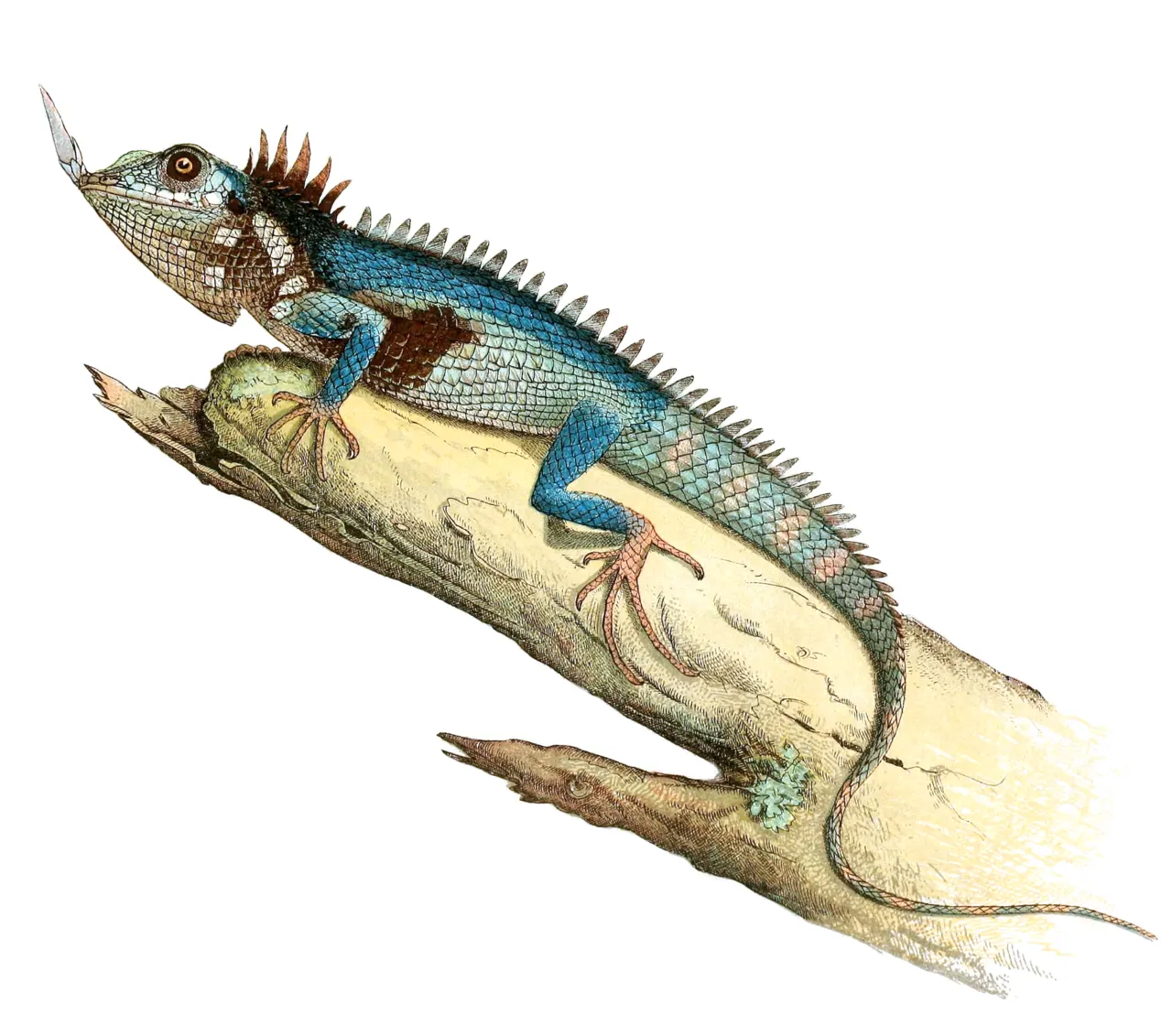
The giveaway is the nose. A flattened, sickle-shaped appendage curves upward from the snout, roughly 40 percent as long as the head in a 2020 redescription. A crest of spines runs from the nape along the back.
The original museum specimen is bluish grey, an effect of preservation. Live animals are green, with yellowish-green spines and belly. When handled, one lizard turned greenish brown, its chestnut patches went white, and within minutes its spines and belly turned chestnut. It returned to green once calm. The 1891 male measured 79 mm from snout to vent in a recent redescription, with a much longer tail.
A lizard lost for over a century
Italian explorer Elio Modigliani collected the only known specimen in the Si-Rambe forest of North Sumatra in 1891. It went to the Museo Civico di Storia Naturale di Genova, and Decio Vinciguerra described and named the species in 1933. The lizard was later assessed as Data Deficient.
In June 2018 wildlife biologist Chairunas Adha Putra found a dead male on the forest floor during a survey around the Toba caldera. The team searched the area for five nights, and on 18 June at 20:45 found a living one resting on a low branch, probably asleep. It was photographed, measured and released the same night. The find was published in Taprobanica in 2020.
Where it lives
Both 2018 animals came from moist forest at 1,675 m on Mt Sibuatan, in Dairi, North Sumatra, within 500 m of each other. A third animal, seen in photographs, was reported from within 20 km. The forest has big trees, a mid-layer of mossy trees and a floor of leaf litter and moss. A lizard seen at 4 m up was clinging to a horizontal branch, head pointing down. The IUCN counts two locations, with an extent of occurrence of 12 to 100 square kilometres.
Putra and colleagues concluded the species is diurnal and arboreal. Its slow, swaying movement and colour change led them to compare it with African mountain chameleons.
Pins are Wikidata “endemic to” fields. Orange dots, when present, are GBIF occurrence tiles — survey bias included.
Why it is in trouble
The site lies outside any protected area, and the 2020 paper describes the forest as under heavy pressure from large-scale clearing, with heavy machinery at work nearby. The IUCN (criterion B1ab(iii)) records continuing habitat decline. Threats listed are logging, tourism and recreation areas, housing, and possible future collecting. Population size and trend are unknown.
The same paper reports attempts to sell the species through social media at about 100 US dollars an animal, and proposes adding it to Indonesia's list of protected species.
Sources
Written for this catalog in our own words from the sources below, checked against them on 12 November 2026. Population figures are estimates and carry the year they were made. Status and assessment year: IUCN. 2026. The IUCN Red List of Threatened Species. Version 2026-1. iucnredlist.org.




