Critically Endangered
Harlequin poison frog
Oophaga histrionica
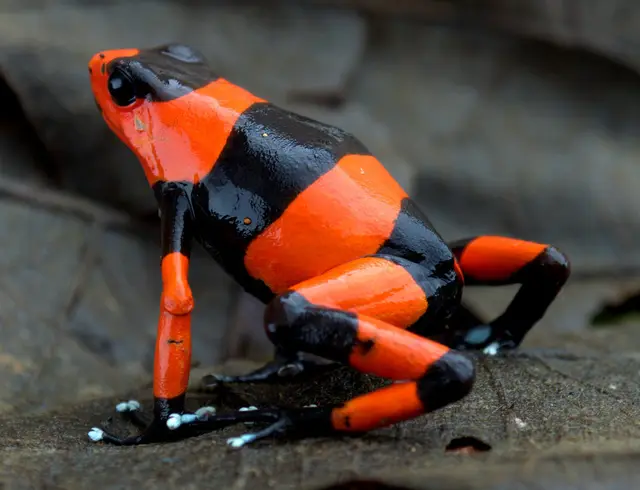
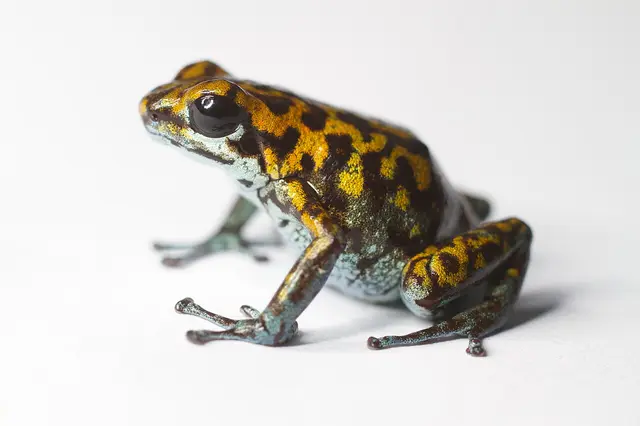
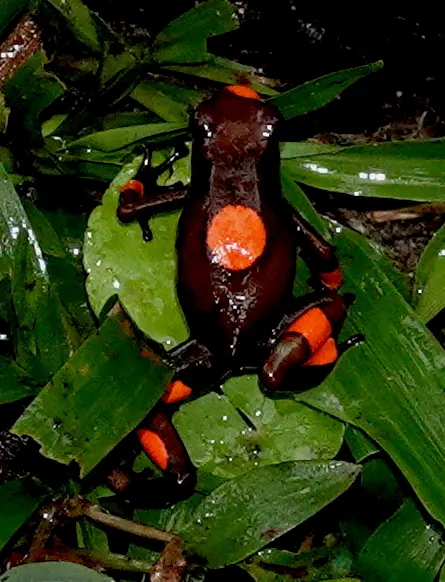
The harlequin poison frog (Oophaga histrionica) is a small, brightly marked poison dart frog found only in the Chocó rainforests of western Colombia. The IUCN Red List rated it Critically Endangered in 2019. Collection for the international pet trade and forest clearance have driven its decline.
How to recognise it
It's a small frog, averaging about 33 mm from snout to vent. The background colour ranges from light to dark brown, usually with a vivid spot on the back. Like other poison frogs it carries skin toxins, here a group called histrionicotoxins that interfere with nerve signalling.
Identification is trickier than it used to be. In 2018 three frogs once counted as harlequin poison frogs were split off as separate species: Oophaga anchicayensis, O. andresi and O. solanensis. Older accounts and some pet-trade descriptions may blend them.
Where it lives
The species is endemic to Colombia, in the Chocó region. The IUCN counts a single location and an extent of occurrence of about 98 square km, at roughly 300 to 730 m above sea level, in moist lowland forest. It doesn't migrate, and the assessment records it as not occurring in any protected area.
It lives on the forest floor among fallen limbs and leaf litter.
Pins are Wikidata “endemic to” fields. Orange dots, when present, are GBIF occurrence tiles — survey bias included.
How it lives
Adults hunt ants and mites on the ground, active after sunrise and generally finished by late afternoon. Males call from low perches. After a courtship in which the pair call to each other and touch, the female lays eggs in leaf litter.
A parent then carries the hatched tadpoles to small pools of water, often in the leaf bases of bromeliads. The mother returns from time to time to lay unfertilised eggs that the tadpoles eat. They can't develop without this food, which is one reason the species is among the hardest poison frogs to breed in captivity.
Why it is in trouble
The IUCN lists small-holder farming and grazing, and mining and mining seepage, among the pressures on its forest. Harvest for the international pet trade is the threat it scores highest, with rapid declines noted. Wild-caught frogs are stressed, need more care and die at much higher rates than captive-bred ones, and few captive-bred frogs exist.
Illegal collection is still a live problem. A 2024 Tico Times report described authorities at Bogotá's El Dorado airport seizing 130 harlequin frogs hidden in film canisters. Trafficking in the frogs carries a prison sentence of 5 to nearly 12 years in Colombia.
The Red List trend is decreasing, with continuing decline in the area the frog occupies. The assessment gave no population size.
What is being done
The assessment records the frog as included in international legislation and subject to international trade controls. It lists national and international legislation, site and habitat protection, and captive breeding among the actions needed.
Captive breeding is difficult. The tadpoles depend on unfertilised eggs from their mother, which makes this one of the hardest poison frogs to raise. In Colombia, Tesoros de Colombia, a licensed breeding reservoir in Cundinamarca, breeds the species and exports captive-bred frogs marked with a 'fingerprint' to tell them from trafficked ones, as a practical alternative to wild collection.
Sources
Written for this catalog in our own words from the sources below, checked against them on 12 November 2026. Population figures are estimates and carry the year they were made. Status and assessment year: IUCN. 2026. The IUCN Red List of Threatened Species. Version 2026-1. iucnredlist.org.