Endangered
Halichoeres burekae
Halichoeres burekae
The Mardi Gras wrasse (Halichoeres burekae) is a small, brightly coloured reef fish from the western Gulf of Mexico. It was first described in 2007 from the Flower Garden Banks. The IUCN Red List assessed it as Endangered in 2015, mainly because it occurs in only a few places.
How to recognise it
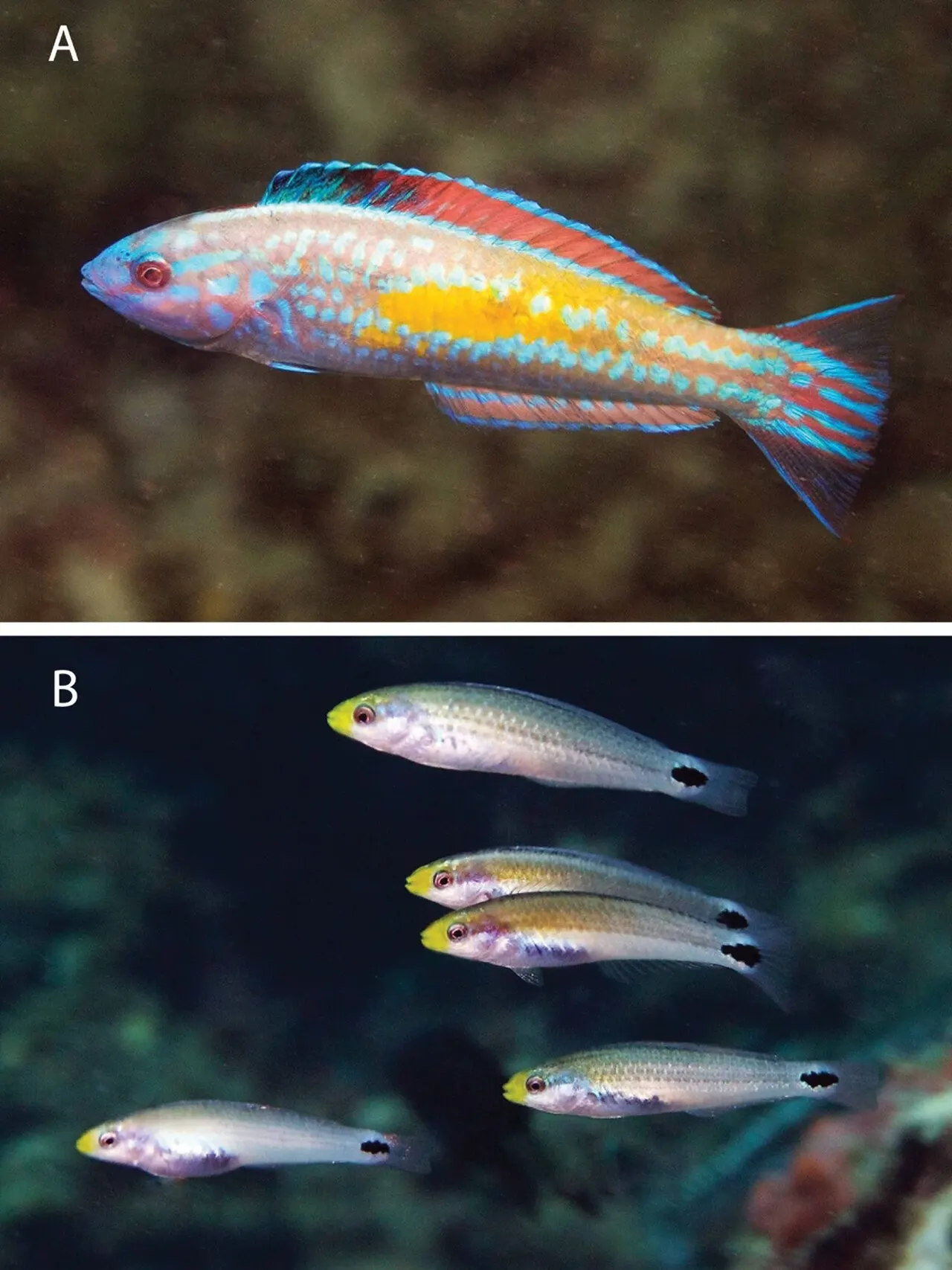
Terminal-phase males are the showy ones. They have a purple head and back, a broken yellow band along the side, and electric blue lines and dots on the head, body and fins. A black band runs along the front of the dorsal fin, and a blue-ringed dark spot sits above the pectoral fin. Sanctuary staff nicknamed the fish for that purple, yellow and green colouring.
Initial-phase fish look quite different. Females are salmon-pink with a yellow snout, a white stripe along the side and a large black spot near the tail. Both phases have a short snout and a well-developed canine tooth at the back of the jaw. FishBase gives a maximum length of 7.7 cm.
Where it lives
Reef surveyors with REEF first spotted it at East Flower Garden Bank in 1997. Douglas Weaver and Luiz Rocha described it in Copeia in 2007, and it was named for Frank and Joyce Burek, the photographers who took the first picture of a male. It is seen most often at Stetson Bank, and it has also been recorded at the East and West Flower Garden Banks and off Veracruz in Mexico.
The IUCN lists the United States and Mexico, three locations, and coral reef, rocky reef and open water over the shelf as habitat. Its depth range in the assessment is about 2 to 50 m, though FishBase gives 24 m as the deepest record.
Pins are Wikidata “endemic to” fields. Orange dots, when present, are GBIF occurrence tiles — survey bias included.
How it lives
Adults gather in small schools along the reef crest, mixed with other plankton-feeding fish. The diet is mostly small copepods, and one stomach held a fish larva. During courtship, a terminal-phase male raises his dorsal fin, circles the female and nips at her fins. Males also display aggressively to one another.
Why it is in trouble
The 2015 assessment (criterion B2ab(ii,iii)) estimates an occupied area of 275 square kilometres across three locations, and records a continuing decline in that area. The population trend is unknown.
The threats it lists are all ongoing, with unknown scope and severity: run-off, nutrient loads, pesticides, sewage, oil spills, coastal development, disease of unknown cause, and the invasive red lionfish (Pterois volitans).
What is being done
Part of its range lies inside the Flower Garden Banks National Marine Sanctuary, and the assessment records that the species occurs in at least one protected area. It also calls for research on life history, threats, and population size and distribution.
Sources
Written for this catalog in our own words from the sources below, checked against them on 12 November 2026. Population figures are estimates and carry the year they were made. Status and assessment year: IUCN. 2026. The IUCN Red List of Threatened Species. Version 2026-1. iucnredlist.org.




