Critically Endangered
Fossorial giant rat
Gyldenstolpia fronto
The fossorial giant rat (Gyldenstolpia fronto) is a large, partly burrowing rodent of South America known from very few specimens. The IUCN Red List assessed it in 2018 as Critically Endangered and possibly extinct. Almost nothing has been recorded about how it lives, and it may already be gone.
How to recognise it
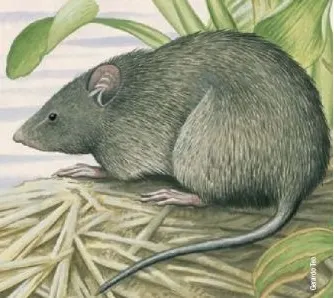
This is the larger of the two species in its genus, and it is described as semi-fossorial, meaning adapted to spend part of its life underground. Descriptions mention a sturdy skull, small eyes, rounded ears that are partly hidden, coarse bristly hair on the back and a tail that is short for its body.
It belongs to the sigmodontine rodents, a large South American group in the family Cricetidae, and sits in the tribe Akodontini. Its smaller relative, Gyldenstolpia planaltensis, is the only other species in the genus.
Where it was found
The first specimen was a fragment of a skull, described by the Danish zoologist Herluf Winge in the late 1880s (sources give 1887 or 1888) as Scapteromys fronto. It came from a cave chamber, recorded as Lapa da Escrivania no. 5, near Lagoa Santa in Minas Gerais, Brazil, in a cave excavated by the naturalist Peter Lund. The exact spot is not known.
A second record comes from Argentina. A preserved specimen collected at Rio de Oro, in Chaco province, in September 1896 is held by the Swedish Museum of Natural History, according to the Global Biodiversity Information Facility. The Red List maps the species in Argentina only and gives its extent of occurrence as about 37,195 square kilometres.
Winge's species was later placed in the genus Kunsia (in 1966), and then moved to the new genus Gyldenstolpia by Pardinas, D'Elia and Teta around 2009. Two subspecies were recognised, G. f. fronto and G. f. chacoensis.
Pins are Wikidata “endemic to” fields. Orange dots, when present, are GBIF occurrence tiles — survey bias included.
How it lives
Hardly anything is known. No ecological details have been reported, and its habitat is reportedly assumed to be dry savanna. The Red List instead links it to moist savanna and to wetlands such as marshes and shrubby swamps. Either way, these are informed guesses rather than field observations.
Why it is in trouble
There are no confirmed recent sightings. The Red List treats the population as severely fragmented, records an ongoing loss of its area, and lists the population trend as unknown. It does not name specific threats.
The status is also contested. A 2019 review of sigmodontine rodents by Formoso and Teta is reportedly the basis for treating the species as extinct, while the 2018 Red List entry stops at Critically Endangered, possibly extinct, under criterion D (a very small population).
What is being done
No conservation measures are recorded. The Red List assessors list taxonomy, threats, population size and distribution, and life history as the research still needed. Without a dedicated search in the Chaco and the old cave region, it will stay unclear whether any animals survive.
Sources
Written for this catalog in our own words from the sources below, checked against them on 12 November 2026. Population figures are estimates and carry the year they were made. Status and assessment year: IUCN. 2026. The IUCN Red List of Threatened Species. Version 2026-1. iucnredlist.org.




