Critically Endangered
Gurney's Pitta
Hydrornis gurneyi
Gurney's pitta (Hydrornis gurneyi) is a secretive, ground-feeding forest bird, now found mainly in southern Myanmar and all but gone from Thailand. The IUCN Red List assessed it as Critically Endangered in 2019, as oil palm clearance stripped away most of its lowland forest.
How to recognise it
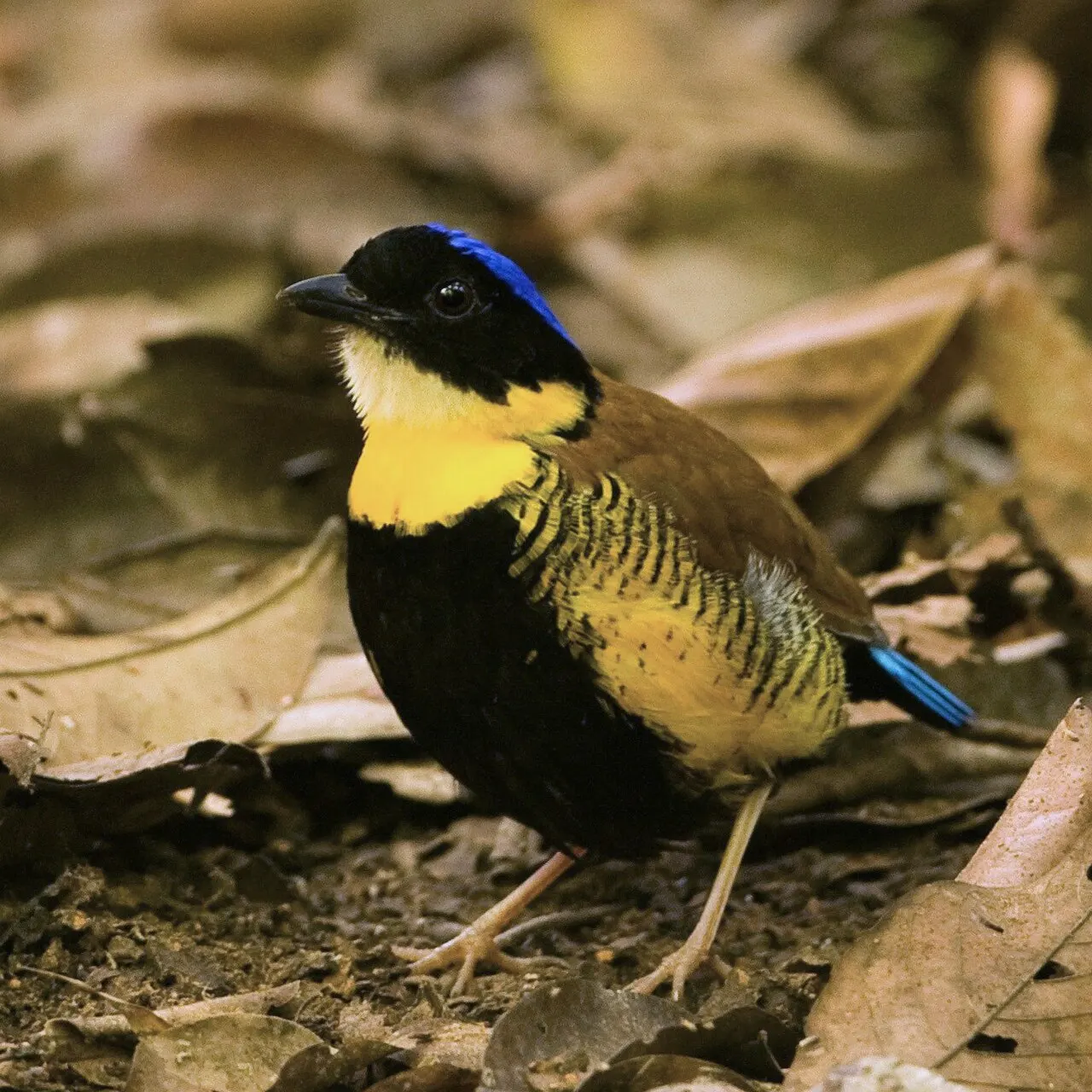
It is a medium-sized pitta, about 21 cm long and 57 to 86 g. The male is the showpiece, with a blue crown, yellow throat, black belly and mask, brown back, blue tail and yellow flanks marked with uneven black bars.
Females are duller. The black mask runs only from the eye to the nape, the crown is golden-brown, the throat is white and the barred yellow covers the belly. Juveniles are dark brown with a streaked breast and an orange tip on the bill.
Where it lives
The species breeds on the Malay Peninsula, with most of the population in southern Myanmar. BirdLife International describes it as restricted to the few remaining areas of lowland forest in Tenasserim (Tanintharyi), after its apparent loss from peninsular Thailand.
Allan Octavian Hume described it in 1875.
Pins are Wikidata “endemic to” fields. Orange dots, when present, are GBIF occurrence tiles — survey bias included.
How it lives
It feeds on the ground, mostly on earthworms, and also takes slugs and insects. A 2016 field study found each bird holds a territory of roughly 0.04 square kilometres.
A rediscovery and a slide
For decades nobody saw it. The last records date to 1936 or 1952, depending on the source, and it was feared extinct until birds turned up in southern Thailand in 1986, a find that traced back to information from animal dealers. By 1997 only about nine pairs were thought to remain.
A 2003 survey in Myanmar found it at four sites, with at most 10 to 12 pairs at one of them. Researchers judged the Myanmar population to be at least double the 11 pairs assumed until then, and the IUCN lowered its status from Critically Endangered to Endangered.
The size of the remaining population is now unknown.
Why it is in trouble
Forest loss is the problem. Researchers using satellite data estimated that potential habitat in southern Tanintharyi shrank from about 3,225 square kilometres in 1999 to about 656 in 2017, a fall of roughly 80 percent. Oil palm clearance was the main driver.
In 2016 the same team visited 142 places where the bird had been recorded. They found suitable forest and the pitta at only 41. Elsewhere the forest had been logged, degraded or cleared, and the bird appeared absent from about 71 percent of its former range.
Trapping adds pressure. Dealers reportedly sold up to 50 pittas a year before the 1980s, and birds can be caught in ground nets set for other animals such as pangolins. The Thai population is now described as all but wiped out.
The species is listed on CITES Appendix I, which bars international commercial trade.
What is being done
BirdLife International and its Myanmar partner BANCA updated the species' conservation action plan in late 2018. A three-year project was planned to develop a joint management agreement for the Lenya Reserve Forest with the Myanmar government and the Karen National Union, and to halt large plantation expansion into the Lenya and Nagawun reserve forests.
Sources
Written for this catalog in our own words from the sources below, checked against them on 12 November 2026. Population figures are estimates and carry the year they were made. Status and assessment year: IUCN. 2026. The IUCN Red List of Threatened Species. Version 2026-1. iucnredlist.org.




