Endangered
Gunnison sage-grouse
Centrocercus minimus
The Gunnison sage-grouse (Centrocercus minimus) is a sagebrush grouse of southwestern Colorado and southeastern Utah, about a third smaller than the greater sage-grouse. It was only described as a separate species in 2000. The Red List rated it Endangered in 2020, with a decreasing population.
How to recognise it
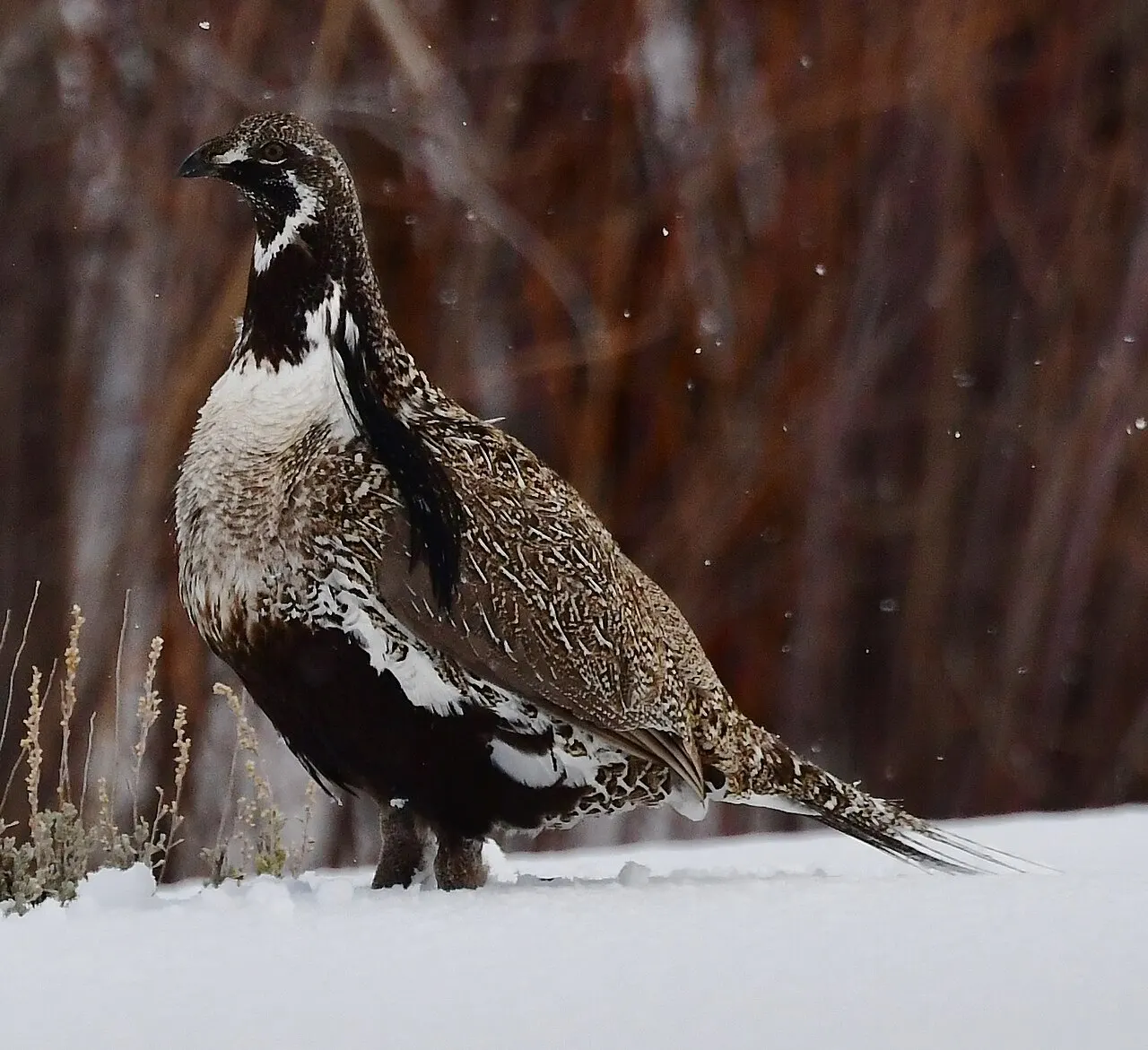
It is a variegated grey-brown grouse with a black belly and long, stiff, pointed tail feathers. Males have a black throat, a white ruff on the breast, thick plumes behind the head and large yellowish air sacs on the neck. The Red List gives 44 to 51 cm for males and 32 to 38 cm for females.
It looks like the greater sage-grouse but is about a third smaller and has a less elaborate courtship dance. Scientists overlooked it until the 1990s, and genetic data show no gene flow between the large and small birds.
Where it lives
The species lives in seven counties of southwestern Colorado and one of southeastern Utah. It once reached Arizona, New Mexico and Oklahoma, and disappeared from Pitkin County in the 1960s and from Eagle and Garfield counties in the 1990s. The Red List puts its elevation at 2,250 to 2,550 m and gives an extent of occurrence of about 37,500 square kilometres.
About 85 percent of the birds are in the Gunnison Basin, a high sagebrush basin in Colorado. The rest are split among six small satellite populations.
Pins are Wikidata “endemic to” fields. Orange dots, when present, are GBIF occurrence tiles — survey bias included.
How it lives
Adults eat sagebrush all year. Chicks need insects and protein-rich broadleaved plants, so meadows with wildflowers matter in summer.
In spring, males gather on leks and strut for several hours in the early morning and evening. They inflate their neck sacs and brush their wings against the pouch feathers to make loud swishing noises. Usually only two dominant males do the breeding. Clutches are 3 to 10 eggs, incubated for 25 to 29 days.
Why it is in trouble
Loss and fragmentation of sagebrush is the main cause. The Red List lists housing, roads and railways, utility lines, oil and gas drilling, farming and livestock grazing, plus drought and temperature extremes. Cheatgrass, which carries fire into sagebrush, and nest predators such as ravens and coyotes add to the pressure.
Counts are tricky and numbers differ. The Red List gives 1,770 to 8,400 individuals, with a declining trend. A 2019 news report gave about 2,500 birds, and a Colorado Parks and Wildlife figure of about 3,500 breeding birds is quoted elsewhere. When the species was listed in 2014, fewer than 4,000 were estimated. A 2019 survey in Colorado found about 1,800 birds, a record low.
What is being done
The US Fish and Wildlife Service listed the species as threatened under the Endangered Species Act in 2014, and designated about 1.43 million acres of critical habitat. A draft recovery plan released in late 2019 sets population targets and actions over 50 years, at an estimated cost of 560 million dollars. Biologists and some conservation groups said the targets are too low.
The Nature Conservancy has built more than 750 one-rock dams in a protected area to hold water and improve habitat. Colorado Parks and Wildlife has run lek-viewing days in April at Waunita Watchable Wildlife Area.
Sources
Written for this catalog in our own words from the sources below, checked against them on 12 November 2026. Population figures are estimates and carry the year they were made. Status and assessment year: IUCN. 2026. The IUCN Red List of Threatened Species. Version 2026-1. iucnredlist.org.




