Endangered
Gundlach's hawk
Accipiter gundlachi
Gundlach's hawk is a bird in the family Accipitridae (order Accipitriformes) — Accipiter gundlachi, recorded as Endangered.
Appearance
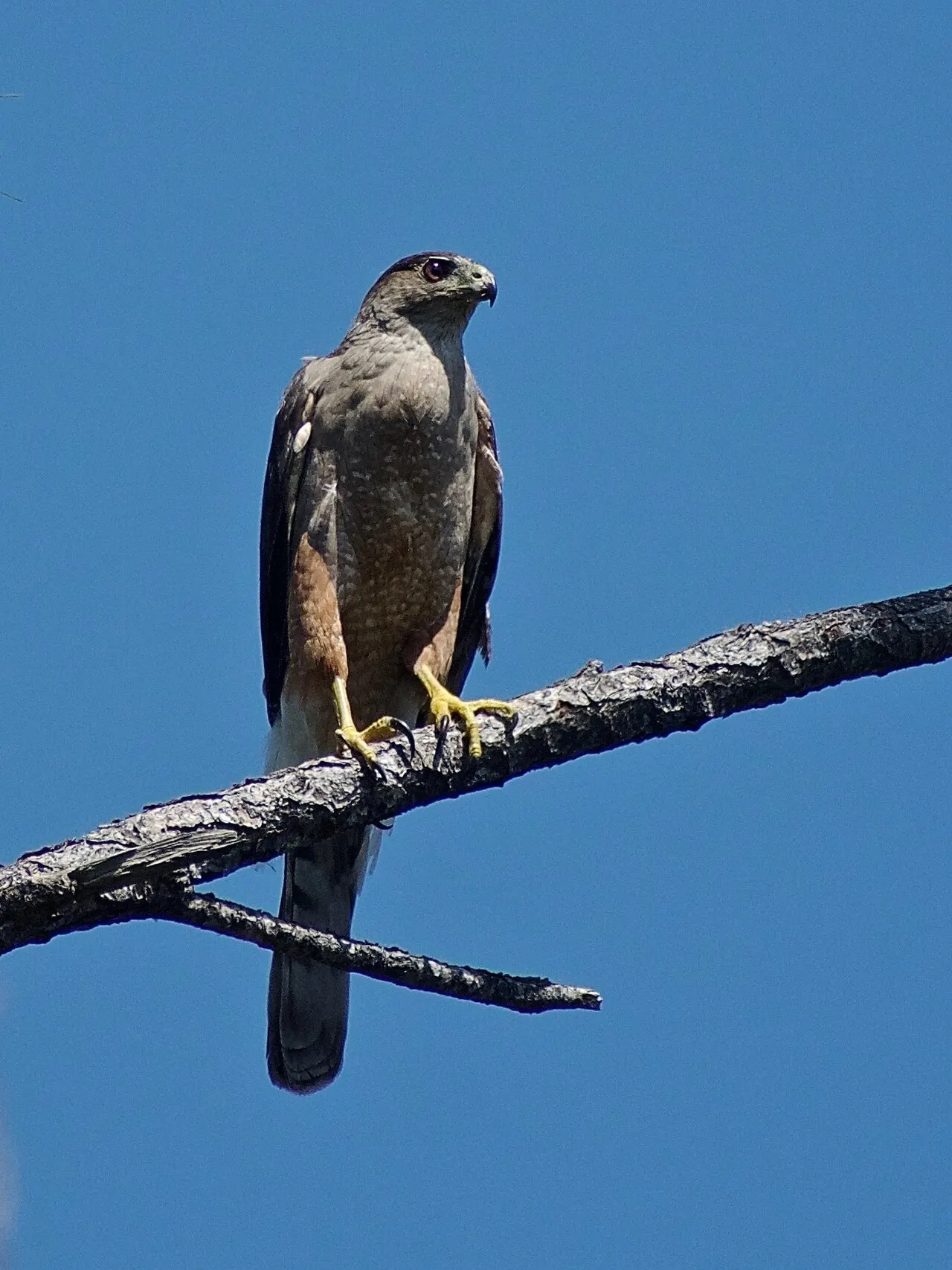
The adult hawk has a dark bluish-gray upper body and wings, with a black head. The under body of the bird is a lighter color. Immature hawks are mostly brown on the top and paler on the bottom, but with dark streaking down the body.
It stands between 43–51 cm (17–20 in) in height and has a stocky body shape.
Range and habitat
Gundlach's hawk is found only in Cuba. At one point it was common to find them throughout the country, even so, now they can only be found in five isolated areas. The bulk of the population exists primarily on the eastern half of the island, in the two larger population centers, with the other three smaller populations on the west side of the island.
Pins are Wikidata “endemic to” fields. Orange dots, when present, are GBIF occurrence tiles — survey bias included.
Diet and breeding
Because of the hawk's large feet, it can feed on the Cuban parrot, the Cuban parakeet, and the Cuban macaw (before its extinction). Other birds in its diet include doves and pigeons, quail, and chicken.
Nesting high allows for hawks to prey on other birds that nest at much lower altitudes, along with the added benefit of protecting against nest predators.
In crisis
It is threatened by habitat loss and human persecution. Gundlach's hawk has been classified as endangered since 1994, due to its small and fragmented population. The past five years even so, has shown a stabilization in the hawk's population trends.
Population totals in Cuba were estimated to be about 400, among them 270 mature hawks. The stabilization of the population may be attributed to conservation efforts bringing awareness to the hawk and its struggles.
CITES lists this taxon on Appendix II. Confirm the current appendix on the CITES checklist.
Gundlach's hawk is Endangered on the IUCN Red List (assessed 2025, criteria C2a(ii)). Confirm the official criteria and any later count on the assessment page.
Sources
Adapted from the English Wikipedia article on Gundlach's hawk (CC BY-SA 4.0; authors are listed in the article history; changes were made), Wikidata item Q114429. Family and order context is original field-guide writing about the group, not a copied assessment of this one species. Not an IUCN assessment. Counts, when quoted, can change — confirm them on the recovery programme and on iucnredlist.org. Status and assessment year: IUCN. 2026. The IUCN Red List of Threatened Species. Version 2026-1. iucnredlist.org.




