Endangered
Grey-cheeked Bulbul
Alophoixus bres
The brown-cheeked bulbul (Alophoixus bres), listed on some sites as the grey-cheeked bulbul, is an olive-brown and yellow songbird found only on Java and Bali in Indonesia. The IUCN Red List rated it Endangered in 2020. Its decline is attributed to trapping for the cage-bird trade, not to lost forest.
How to recognise it
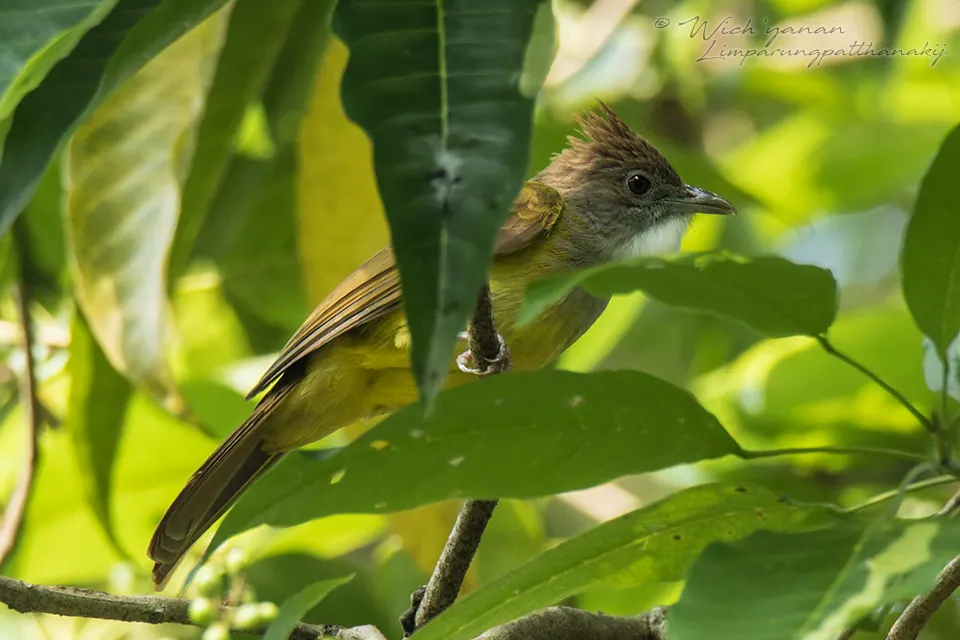
This is a fairly large bulbul, about 19 to 23 cm long and 29 to 52 g, with females a little smaller than males. The back is olive-brown and most of the underparts are yellow, with an ashy brown breast and a white chin and throat. The face is grey and the head carries a short reddish-brown crest.
Names cause confusion here. Some lists call this bird the grey-cheeked bulbul, but that name also belongs to a different species, Alophoixus tephrogenys. Older taxonomies lumped A. bres with that bird and a third relative, A. frater, so older records and trade counts can be muddy.
Where it lives
The species is confined to Java and Bali, where it uses primary, secondary and submontane forest, in moist lowland and hill country. It occurs below about 1,500 m. It is considered fairly tolerant of degraded habitat, it is recorded in at least one protected area, and it does not migrate.
It was once common in forest patches across both islands. Surveys of 35 locations between 1981 and 1990 found it commonly, but it is now at best rare at a few sites and absent from many, including areas where it used to be easy to find, such as Gunung Halimun-Salak and Alas Purwo national parks.
Pins are Wikidata “endemic to” fields. Orange dots, when present, are GBIF occurrence tiles — survey bias included.
How it lives
Insects make up most of the diet, including caterpillars, moths, butterflies, beetle larvae, cicadas, crickets and grasshoppers, with some fruit as well. The nest is a cup of plant material disguised with moss and lichen. Nests have been found in trees such as cacao, mahogany and melinjo.
Breeding occurs in almost all months, particularly in western and central Java. The Red List gives a generation length of about 2.8 years.
Why it is in trouble
The Red List calls trapping for the cage-bird trade the overwhelming threat. The bird is one of the most heavily traded in Java, and effectively the whole population is judged to be within reach of trappers. Population decline is suspected to be 50 to 79 percent over ten years, and the trend is decreasing. No total population estimate exists.
The evidence is mostly from 2019 and 2020. During a January 2020 citizen-science event, the species turned up in only 8 of 7,935 survey squares of 2 by 2 km. In Javan bird markets it made up 0.9 percent of birds in a 2014 inventory (178 of 19,036) but 0.1 percent in July 2019 (13 of 14,617). A 2018 household survey of more than 3,000 households estimated about 340,620 birds of the genus Alophoixus were kept in captivity on Java. Most are thought to be this species, judging by market ratios.
A March 2026 Mongabay report on a study of the crested jayshrike also named the brown-cheeked bulbul among the songbirds at risk because of demand for master birds, which are kept to teach songs to other birds.
What is being done
Capturing and trading wild birds has been essentially illegal in Indonesia since 2002, but the rules are scarcely enforced. No conservation action aimed specifically at this species is in place, and the assessment records no recovery plan and no systematic monitoring.
It recommends enforcing trade laws after careful review involving everyone affected, awareness campaigns that work with trappers, a commercial captive-breeding programme to ease pressure on wild birds, and better survey and monitoring, in the field and in the pet market.
Sources
Written for this catalog in our own words from the sources below, checked against them on 12 November 2026. Population figures are estimates and carry the year they were made. Status and assessment year: IUCN. 2026. The IUCN Red List of Threatened Species. Version 2026-1. iucnredlist.org.




