Endangered
Greater Wilfred's mouse
Wilfredomys oenax
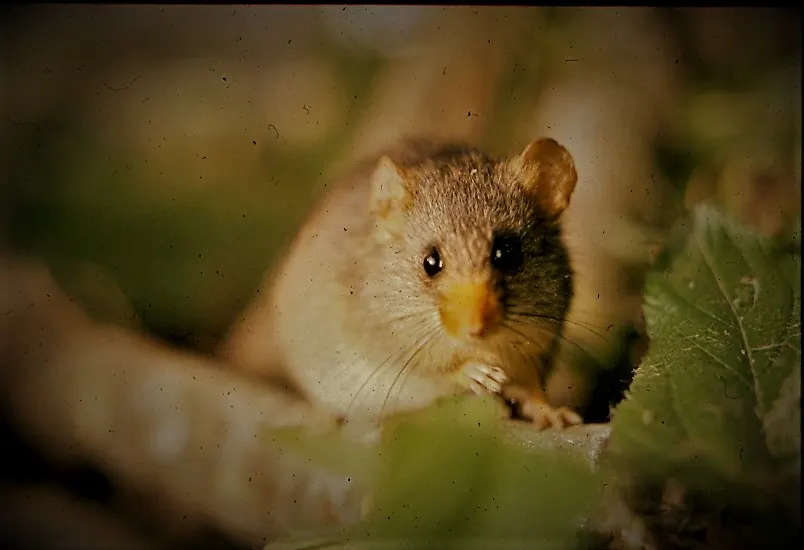
The greater Wilfred's mouse (Wilfredomys oenax) is a rarely seen, tree-climbing rodent of southern Brazil and northern Uruguay, with a long tail and a rusty-orange nose. The IUCN Red List rated it Endangered in 2018, mainly because the forests it needs are shrinking and broken into pieces.
How to recognise it
It's a medium-sized, brightly coloured mouse. Head and body measure about 119 to 130 mm, and the tail is longer than that, at 161 to 211 mm. Weight is reported at roughly 42 to 62 g, though a Uruguayan account gives 34 to 62 g.
The upper parts are orange-brown, the underparts paler, and the throat and groin whitish. The nose and ears carry very short ochre to rufous hairs, which gives the animal its Spanish name, rata de hocico ferrugineo (rust-snouted rat). The tail looks almost bare, brown above and paler below, with fine rings and a small tuft at the tip.
Where it lives
Records come from a few scattered sites in southeastern and southern Brazil, from São Paulo state down to Rio Grande do Sul, and from northern Uruguay. Uruguayan localities include Paso Centurión in Cerro Largo and Laureles in Tacuarembó. Oldfield Thomas described the species in 1928, as Thomasomys oenax, from a specimen collected at São Lourenço do Sul in Rio Grande do Sul.
It lives in lowland subtropical forest, including gallery forest along watercourses, and in montane forest. One trapping record came from a canyon with moist subtropical woodland, where mice were caught among large rocks and in branches a metre or two above the ground.
Pins are Wikidata “endemic to” fields. Orange dots, when present, are GBIF occurrence tiles — survey bias included.
How it lives
The mouse is nocturnal and climbs well. It has been found using abandoned birds' nests. Stomach contents have included green plant matter and the purplish berries of aroeira (Lithraea molleoides), and a well-developed caecum points to a diet rich in plants.
Very little else is documented. Home range, movements and social life are unknown. Males trapped in winter were in breeding condition, but nothing is recorded about litter size or breeding season. It is the only species in its genus, and small differences have been noted between Brazilian and Uruguayan animals.
Why it is in trouble
The 2018 Red List assessment (criteria B2ab(ii,iii,iv)) estimates the area it actually occupies at somewhere between 10 and 500 square km, within a much larger overall range of about 980,000 square km. Its forest habitat is severely fragmented and still shrinking. The population trend is listed as unknown, because there are no counts.
The listed threats are conversion of forest to farms and plantations, both large agro-industrial operations and small-holder ones. Wood and pulp plantations, cattle ranching and logging are reportedly pressures too.
What is being done
The assessment records that the mouse occurs in at least one protected area, and it lists no species-specific conservation actions. In Uruguay it is treated as a priority species for the national protected-area system (SNAP), because its range there is small and fragmented.
Sources
Written for this catalog in our own words from the sources below, checked against them on 12 November 2026. Population figures are estimates and carry the year they were made. Status and assessment year: IUCN. 2026. The IUCN Red List of Threatened Species. Version 2026-1. iucnredlist.org.




