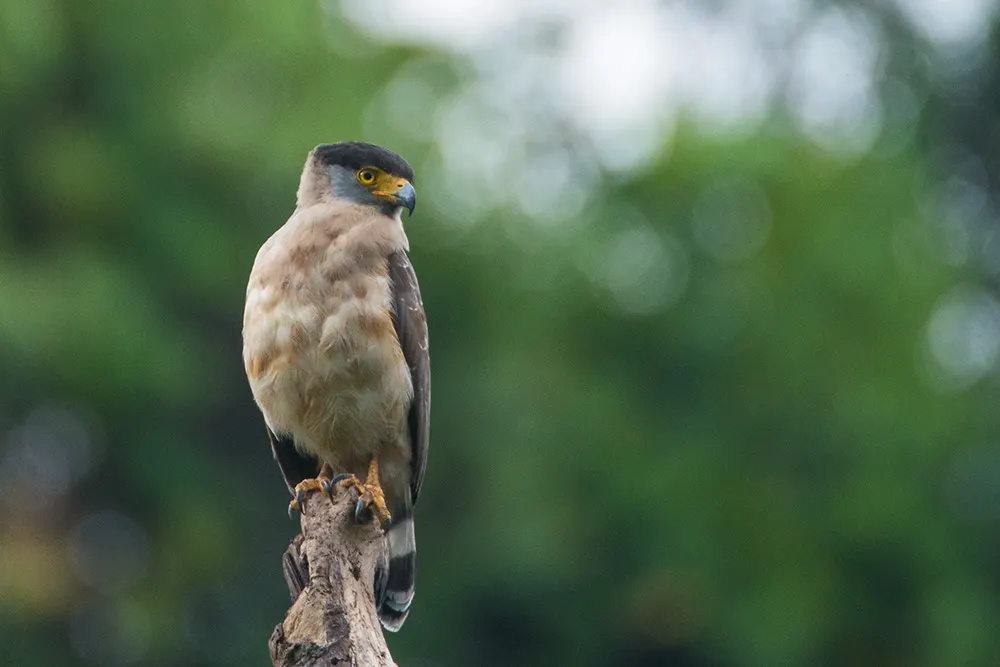
Endangered
Great Nicobar Serpent Eagle
Spilornis klossi
The Great Nicobar serpent eagle (Spilornis klossi) is a compact forest raptor found only on Great Nicobar Island, India. The IUCN moved it from Near Threatened to Endangered in 2023, giving a rough population estimate of 150 to 370 birds. Whether that number is rising or falling is unknown.
How to recognise it
It's a compact eagle, about 38 to 42 cm long with a wingspan of 85 to 95 cm, and it weighs roughly 420 to 450 g depending on the source. It is sometimes billed as the smallest eagle in the world. It belongs to the serpent eagles (genus Spilornis) and is also called the South Nicobar serpent eagle. Charles Wallace Richmond described it in 1902.
For a time some authorities treated it as a subspecies of a related Nicobar form, Spilornis minimus. All major authorities now recognise it as a species in its own right.
Where it lives
The species is endemic to Great Nicobar, the southernmost island of India's Nicobar chain. The IUCN assessment records it in lowland moist tropical forest from sea level up to about 640 m. It is not a migrant, and its range is not considered severely fragmented.
Much of the island is hard to reach, so field data are thin. During BirdLife International's 2023 consultation, one field ornithologist commented that the eagle is rare in the accessible southern part of the island, with very few pairs in the tourism zone.
Pins are Wikidata “endemic to” fields. Orange dots, when present, are GBIF occurrence tiles — survey bias included.
Why it is in trouble
The Red List team assessed the eagle as Near Threatened in every review from 2002 to 2016. In 2023 it was listed as Endangered under criterion D, which applies to very small populations. The population estimate of 150 to 370 birds is rough, and one commenter in the consultation called 150 to 180 mature birds a realistic figure. The trend is recorded as unknown.
The assessment names housing, small-scale farming, tourism and recreation areas, and unintentional harm from subsistence harvesting as threats. Larger pressure comes from a planned development. By November 2022 India's environment ministry had given in-principle (Stage 1) clearance to divert 130.75 sq km of forest on the island for a container transhipment terminal, an airport, a township and a power plant, according to The Quint. Commenters in the 2023 consultation cited that project as a concern.
What is being done
The IUCN assessment lists site protection as the one conservation action for the eagle, with conservation sites identified over its entire range and at least one protected area holding it. It records no recovery plan and no systematic monitoring scheme in place. One commenter in the BirdLife consultation backed the Endangered listing so that a conservation action plan could be started quickly.
Sources
Written for this catalog in our own words from the sources below, checked against them on 12 November 2026. Population figures are estimates and carry the year they were made. Status and assessment year: IUCN. 2026. The IUCN Red List of Threatened Species. Version 2026-1. iucnredlist.org.




