Endangered
Graphium levassori
Graphium levassori
Graphium levassori is a pale yellow swallowtail butterfly found only in the Comoro Islands off East Africa, and specialist sources place it on Grande Comore. The IUCN Red List last assessed it as Endangered in 1996. Little has been published about its life, and it is described as extremely scarce.
How to recognise it
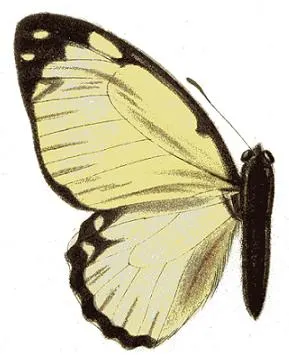
The forewings are 43 to 55 mm long. The upperside is pale yellow, bordered in black along the wing tip and outer edges, with a reddish base to the wings and two yellow spots near the forewing tip. The underside is fawn with a brick-red base.
Males and females look alike, though females run slightly larger. It belongs to the leonidas group of Graphium, alongside Graphium leonidas. The name is credited to Oberthur, dated 1890 by the IUCN and 1886 in some other lists, where an earlier name, Papilio levassori, is treated as a synonym.
Where it lives
The IUCN lists the species as native to the Comoros and endemic there. A specialist swallowtail trust is more precise and says it is confined to Grande Comore (Ngazidja), where it is extremely scarce. The island has no streams or rivers, and annual rainfall ranges from 1,000 to 5,000 mm depending on the site.
The butterfly lives in forest and seems to be restricted to middle altitudes, very patchily. The main remaining forests lie on the flanks of La Grille (1,087 m) and the Karthala volcano (2,560 m), reaching up to about 1,900 m.
Pins are Wikidata “endemic to” fields. Orange dots, when present, are GBIF occurrence tiles — survey bias included.
How it lives
Its life history has not been studied. Related species in the leonidas group feed as caterpillars on plants of the custard apple family, and that is the likeliest host for this one too, but no host plant has been recorded for it. Adults may fly all year, and they have been seen at the start of the heavy April rains.
A report from 1980 described it as not rare in forest near M'Lima Manda, north of Karthala, and difficult to catch. A follow-up visit to find it in 1983 was unsuccessful. A single sea-level record from the north has not been confirmed.
Why it is in trouble
The chief problem is forest loss. Banana cultivation reaches up to about 1,200 m on Grande Comore, and the forests on La Grille are severely depleted. Remaining forest has few large trees, and wild trees are struggling to regenerate. The island's human population was about 150,000 in 1976 and growing rapidly.
Collectors also prize the species, which is large and rare. The Comoros have no protected areas, and the swallowtail specialists say species-specific conservation measures are not yet possible because more data are needed. The IUCN rated it Endangered under range-based criteria (B1+2c) in 1996, and that remains the latest assessment.
Sources
Written for this catalog in our own words from the sources below, checked against them on 12 November 2026. Population figures are estimates and carry the year they were made. Status and assessment year: IUCN. 2026. The IUCN Red List of Threatened Species. Version 2026-1. iucnredlist.org.




