Endangered
Grand Comoro Drongo
Dicrurus fuscipennis
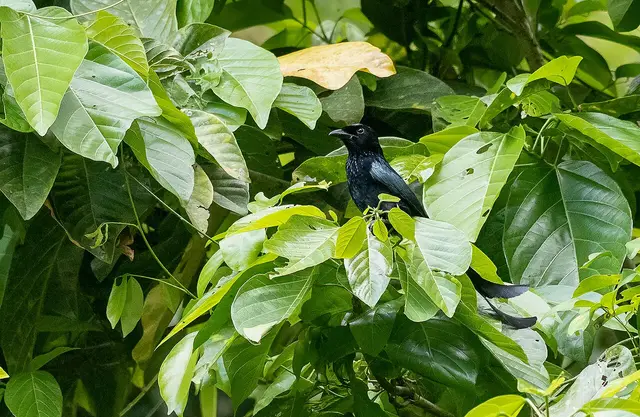
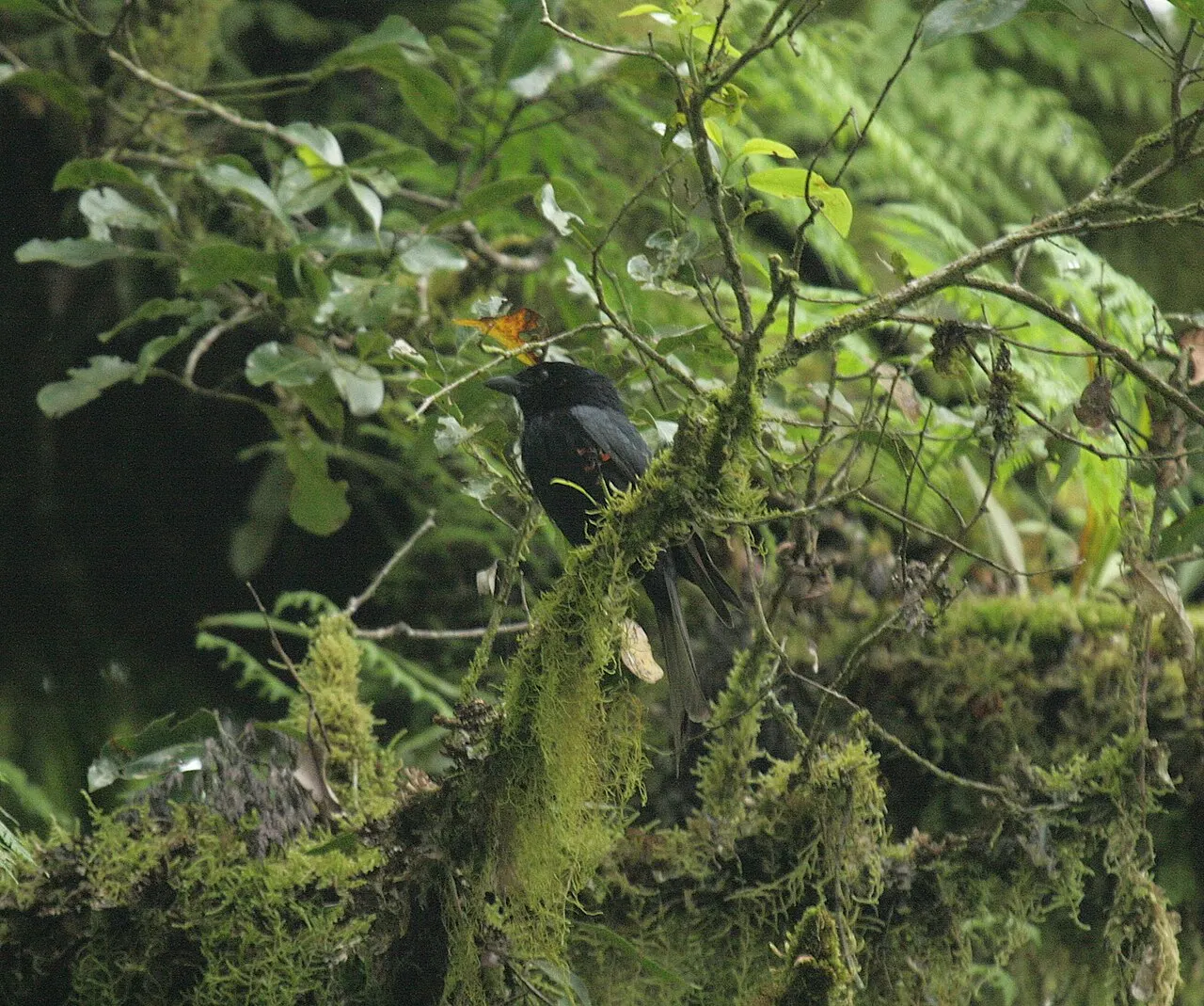
The Grand Comoro drongo (Dicrurus fuscipennis) is a starling-sized black songbird with a forked tail, found only on Grande Comore in the Comoro Islands. The IUCN Red List assessed it as Endangered in 2025, putting the whole population at roughly 70 to 200 birds.
How to recognise it
Drongos are slim, long-tailed perching birds, and this one is mostly black with a faint deep blue sheen in direct sun. Its flight feathers and tail look browner and duller than the rest of the body, and the bill and legs are black. Young birds are a matt blackish brown.
The Red List gives its length as about 24 cm, while a bird-data site gives 26 to 29 cm and a weight of around 50 g. Seen from below in flight, the flight feathers can catch the light and look like pale wing patches.
Where it lives
It is endemic to Comoros and the assessment treats the species as a single population at a single location. Its estimated extent of occurrence is 510 square kilometres, and the area it actually occupies is put at 316 square kilometres. It lives from about 100 to 1,150 metres above sea level.
The drongo is not restricted to untouched forest. It is recorded in moist lowland forest but also in pasture and plantations, and it does not migrate.
Pins are Wikidata “endemic to” fields. Orange dots, when present, are GBIF occurrence tiles — survey bias included.
How it lives
Drongos in general hunt by flying out from a perch to snatch prey, and this species feeds mainly on invertebrates, including cockroaches, grasshoppers, beetles and mantises. It also eats fruit. It is sedentary, and its voice is a mix of squeaks, sharp clicks and a softer wit-wit note. Nesting is poorly documented.
Why it is in trouble
With so few birds in such a small area, the species qualifies as Endangered on population size alone, in addition to its restricted range. The assessment gives the volcano on the island as the highest scoring threat, since an eruption could affect the whole range. Small-scale farming is affecting most of its habitat, and a future road is listed as a lesser risk.
Introduced animals are also named: rats, the small Indian civet and the small Indian mongoose. The assessment lists their effect as unknown, though it records reduced breeding success among the stresses.
The 2025 assessment lists the population as stable, but the figure is a range, not a count, and the area it lives in is still shrinking.
What is being done
The sites where the species lives have been identified across its whole range, and at least part of it lies in a protected area. There is no recovery plan, no regular monitoring and no control of invasive animals.
The assessors recommend field surveys to pin down the real population and trend, an environmental education programme on the island, locally run ecotourism for people around Mt Karthala, a land-use strategy for the island and reforestation of grassland on the central ridge.
Sources
Written for this catalog in our own words from the sources below, checked against them on 12 November 2026. Population figures are estimates and carry the year they were made. Status and assessment year: IUCN. 2026. The IUCN Red List of Threatened Species. Version 2026-1. iucnredlist.org.