Critically Endangered
Gough Finch
Rowettia goughensis
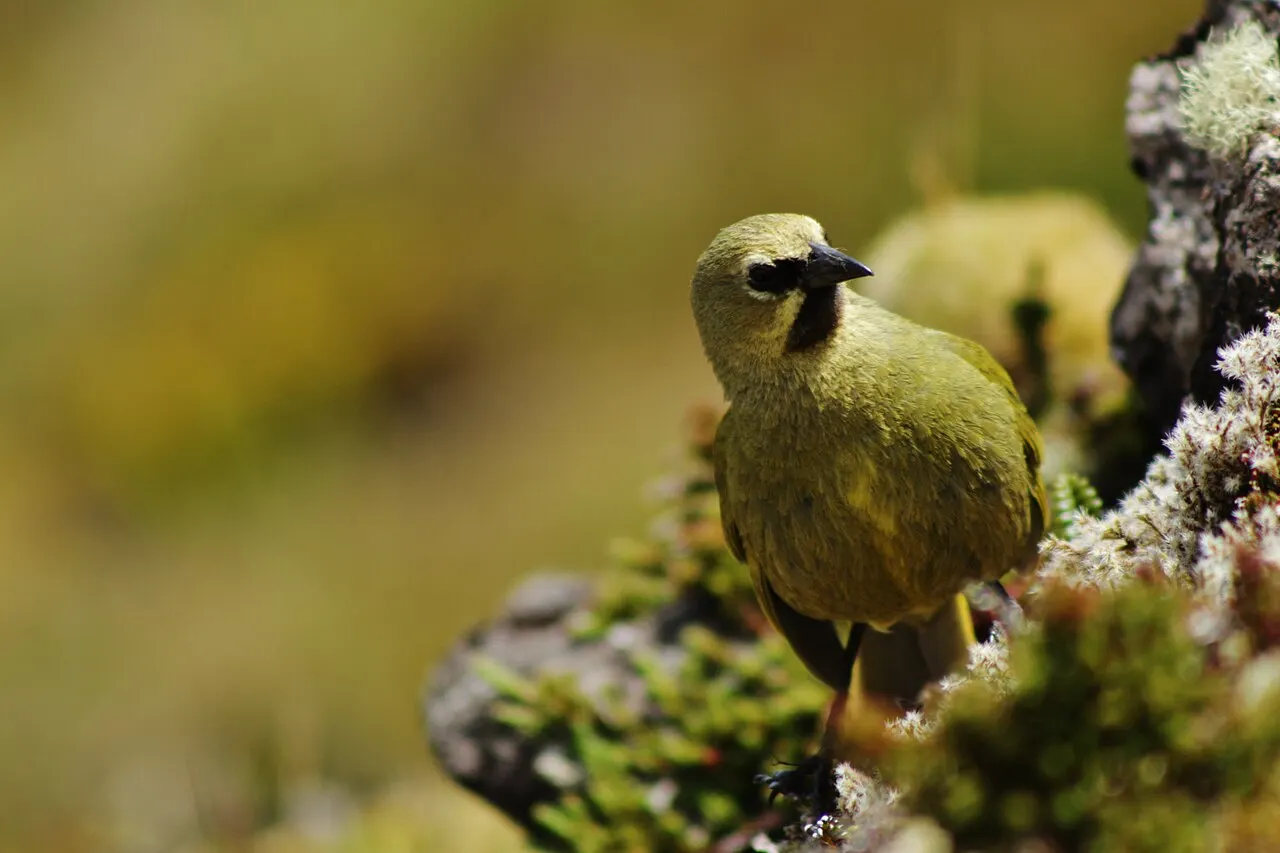
The Gough finch, also called the Gough bunting, is a stocky olive songbird found only on Gough Island and its offshore stacks in the South Atlantic. The IUCN Red List has rated it Critically Endangered since 2008, most recently in 2024. Introduced house mice are the main threat.
How to recognise it
It's a large, chunky finch with a thick, pointed black bill and a drab olive look. Adult males are dull olive-green with a yellowish forehead and eyebrow and a black bib. Females and young birds are buffy olive and heavily streaked with dark brown.
Published sizes differ. Reference works give a length of 22 to 26 cm and a weight of 50 to 56 g, while the Red List account gives about 18 cm. The bird was first described in 1904, and for a long time it was grouped with the buntings. DNA studies now place it among the tanagers (family Thraupidae).
Where it lives
Gough Island is a rugged volcanic island of about 65 square kilometres, roughly 400 km south-east of the Tristan da Cunha group. It's a UNESCO World Heritage Site and a major nesting ground for seabirds. The finch lives only here and on nearby stacks, and the Red List treats its whole range as a single location.
It uses temperate shrubland and subantarctic grassland, from sea level up to about 910 m. It doesn't migrate.
Pins are Wikidata “endemic to” fields. Orange dots, when present, are GBIF occurrence tiles — survey bias included.
How it lives
Nests are hard to find. Field teams working on the island describe them as tucked under bog ferns or grass, or in small hollows in rock faces. As in many songbirds, the female incubates while the male forages, and he feeds her when she briefly leaves the nest to beg.
A generation is estimated at about 4.8 years. The Red List's estimate from the 2024 assessment is 1,118 to 2,030 birds, with a best figure of 1,440. A separate listing for the island mentions about 3,000 birds, so counts differ. The Red List gives the population trend as stable.
Why it is in trouble
House mice are an introduced species on Gough, and they behave unusually aggressively. They compete with the finch for food and eat eggs and chicks. The Red List scores their impact as high and ongoing, with very rapid declines possible. It also treats the accidental arrival of black rats from ships as a potential threat.
Because the whole species lives in one place, one bad event could do serious harm. The finch is rated under the Red List's range-size criteria (B1ab(iii)), which is why it stays Critically Endangered even though the count has held steady.
What is being done
The Gough Island Restoration Programme, led by the RSPB, used helicopters to drop poison bait in 2021 to remove the mice, which prey on seabird chicks. The drops were completed in July 2021 and early signs looked good. In mid-December 2021 a mouse was seen on a camera trap, and four more were later caught at two other locations. The programme had not removed every mouse, and staff are working out how widely they survived. A renewed attempt may be made in future.
In 2018 a field team marked and followed finch nests from eggs to fledglings. Breeding success hadn't been monitored since 2009. The Red List also records invasive species control and prevention in place, and the finch occurs in a protected area.
Sources
Written for this catalog in our own words from the sources below, checked against them on 12 November 2026. Population figures are estimates and carry the year they were made. Status and assessment year: IUCN. 2026. The IUCN Red List of Threatened Species. Version 2026-1. iucnredlist.org.




