Critically Endangered
Gonatodes daudini
Gonatodes daudini
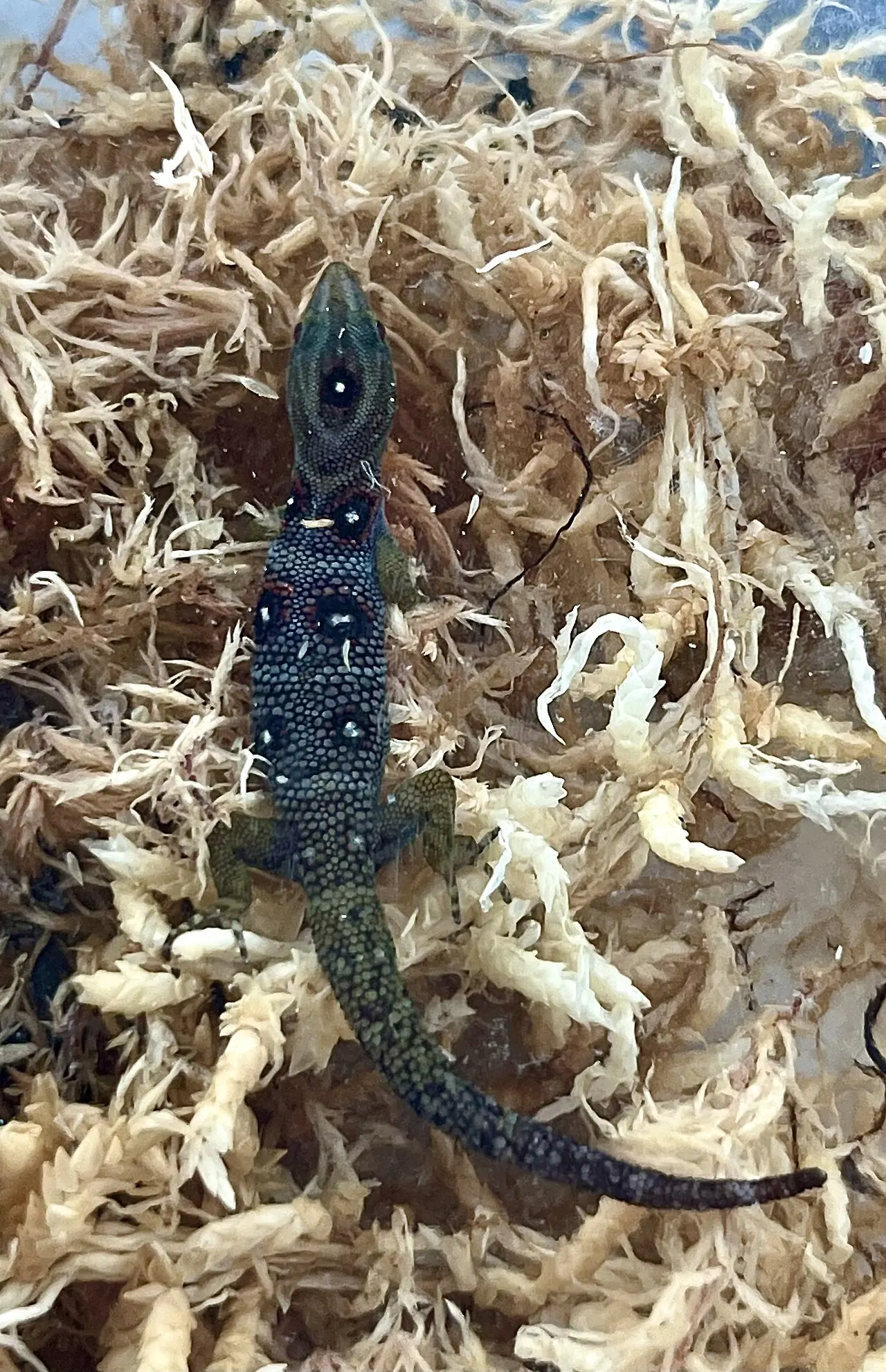
The Union Island gecko (Gonatodes daudini), also called the Grenadines clawed gecko, is a tiny, brightly marked lizard found only on Union Island in Saint Vincent and the Grenadines. The IUCN Red List rated it Critically Endangered in 2019, mainly because of collecting for the international pet trade.
How to recognise it
It is very small, around 6 cm from snout to tail tip, roughly the size of a paperclip. The skin carries bull's-eye patterns of red and black with white centres. That striking look made the species a target for collectors.
Where it lives
The species is endemic to Union Island, and its range is tiny. It lives in remnant dry forest, and accounts of the exact area differ. A 2022 Mongabay report put it at roughly 50 hectares of old-growth forest, while a 2019 National Geographic article described a forest patch overlooking Chatham Bay about two city blocks in size. Both describe a very small area.
Pins are Wikidata “endemic to” fields. Orange dots, when present, are GBIF occurrence tiles — survey bias included.
How it lives
It is active by day and lives mostly on the ground. Females usually lay a single egg rather than a clutch of two, and eggs can be found under leaf litter. Hobbyists report that captive pairs breed year-round under suitable conditions, though that detail comes from captive accounts, not field studies.
Discovery and trade
A priest, Father Mark da Silva, found the gecko in early 2005 while studying plants and photographed it. Herpetologists Robert Powell and Robert Henderson visited that June, and their description appeared in December 2005. It is named for Jacques Daudin, a naturalist who lived on Union Island.
Collectors arrived soon afterwards. A 2017 study found it was the most trafficked reptile from the eastern Caribbean. National Geographic reported that its density across much of its range fell by roughly 80 percent between 2010 and 2018.
Why it is in trouble
Poaching for the pet trade is the main threat. Poorly managed development on the island is a continuing concern, according to Fauna & Flora International. Export is illegal under local law, but wild-caught geckos have still been offered for sale in Europe. National Geographic counted at least 36 advertised online over four years, five of them described as wild-caught, mostly by sellers in Germany, the Netherlands and Austria.
What is being done
Saint Vincent and the Grenadines proposed the gecko for CITES Appendix I, the strictest level of trade control, and it was listed in 2019. Since 2017, trained local residents have reportedly patrolled the forest, and camera traps help watch the habitat. Partners include Fauna & Flora International, Re:wild, the Union Island Environmental Alliance and the national Forestry Department.
Mongabay reported in December 2022 that the population had risen from about 10,000 geckos in 2018 to about 18,000. The article did not explain how the counts were made, so treat the figures as rough.
Sources
Written for this catalog in our own words from the sources below, checked against them on 12 November 2026. Population figures are estimates and carry the year they were made. Status and assessment year: IUCN. 2026. The IUCN Red List of Threatened Species. Version 2026-1. iucnredlist.org.




