Critically Endangered
Gocea ohridana
Gocea ohridana
Gocea ohridana is a tiny freshwater snail found only in Lake Ohrid, on the border of North Macedonia and Albania, where it lives on stony shore bottoms near underwater springs. The IUCN Red List rated it Critically Endangered in its 2026 assessment. It is the only species in its genus.
How to recognise it
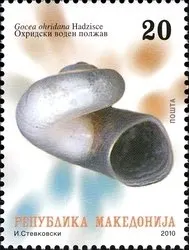
This is a very small snail in the family Hydrobiidae. Radoman's 1985 description, summarised in a 2019 survey, gives it a valvatiform shell (low and disc-like) with fine radial lines. The last whorl is large and stretched out, so the opening sits well away from the whorl before it. The opening is narrow and angular at the top, and the operculum (the little trapdoor that seals the shell) is reddish.
It was first described in 1956 by Hadzisce and is the only species in its genus. Shell length and diameter increase a little with depth, according to samples from 0.5 and 2 metres.
Where it lives
Lake Ohrid is an ancient lake and holds an unusual number of species found nowhere else. Gocea ohridana is among the most restricted of them. It is known only from the south-eastern shore, where the IUCN records North Macedonia and an area of occupancy of about 16 square kilometres (earlier estimates were under 10). The snail lives on the underside of stones, near underwater springs, in water no deeper than about 3 metres.
A Hydrobiological Institute survey of two sites, Velidab and Sveti Zaum, ran monthly from August 2009 to August 2010. The snail turned up only on sandy and stony bottoms. It was absent from sand, mud and beds of submerged plants. At Velidab it was found only at 0.5 metres. At Sveti Zaum it occurred at 0.5 and 2 metres. The survey reported densities of 44 to 220 snails per square metre, an annual average of 220, and a one-month peak of 1,100 per square metre in July 2010. The team saw this fussiness about habitat as one reason the species stays so confined.
Pins are Wikidata “endemic to” fields. Orange dots, when present, are GBIF occurrence tiles — survey bias included.
Why it is in trouble
The IUCN lists soil erosion and sediment, sewage, nutrient loading, and more frequent or intense fires as ongoing threats across the whole of its range. Deforestation near the lake sends sediment into the water, which reduces the snail's ability to filter water. Sewage from nearby towns adds nutrients, and farm runoff into connected Lake Prespa feeds the aquifer that supplies Ohrid. The 2019 survey notes that nutrient concentrations in the lake have roughly doubled over about 60 years.
Numbers at the best-known site look low. A 2017 resurvey at Velidab, funded by the Rufford Foundation, found the snail only at 0.5 metres, at 25 per square metre. Water quality at 2 and 5 metres had dropped from good or high to moderate compared with the earlier survey, although the site as a whole still rated good. The IUCN lists the population trend as unknown.
What is being done
Protection is thin. The 2019 survey reported no conservation actions aimed at this snail, although Lake Ohrid is a World Heritage Site and the Albanian side has had national protection since 1999. The IUCN records that the snail occurs in at least one protected area and that an area-based management plan exists for the region.
The Velidab researchers urged chemical monitoring to trace pollution sources, a request to ministries for stronger protection, DNA barcoding and laboratory cultivation, a visual barrier 200 metres from the shore, and public awareness work.
Sources
Written for this catalog in our own words from the sources below, checked against them on 12 November 2026. Population figures are estimates and carry the year they were made. Status and assessment year: IUCN. 2026. The IUCN Red List of Threatened Species. Version 2026-1. iucnredlist.org.




