Endangered
Gnathopogon caerulescens
Gnathopogon caerulescens
The Biwa moroko gudgeon, or honmoroko (Gnathopogon caerulescens), is a slender carp relative native to Lake Biwa in Japan and prized as food. The IUCN Red List assessed it as Endangered in 2019. Spawning habitat loss, introduced predators and heavy fishing have all been blamed for its fall.
How to recognise it
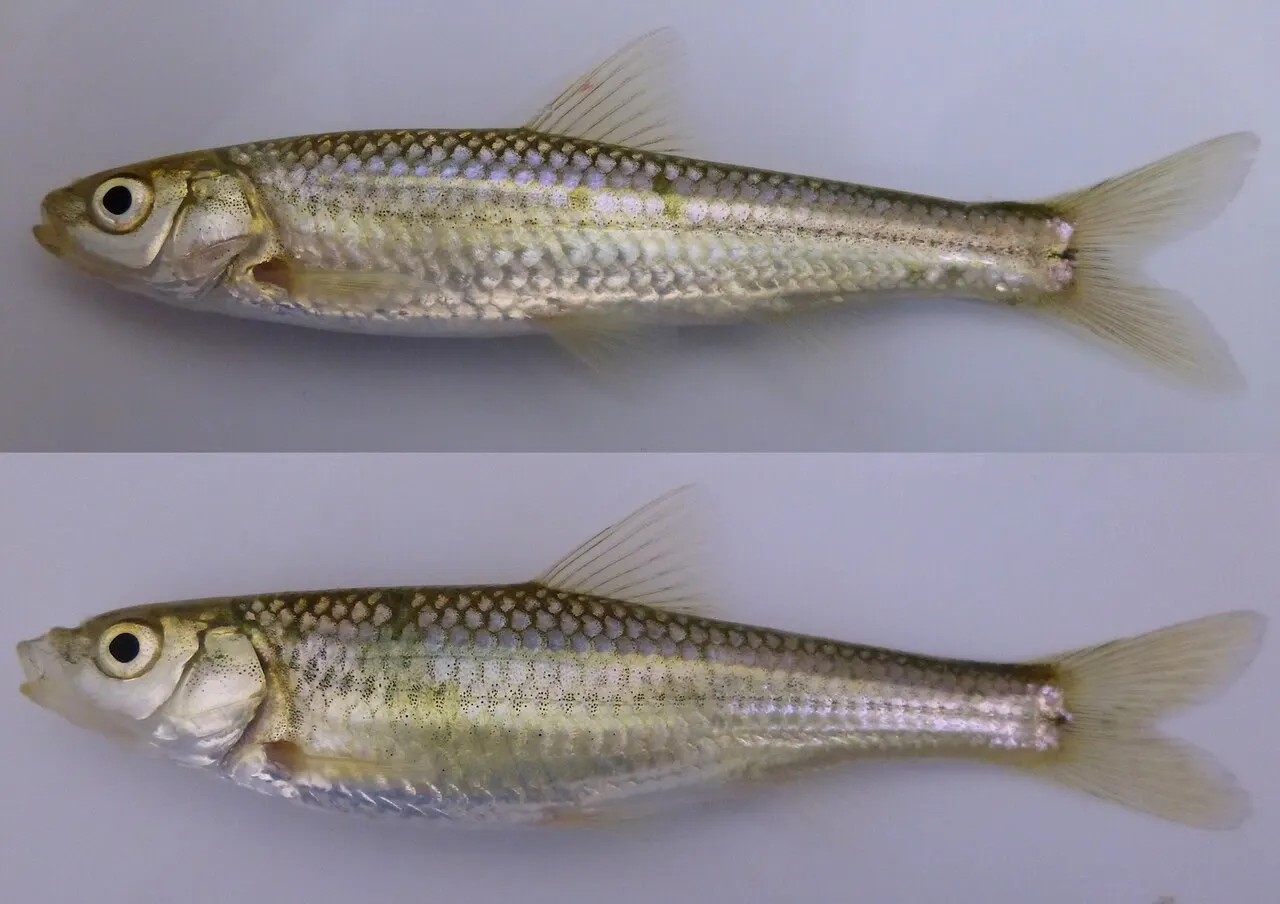
It is a slender fish, with large individuals reaching about 15 cm. Compared with its relative the tamoroko, it has shorter barbels, an angular throat and a paler stripe along its side.
Where it lives
The species was originally found only in Lake Biwa on Honshu, where the IUCN counts a single location. It has since been introduced to lakes Yamanaka, Suwa and Okutama. In Biwa it lives in open water, usually at depths of 5 m or more, and moves to lakeshores, lagoon inlets and waterways to breed. The IUCN habitat list covers freshwater lakes, rivers and small marshes and pools.
Pins are Wikidata “endemic to” fields. Orange dots, when present, are GBIF occurrence tiles — survey bias included.
How it lives
It feeds mainly on zooplankton, aquatic insects and small crustaceans. It matures at six months to a year old and usually lives two or three years, and many die soon after spawning.
Breeding runs roughly from March to July. Large schools come inshore, females trailed by several males, and lay eggs a few centimetres deep on willow and grass roots, reeds and small pebbles. Eggs laid so shallow are sensitive to changes in water level. A 2020 survey of the Lake Biwa shoreline, mainly the North Basin, collected 1,950 eggs from submerged willow roots at 67 egg sites, and DNA tests on a sample of the eggs identified this species at 56 of them.
Why it is in trouble
Before 1994 the lake's catch was reported as a steady 150 to 350 tons a year. From 1996 it fell to under a tenth of the peak, with about 5 tons in 2004 and 10 tons in 2008. The price rose and it became a luxury food in Kyoto restaurants.
Researchers have proposed several causes. Spawning once covered almost the whole shoreline around 1940, but by the mid-1990s it was documented in only 17 of 50 areas where it could be checked. Shoreline development and embankments, falling oxygen in deep winter waters, bird predation, introduced black bass and bluegill, and heavy fishing have all been suggested. A 2023 study in the Japanese Journal of Ichthyology concluded that water-level control on the lake, begun in 1992, was unlikely to explain the loss of spawning sites, because most of that decline had happened earlier. The IUCN assessment also lists roads, farm run-off and dams.
What is being done
Shiga Prefecture and nearby local governments have responded with habitat restoration, removal of invasive fish, and aquaculture and stocking. Several prefectures also farm the species for the table, including Saitama, Yamanashi (on fallow rice paddies since 2007), Hiroshima and Gifu. The IUCN assessment lists habitat restoration, invasive species control, site protection and harvest management among the relevant actions.
The same 2023 study found some recovery. Across 41 shoreline areas surveyed in 2019 and 2020, eggs were found in 29, spread over seven of the eight shore regions.
Sources
Written for this catalog in our own words from the sources below, checked against them on 12 November 2026. Population figures are estimates and carry the year they were made. Status and assessment year: IUCN. 2026. The IUCN Red List of Threatened Species. Version 2026-1. iucnredlist.org.



