Critically Endangered
Glyptothorax kashmirensis
Glyptothorax kashmirensis
The Kashmir catfish (Glyptothorax kashmirensis) is a small, dark river catfish of the upper Indus system in Pakistan and Indian-administered Kashmir. It clings to river beds with a ridged adhesive pad on its chest. The IUCN rated it Critically Endangered in 2022, with dams and mining the main threats.
How to recognise it
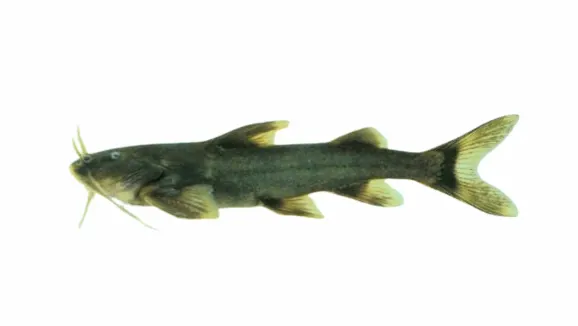
This is a small catfish. In a 2021 study of 19 fish from three Pakistani rivers, total length ranged from 82 to 160 mm and averaged about 123 mm. Earlier reports gave maximums of 117 and 145 mm. The back and flanks are dark brown, the belly is pale yellowish near the fin bases, and the skin carries black dots and fine tubercles on the upper side.
Its most distinctive feature is the thoracic adhesive apparatus, a pad on the chest with 30 to 36 prominent streaks around an oval, creamy central pit. The head is flattened, the mouth inferior and wide, and the eyes very small and set under the skin. It has four pairs of barbels, an adipose fin and a forked tail.
Where it lives
Sunder Lal Hora described the species in 1923, from the Jhelum valley, on only two specimens. The IUCN lists it as present in India and Pakistan, with presence in Nepal uncertain. It lives in permanent rivers and streams, and also in large freshwater lakes. The IUCN gives an extent of occurrence of about 59,564 square kilometres and an occupied area of about 3,568 square kilometres.
The 2021 study found it in the Jhelum River between Chakothi and Kohala, in the Poonch River from Jawra to Gulpur, and in the Kurram River between Sadda and Shalozan. The Jhelum is a large eastern tributary of the Indus, and the Poonch joins it just above Mangla Reservoir.
Pins are Wikidata “endemic to” fields. Orange dots, when present, are GBIF occurrence tiles — survey bias included.
How it lives
Most of what is known about its biology comes from that one small study. Researchers examined the stomachs of 19 fish caught by cast net between March and October 2017. Caddisflies of the family Hydropsychidae made up 46 percent of prey, followed by pupae and unidentified items (17.2 percent), mayflies of the family Baetidae (8.6 percent) and midges (8.3 percent). Smaller shares were beetles, stoneflies and other insects. The prey were mostly bottom-living invertebrates, and the study concluded the fish is a bottom feeder and a carnivore.
No sampling was done between November and February, because earlier work had shown the fish stay inactive in winter. The study also notes the species is most active in turbid water and hard to catch in clear water. The IUCN assessment gives a generation length of about 4.5 years.
Why it is in trouble
The 2022 assessment rates large dams, small dams, and mining and quarrying as high-impact, ongoing threats, each causing very rapid declines. Dams affect half to nine-tenths of the range and mining more than nine-tenths. The population is recorded as decreasing and is not severely fragmented. The assessment estimates a past reduction of 80 to 90 percent, based on loss of occupied area and habitat quality, with a similar reduction projected.
The 2021 study cites an earlier IUCN prediction of a decline of about 5 percent a year, driven by dam building. The assessment also lists ecosystem conversion and degradation, indirect ecosystem effects, and deaths and disturbance of fish.
What is being done
Conservation sites have been identified over part of the range, but the species is not found in any protected area. No recovery plan or systematic monitoring scheme is in place, and no captive population exists. The assessment suggests site protection and management, awareness work, invasive-species control and captive breeding.
Sources
Written for this catalog in our own words from the sources below, checked against them on 12 November 2026. Population figures are estimates and carry the year they were made. Status and assessment year: IUCN. 2026. The IUCN Red List of Threatened Species. Version 2026-1. iucnredlist.org.




