Critically Endangered
Glaucous Macaw
Anodorhynchus glaucus
The glaucous macaw is a large, pale blue-grey parrot that once lived along the big rivers of southern South America. The IUCN Red List rates it Critically Endangered (Possibly Extinct), most recently in 2019. No reliable sighting has been made for decades, and some sources put the last record in the nineteenth century.
How to recognise it
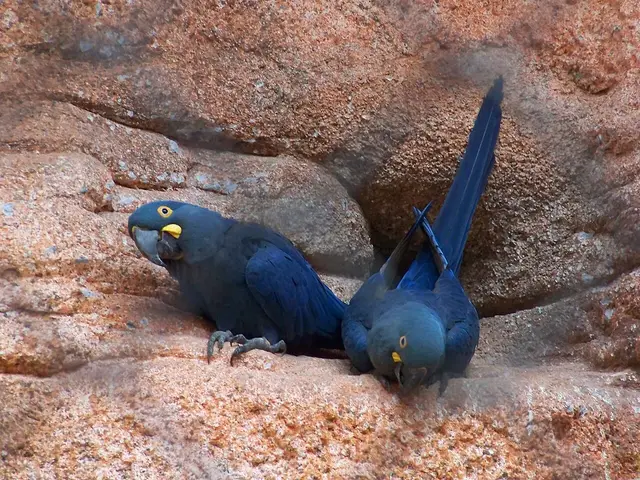
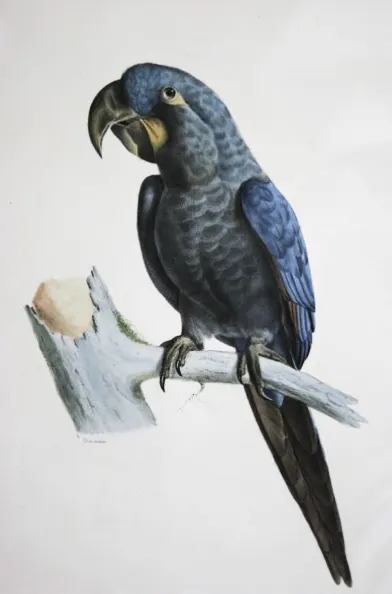
About 70 cm long, this was one of the big macaws. The plumage was a pale turquoise blue, set off by a large greyish head, which is where the name comes from (glaucous means a dull blue-grey). It had a long tail, a large bill, a bare yellow ring around the eye and half-moon shaped flaps of skin along the lower bill.
Its closest relatives are Lear's macaw and the hyacinth macaw. In the Guarani language it is called gua'a hovy, a name that comes from its calls.
Where it lived
The bird was native to northern Argentina, southern Paraguay, southern Brazil and Uruguay, and older accounts also place it in Bolivia. Records cluster around the Uruguay, Paraná and Paraguay rivers, with Corrientes in Argentina the best-known area.
Its habitat was subtropical gallery forest with cliffs, and lightly wooded, palm-rich savanna. Suitable ground still exists in places such as El Palmar National Park in Argentina and in southern Brazil, but no credible recent reports have come from them.
Pins are Wikidata “endemic to” fields. Orange dots, when present, are GBIF occurrence tiles — survey bias included.
How it lived
Its main food was the nuts of the yatay palm (Butia yatay). It was probably sociable, and it nested in steep river banks and cliffs, and less often in tree holes. Little was recorded before it vanished, so much of what is said about its habits is inference.
Why it disappeared
It became rare during the nineteenth century. The likely causes are the trapping of adults for the wild bird trade and the felling of yatay palms, its main food plant, together with loss of habitat.
Sources disagree about when it was last seen. One account puts the last record in the 1870s, and the Search for Lost Birds project gives 1883 as the last documented record. The World Parrot Trust says there has been no reliable record since the 1960s and mentions a direct sighting in Uruguay in 1951. A 1936 photograph is said to show a bird at the Buenos Aires zoo.
Expeditions in the 1990s in south-western Paraguay found no sign of it, and a 1992 search by Joe Cuddy and Tony Pittman concluded it was extinct across its old range.
What is being done
The glaucous macaw is on CITES Appendix I, which bans international commercial trade. In 1999 the World Parrot Trust sent four specialists, Charles Munn, Carlos Yamashita, Richard Hartley and Alfredo Begazo, to survey its historical range in Brazil. They found no birds in any area they covered. The species is listed as a target of the Search for Lost Birds project, which reports no current news. Specimens survive in museums, including the Naturalis Biodiversity Center in Leiden.
Sources
Written for this catalog in our own words from the sources below, checked against them on 12 November 2026. Population figures are estimates and carry the year they were made. Status and assessment year: IUCN. 2026. The IUCN Red List of Threatened Species. Version 2026-1. iucnredlist.org.