Critically Endangered
Gigantopelta aegis
Gigantopelta aegis
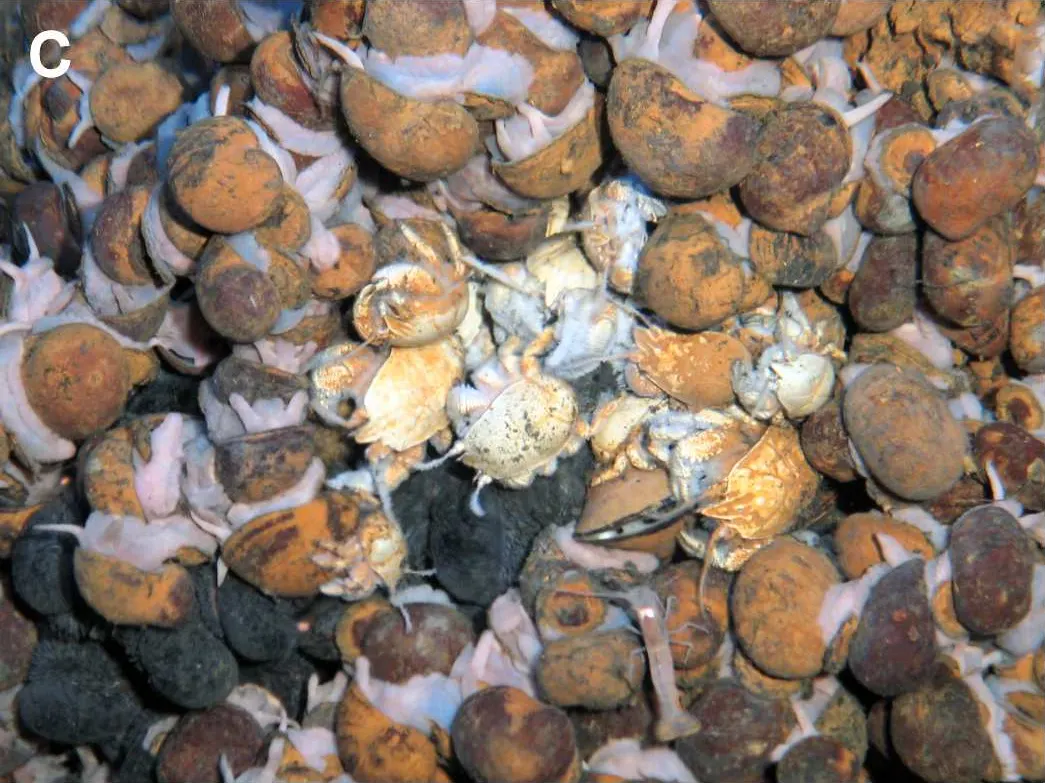
Gigantopelta aegis is a large deep-sea snail that lives around hot hydrothermal vents on the Southwest Indian Ridge, nearly 2,800 m down. It's known from a single vent field, Longqi, and was assessed as Critically Endangered in 2019, with seabed mining the threat listed for a population this small.
How to recognise it
For a vent snail it's big. The shell can reach about 45 mm across, roughly three times the 15 mm average for its relatives in the family Peltospiridae. Young snails are tiny, with measured shells starting just under 5 mm, and an adult used for genome work had a shell length of 4 cm.
The shell is thickly coated in a layer of sulphide minerals, as in other vent gastropods, and males and females reportedly look alike.
Where it lives
The species was described in 2015 by Chen, Linse, Roterman, Copley and Rogers, who placed it in a new genus. It's known only from the Longqi hydrothermal vent field, which sits on an ultraslow-spreading stretch of the Southwest Indian Ridge. The Red List gives a depth range of 1,732 to 2,778 m and counts it as one location.
Longqi was the first vent field known on this ridge. A 2016 survey in Scientific Reports, based on the first remotely operated vehicle dives there, collected 21 kinds of larger animals, six of them not known from other vents. The snail and the scaly-foot snail, a deep-sea mussel and a stalked barnacle dominated the fauna in zones away from the vents. At the Tiamat chimney, the two snails sit side by side in great numbers.
Pins are Wikidata “endemic to” fields. Orange dots, when present, are GBIF occurrence tiles — survey bias included.
How it lives
Young snails graze. At a shell length of roughly 5 to 7 mm they shift to relying on bacteria. A 2021 study in Nature Communications, led by a Hong Kong University of Science and Technology team, found two kinds of symbiotic bacteria living inside cells of an enlarged gland in the snail's gut: one that gets energy from sulphur compounds and one that uses methane. In the animal analysed, the sulphur-based bacteria were about seven times more abundant.
The bacteria make food from chemical energy rather than sunlight. The snail's genome also carries extra copies of genes for recognising microbes, and these are active in the gland that houses the bacteria.
Why it is in trouble
Longqi sits in an area where the 2016 survey reported mineral exploration licensed by the United Nations, and the Red List names mining as the ongoing threat. Because the snail occurs in one vent field, any disturbance there could reach the whole known population. The assessment lists the population trend as unknown, and no population size has been published.
Nothing protects it at present. The Red List records no protected area covering its habitat, no recovery plan or monitoring scheme, and no international trade controls.
Sources
Written for this catalog in our own words from the sources below, checked against them on 12 November 2026. Population figures are estimates and carry the year they were made. Status and assessment year: IUCN. 2026. The IUCN Red List of Threatened Species. Version 2026-1. iucnredlist.org.
- IUCN Red List assessment, Gigantopelta aegis (2019)
- Gigantopelta aegis, encyclopedia entry
- Dual symbiosis in the deep-sea hydrothermal vent snail Gigantopelta aegis revealed by its hologenome (bioRxiv preprint, 2020)
- HKUST news release on the snail hologenome (Nature Communications, February 2021)
- Copley et al. 2016, Scientific Reports 6, megafauna and macrofauna at Longqi




