Critically Endangered
Giant salmon carp
Aaptosyax grypus
The giant salmon carp (Aaptosyax grypus), nicknamed the Mekong ghost, is a huge predatory carp of the middle Mekong River. The IUCN Red List rated it Critically Endangered in 2011 after a decline of about 90 percent. After roughly 15 years without a confirmed adult, three fish were documented in Cambodia between 2020 and 2023.
How to recognise it
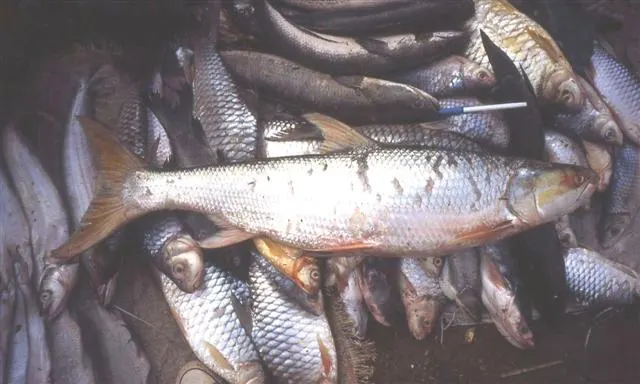
This is one of the Mekong's big fish, reaching about 1.3 m long and over 30 kg, though one conservation group puts its length at up to 1.8 m. It has a salmon-like body with bright scales and a hooked, S-shaped lower jaw. It is the only member of its genus, first described by Rainboth in 1991, and is sometimes called the Mekong giant salmon carp. Lao and Thai local names include pa sanak nyai and pa sanaag.
Where it lives
It is a fish of the middle Mekong, in permanent river habitat at roughly 180 to 200 m elevation. The IUCN lists it as present in Laos, and as possibly extinct in Cambodia and Thailand, where it was once recorded.
Two of the three recent Cambodian fish were caught in the Sesan River, a Mekong tributary where dams have altered flows and blocked migration routes. The catches lay outside what was thought to be its historic range, which researchers read as a sign it may be more widespread than assumed. How many populations remain, and whether they are linked, is unknown.
Pins are Wikidata “endemic to” fields. Orange dots, when present, are GBIF occurrence tiles — survey bias included.
How it lives
The IUCN classes it as a full migrant, and a 2024 report describes it as relying on seasonal movements to feed and spawn. Its hooked jaw suggests a predator. Little else about its diet and breeding has been published, because so few have been seen.
Why it is in trouble
The 2011 assessment estimated a population fall of about 90 percent, based on direct observation, habitat decline and exploitation, and described the population as severely fragmented. It named harvest by small-scale and subsistence fishers as an ongoing threat to most of the population, and future large dams as a further one.
Dams on the Mekong system cut migration routes. Conservation groups also point to overfishing, habitat degradation and, increasingly, droughts and floods linked to climate change.
What is being done
No adult was documented between 2005 (some accounts say 2004) and 2020, and many feared it extinct. In 2020 a fisher contacted authorities with photos of an unusual catch, which could not settle the identification. Specimens obtained in 2022 and 2023 confirmed the species. A study led by Bunyeth Chan of Svay Rieng University, with Zeb Hogan of the University of Nevada, Reno as coauthor, appeared in Biological Conservation in November 2024.
After the rediscovery Cambodia's Fisheries Administration added the species to its protected list. The Wonders of the Mekong programme has worked on the species since 2017, involving local fishers, and SHOAL lists it as a priority fish.
Sources
Written for this catalog in our own words from the sources below, checked against them on 12 November 2026. Population figures are estimates and carry the year they were made. Status and assessment year: IUCN. 2026. The IUCN Red List of Threatened Species. Version 2026-1. iucnredlist.org.




