Critically Endangered
Giant muntjac
Muntiacus vuquangensis
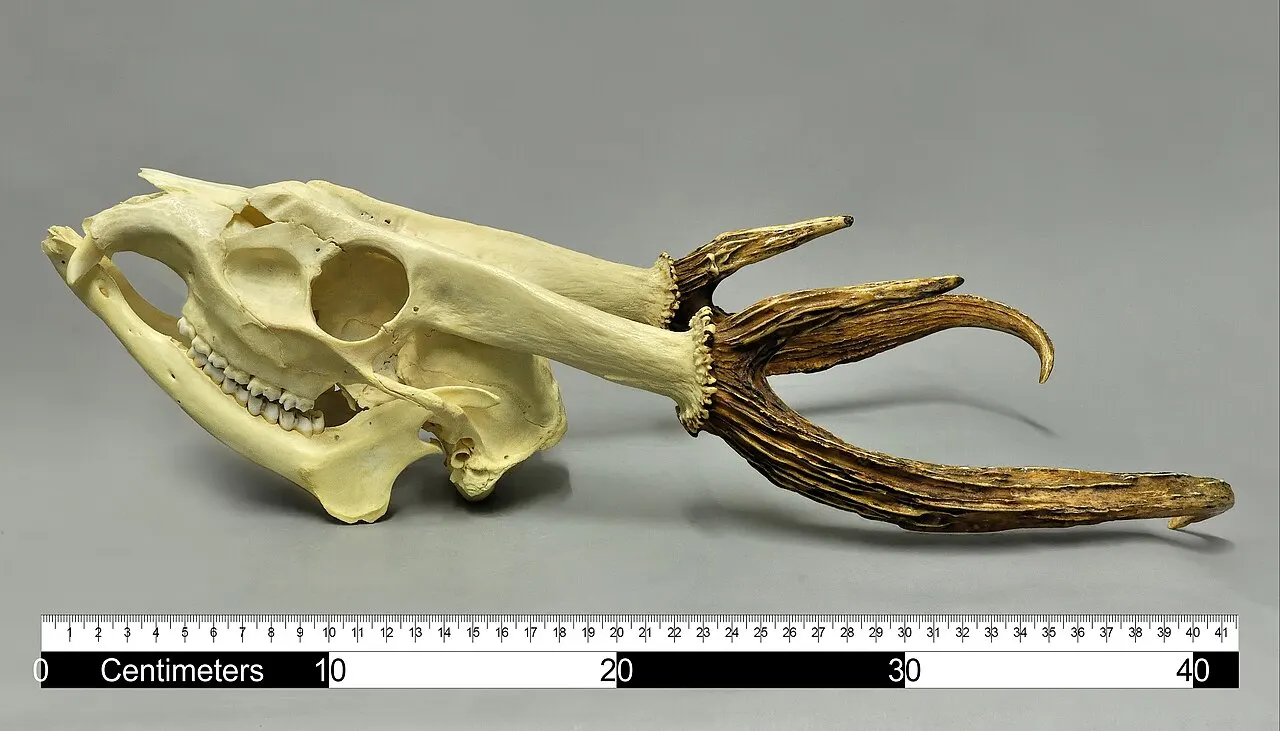
The giant muntjac (Muntiacus vuquangensis), also called the large-antlered muntjac, is the biggest of the muntjac deer. It lives in the forests of the Annamite Mountains of Vietnam, Laos and Cambodia. The IUCN Red List rated it Critically Endangered in 2016, mainly because of hunting and habitat loss.
How to recognise it
Muntjacs are small forest deer, and this is the largest of them, reportedly weighing roughly 30 to 50 kg. It is described as red-brown. Its closest relative is the common muntjac, Muntiacus muntjak.
Seeing one is rare. It is mostly nocturnal, shy and fairly solitary, which makes it hard to study. Most records come from trophy antlers held in villages rather than from sightings of live animals.
A deer found late
Science only caught up with it in the 1990s. In 1993 Rob Timmins and Tom Evans saw unusual antlers in a house near the Phou Xang He protected area in Laos. Timmins later saw a live female on the Nakai Plateau, and in 1994 a live animal turned up at Lak Sao Zoo in Laos.
Tuoc and colleagues formally described the species in 1994 from Vu Quang in Ha Tinh Province, Vietnam, placing it in its own genus, Megamuntiacus. Later authors moved it into Muntiacus.
Where it lives
The Red List says it is known only from the Annamite mountain chain and associated hill ranges of Laos and Vietnam and, marginally, eastern Cambodia. It uses moist evergreen forest from lowland to montane, and also heavily degraded former forest. It does not occur in the northern highlands or on the Mekong plain.
A camera-trap study in Virachey National Park, northeastern Cambodia, ran from February to July 2021. Sinovas and colleagues, writing in Endangered Species Research, recorded the deer at 6 camera stations in 2 of 7 survey areas, with estimated occupancy averaging 0.1 across all stations. Detections were more likely at higher elevations and in less remote areas. The study called the park a likely stronghold.
Pins are Wikidata “endemic to” fields. Orange dots, when present, are GBIF occurrence tiles — survey bias included.
Why it is in trouble
Hunting is the central problem. Cheap wire snares, often made from bicycle cable, kill animals without choosing, and hunters take anything with marketable meat or medicinal parts. In 2015, rangers in Cambodia's Southern Cardamom National Park alone found 27,714 snares. The Red List also names farming, including shifting agriculture, roads, housing and dams, with mining expected to add to the pressure. It records the species as used for food, medicine and handicrafts.
The assessment projects an ongoing and future population reduction of about 90 percent, with a generation taken as 7 years. No one has a firm population count, and the evidence is thin because few field records exist.
What is being done
The Red List says conservation sites have been identified across the whole range, and the species is listed in CITES Appendix I, so international trade controls apply. It calls for protecting habitat, managing harvest and trade, and raising awareness, along with research on population size and trends and on the species' ecology. Its single most important measure is effective management of Laos's Nakai-Nam Theun National Protected Area.
A Mongabay commentary by Joel Berger and Nguyen Thi Anh Minh sees in-place conservation as possible on Vietnam's Dalat Plateau and in Nakai-Nam Theun. The IUCN Deer Specialist Group has suggested captive breeding as insurance, though funding is uncertain.
When Laos flooded the Nakai reservoir for a hydropower project, 38 giant muntjac were reportedly captured and released into the neighbouring protected area, and radio-tracking of a sample suggested the move worked.
Sources
Written for this catalog in our own words from the sources below, checked against them on 12 November 2026. Population figures are estimates and carry the year they were made. Status and assessment year: IUCN. 2026. The IUCN Red List of Threatened Species. Version 2026-1. iucnredlist.org.




