Endangered
Giant Fijian long-horned beetle
Xixuthrus heros
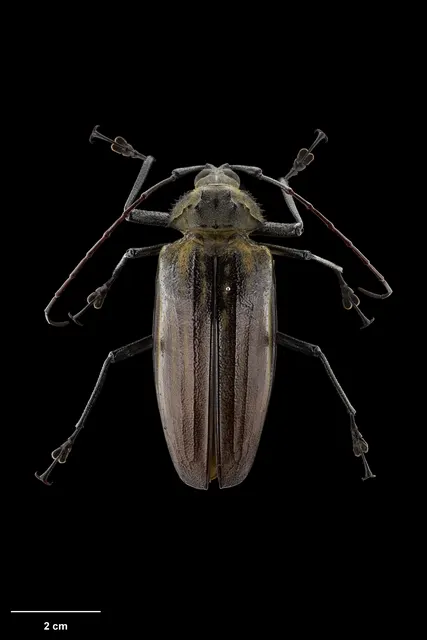
The giant Fijian long-horned beetle (Xixuthrus heros) is one of the largest insects alive, with a body about 15 cm long. It lives only on Viti Levu in Fiji, in lowland rainforest. The IUCN Red List rated it Endangered in 2021, with a decreasing population, because its forest and its giant host trees keep shrinking.
How to recognise it
This is a long-horned beetle (family Cerambycidae) of bulky, heavy build. Specimens reach roughly 15 cm in body length, not counting the legs, antennae or jaws, which puts it among the biggest insects on Earth. Its jaws are powerful enough that live beetles need careful handling.
When threatened it forces air out from under its wing covers and produces a loud hiss. Adults are mostly active at night. Its close relative, the Taveuni beetle, is reportedly only slightly smaller.
The species was described in 1868. In a 2004 revision in the journal Zootaxa, Yanega and colleagues reviewed the four Xixuthrus names used for Fiji and concluded that at least three species live there today, and that this one is not extinct.
Where it lives
It is found on one island, Viti Levu, mainly in lowland rainforest in the southeast. Colo-i-Suva Forest Reserve, near the capital Suva, is regarded as its stronghold. The IUCN counts Fiji as its only country and treats the whole range as a single location.
The assessment estimates the area the beetle actually occupies at about 40 square km, inside a wider range of roughly 1,455 square km. It has been recorded up to about 732 m above sea level.
Pins are Wikidata “endemic to” fields. Orange dots, when present, are GBIF occurrence tiles — survey bias included.
How it lives
The larvae grow inside rotting wood, and they seem to need big trees. Large trees of at least 80 cm across are the usual home, and trees that size are scarce in what is left of the forest. Larval galleries have been associated with the buabua tree (Fagraea gracilipes).
Adults fly long distances at night to find mates and suitable trees, and they are drawn to lights. Records from museum collections and observers suggest they turn up more often between May and September. How long the larval stage lasts and how many eggs a female lays are still unknown, so the full life cycle remains a gap.
Why it is in trouble
The IUCN lists small-holder plantations as the main habitat pressure, affecting over half the population. Shifting agriculture, small farms and housing add to it. Storms and flooding are rated as affecting the whole range, and cyclones can damage the forest that remains.
People also play a direct part. Some villages eat the larvae, which they find by splitting decaying logs, and the split wood is then burned as fuel. Adults that come to lights near buildings are often killed because of their size and their hissing. Introduced mammals such as the small Indian mongoose are reported to degrade the forest, and collection for international trade is reportedly a further pressure.
The area of habitat, the extent of the range and the population are all judged to be declining.
What is being done
Conservation sites have been identified across the whole range, and the beetle occurs in at least one protected area. There is no recovery plan, no systematic monitoring scheme, no captive population and no control of invasive species in place, according to the 2021 assessment.
The IUCN lists protection of remaining forest, habitat restoration and awareness work among the actions needed. A 2005 paper in the journal Oryx by Lal and colleagues carried the title Vulnerable, not extinct.
Sources
Written for this catalog in our own words from the sources below, checked against them on 12 November 2026. Population figures are estimates and carry the year they were made. Status and assessment year: IUCN. 2026. The IUCN Red List of Threatened Species. Version 2026-1. iucnredlist.org.




