Critically Endangered
Giant Bronze Gecko
Ailuronyx trachygaster
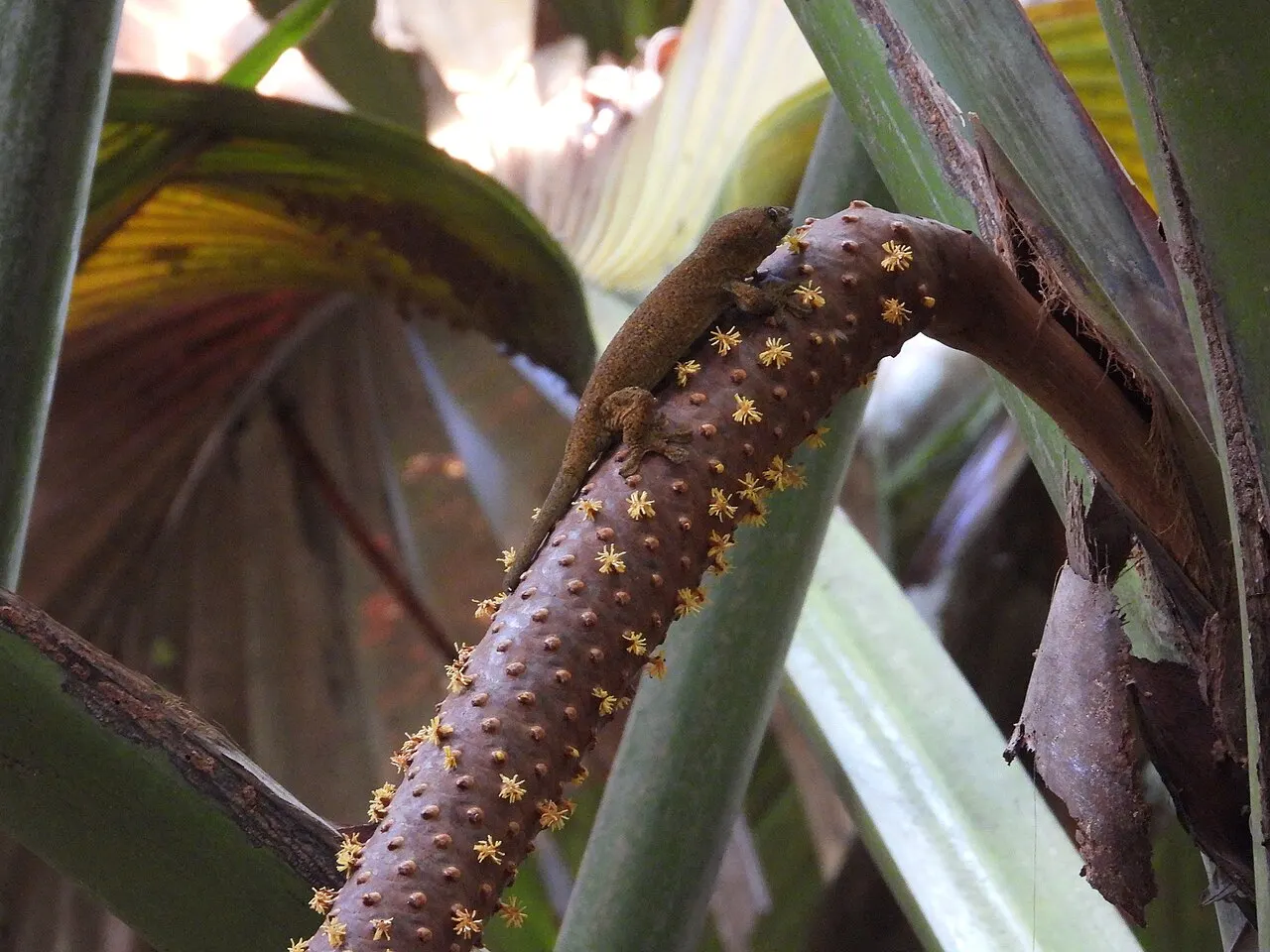
The giant bronze gecko (Ailuronyx trachygaster) is a very large and very rare gecko. It lives only in a small patch of palm forest on Praslin, in the Seychelles. The IUCN Red List rated it Critically Endangered in 2025, and poaching for the pet trade is a major worry.
How to recognise it
This is a big gecko. Adults measure roughly 150 to 172 mm from snout to vent (not counting the tail), A single recorded hatchling measured about 51 mm, and two eggs were about 20 mm across. It also goes by the name yellow gecko.
The scales along its back are low and conical, its head is long and deep, and it has large feet with broad toe pads for gripping. It is a member of the bronze gecko group, which holds three species in the Seychelles. This one is the oldest lineage of the three, having split from the other two around 10 million years ago, according to a 2017 genetic study.
Where it lives
The gecko is a Seychelles endemic. Its type specimen was wrongly labelled as coming from Madagascar, and the mistake was only corrected in 1990. Old records from Silhouette island are now thought to be errors, so it is treated as a Praslin species.
Within Praslin it follows mature palm forest dominated by the coco de mer, a huge endangered palm. The Red List gives its occupied area as about 8 square kilometres, at elevations between 30 and 350 m, and treats it as a single location. The Mohamed bin Zayed Species Conservation Fund says fewer than 10 square kilometres of this forest remain. The gecko lives high in the canopy, and is considered the main pollinator of the coco de mer.
Pins are Wikidata “endemic to” fields. Orange dots, when present, are GBIF occurrence tiles — survey bias included.
How it lives
It lays eggs. Beyond that, its biology is thinly studied. A conservation researcher working on Praslin, Markus Roesch, describes major gaps in what is known about its ecology, genetics and population status, and its exact distribution beyond the Vallee de Mai is unknown.
Why it is in trouble
A small range is the root problem. A 2016 count estimated about 1,848 geckos in the 19.5 hectare Vallee de Mai reserve, a number below the level usually seen as viable over the long term. A 2017 genetic study by Rocha and colleagues found low genetic diversity and a small effective population size, which can reduce fitness and make a species less able to adapt.
On top of that, a recent surge in collecting for the international pet trade is widely thought to have driven a significant decline. The Red List also names invasive species, habitat shifting and temperature extremes as ongoing threats, and drought, higher fire risk and tourism development as future ones. It records the population as decreasing.
What is being done
The gecko occurs in at least one protected area, and the Red List records invasive species control or prevention as in place. As of 2024 there was no species action plan and no steady monitoring programme. A small grant awarded in March 2024 to Markus Roesch of the University of Porto aimed to produce the first island-wide population estimate, train local staff to monitor the gecko, and feed into a species action plan.
The same project aimed to supply Seychelles with the evidence needed to seek a CITES listing, which would regulate international trade in poached animals.
Sources
Written for this catalog in our own words from the sources below, checked against them on 12 November 2026. Population figures are estimates and carry the year they were made. Status and assessment year: IUCN. 2026. The IUCN Red List of Threatened Species. Version 2026-1. iucnredlist.org.




