Endangered
Ghatixalus variabilis
Ghatixalus variabilis
Ghatixalus variabilis is a frog of the high mountain forests of southern India's Western Ghats. Despite its common name, green tree frog, it lives mostly on the ground beside streams. The IUCN lists it in Tamil Nadu and Kerala and rated it Endangered in 2023.
How to recognise it
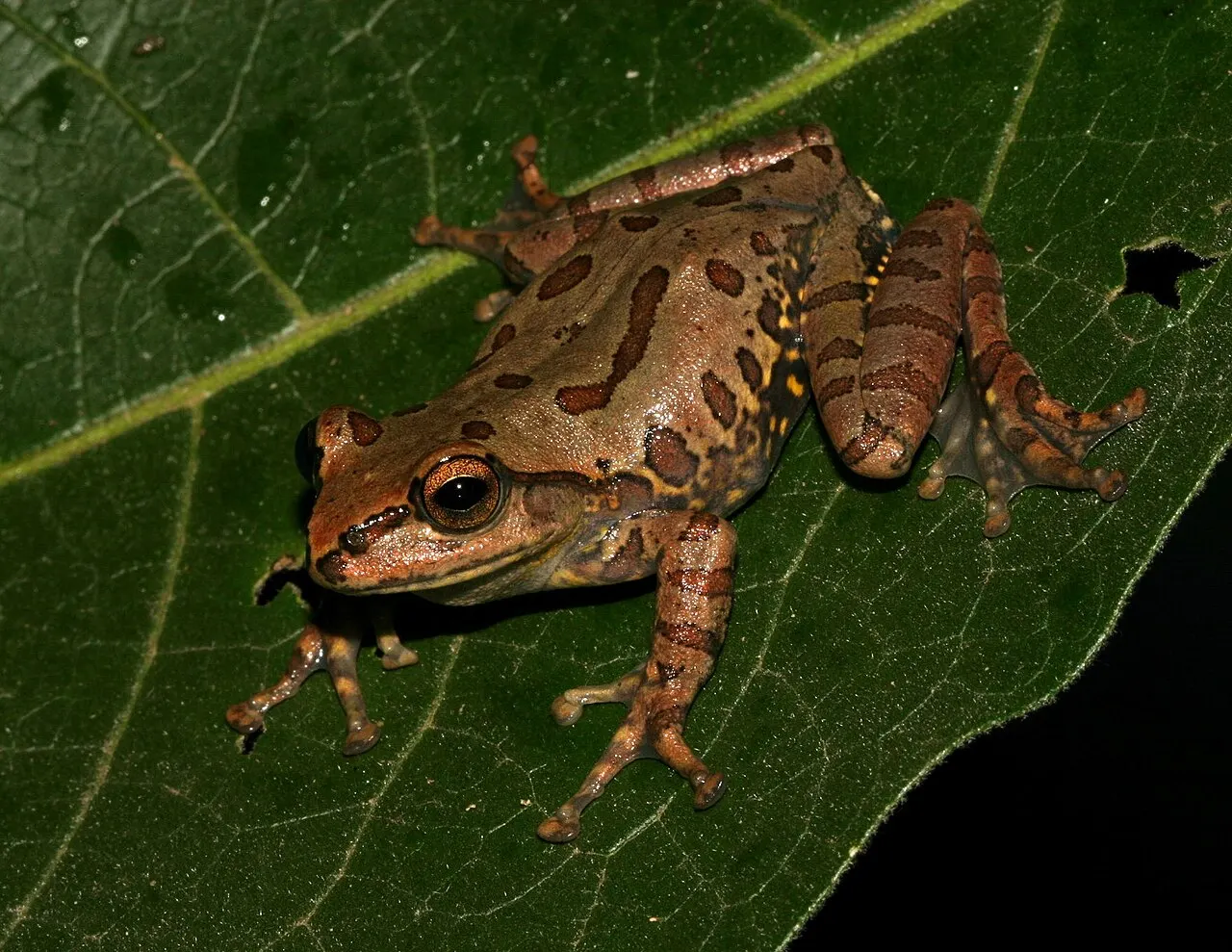
Males reach a snout to vent length of 41 to 51 mm, and females grow larger, to about 67 mm. Males carry nuptial spines. The colour varies, even within a single site, but adults usually show prominent dark brown blotches on the back. Tadpoles and froglets have no pattern.
Where it lives
The species is endemic to the Western Ghats. Thomas Jerdon described it in 1853 as Polypedates variabilis (some sources give 1854), and in 2008 it became the type species of its own genus, Ghatixalus, which reportedly holds three species.
The IUCN lists Tamil Nadu and Kerala and gives a range of 925 to 2,630 m above sea level, with 6 to 10 locations within an extent of about 3,504 square kilometres. Some other accounts name only the Nilgiri Hills of Tamil Nadu. It occurs in montane evergreen forest, along permanent streams and in marshy pools, and also in plantations. Between 41 and 50 percent of the population is estimated to fall inside protected areas.
Pins are Wikidata “endemic to” fields. Orange dots, when present, are GBIF occurrence tiles — survey bias included.
How it lives
It stays very close to mountain streams, on the ground or low in vegetation, and when disturbed it escapes into the water. Females make spherical foam nests that hang up to 3 m above water. The tadpoles hatch inside the foam and drop into the stream after a few days. They have large oral suckers that let them hold on in rocky current.
Why it is in trouble
The IUCN reports a decreasing population, a continuing decline in habitat area and a severely fragmented range. The pressures it lists are farming and plantation agriculture, housing, garbage, habitat shifting and recreation, all ongoing. Patches of forest are separated by farmland, which stops frogs moving between them. Invasive trees such as eucalyptus, acacia and pine are also reportedly spreading at the expense of the native shola forest.
What is being done
The IUCN lists site protection, awareness work, and policy and regulation as the actions needed. Part of the range lies in protected areas, but the fragments outside them remain exposed.
Sources
Written for this catalog in our own words from the sources below, checked against them on 12 November 2026. Population figures are estimates and carry the year they were made. Status and assessment year: IUCN. 2026. The IUCN Red List of Threatened Species. Version 2026-1. iucnredlist.org.




