Critically Endangered
Geomitra coronula
Geomitra coronula
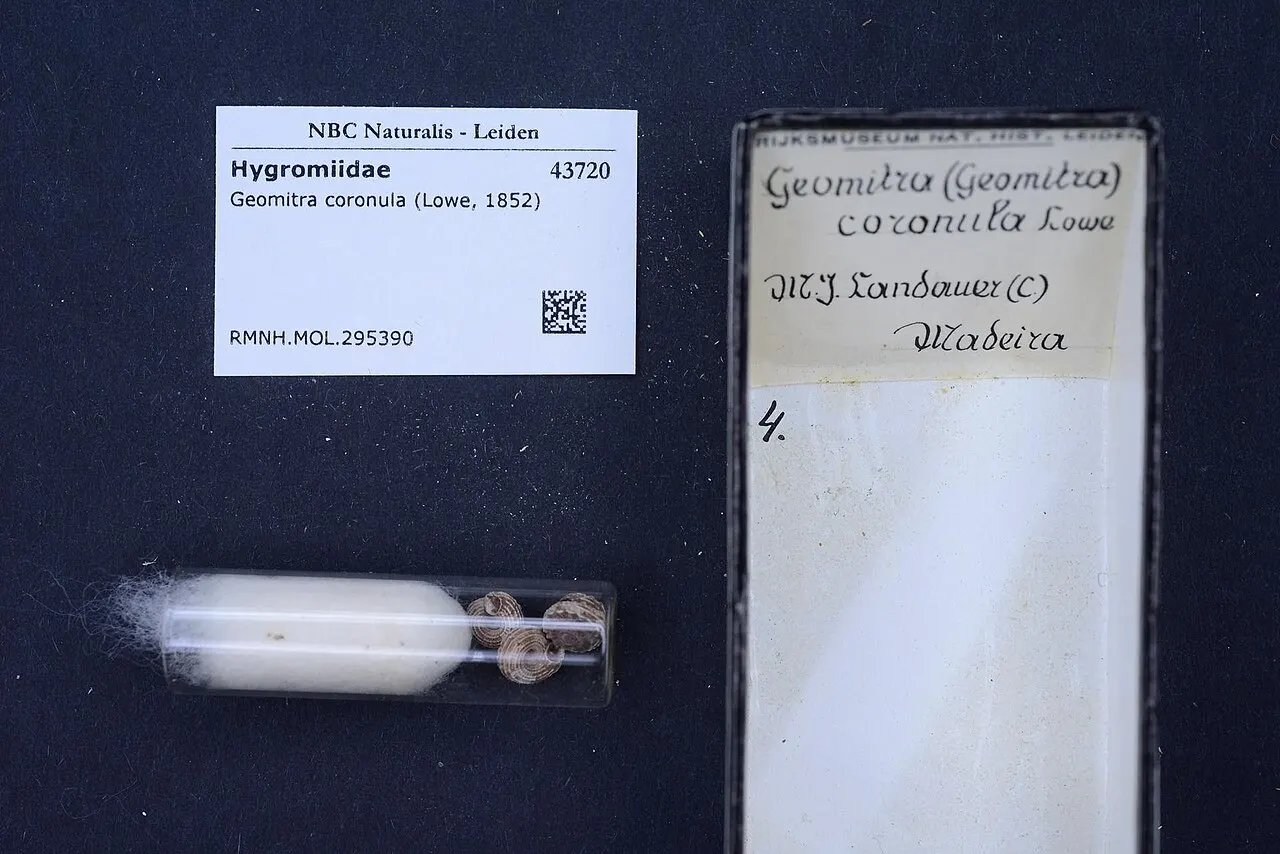
Geomitra coronula is a tiny white land snail from the Desertas Islands of Madeira, Portugal. Its shell is only about 5 to 6 mm across. The IUCN Red List assessed it as Critically Endangered in 2025, with a population estimated at 45 to 50 individuals, and captive breeding and reintroduction are now under way.
How to recognise it
The shell is conical and white, with five whorls. It measures roughly 5 to 6 mm wide and 3.5 to 4.5 mm high, small enough for several to sit on a fingernail.
The English naturalist Richard Thomas Lowe described it in 1852 as Helix coronula, working from fossil deposits in the southern part of Bugio island. The species has since been moved between genera, and older papers may call it Craspedaria coronula.
Where it lives
Living snails survive on Deserta Grande, one of the Desertas, a small island group in the Madeira archipelago. Bugio, another of the Desertas, has so far yielded only subfossil shells, though reintroduction is changing that.
The IUCN assessment counts a single location, between about 150 and 275 m above sea level. Its habitat is temperate grassland and rocky ground. Close to all of the population (91 to 100 per cent) lies inside a protected area.
Pins are Wikidata “endemic to” fields. Orange dots, when present, are GBIF occurrence tiles — survey bias included.
Why it is in trouble
No living snail was recorded for more than a century before experts from Madeira's nature agency found the species again on Deserta Grande, in 2013 by one account and 2017 by another. At the time, 21 animals found under a single rock were believed to be all that remained.
Introduced goats spread across the islands, destroying native vegetation and speeding up soil erosion, and mice eat the snails directly. The 2025 assessment lists drought, landslides and shifting habitat as further pressures, and records the population as still declining.
What is being done
Madeira's Institute of Forests and Nature Conservation, with conservationist Dinarte Teixeira leading the rescue, worked with Chester Zoo in England and ZooParc de Beauval in France. Sixty snails of two Desertas species were flown to Chester, where the zoo bred them in human care for the first time. Stock was later shared with Bristol and Beauval.
Bugio was chosen for release because goats and rats have been removed there and fossils show the snails once lived on it. A first release in November 2024 put more than 1,300 captive-bred snails on the island, each marked so they could be tracked. Releases were made at night to avoid disturbing the endangered Desertas petrels. In April 2026 a further 300 G. coronula went out across three sites on Bugio.
Early results are encouraging but not settled. One project report gave 67 per cent survival for the first G. coronula releases by December 2025, while a zoo summary put early survival at 40 to 50 per cent. Breeding in the wild and young snails have been observed. The assessment also records a monitoring scheme and invasive species control.
Sources
Written for this catalog in our own words from the sources below, checked against them on 12 November 2026. Population figures are estimates and carry the year they were made. Status and assessment year: IUCN. 2026. The IUCN Red List of Threatened Species. Version 2026-1. iucnredlist.org.
- IUCN Red List assessment, Geomitra coronula (2025)
- Wikipedia, Geomitra coronula
- Chester Zoo, rescuing the Desertas Island land snail
- Mossy Earth, Snail Species Rescue
- ZooParc de Beauval, endangered snails reintroduced to the Desertas
- The Cool Down, endangered land snails Madeira
- Recently Extinct Species, Geomitra coronula




