Endangered
Geobatrachus walkeri
Geobatrachus walkeri
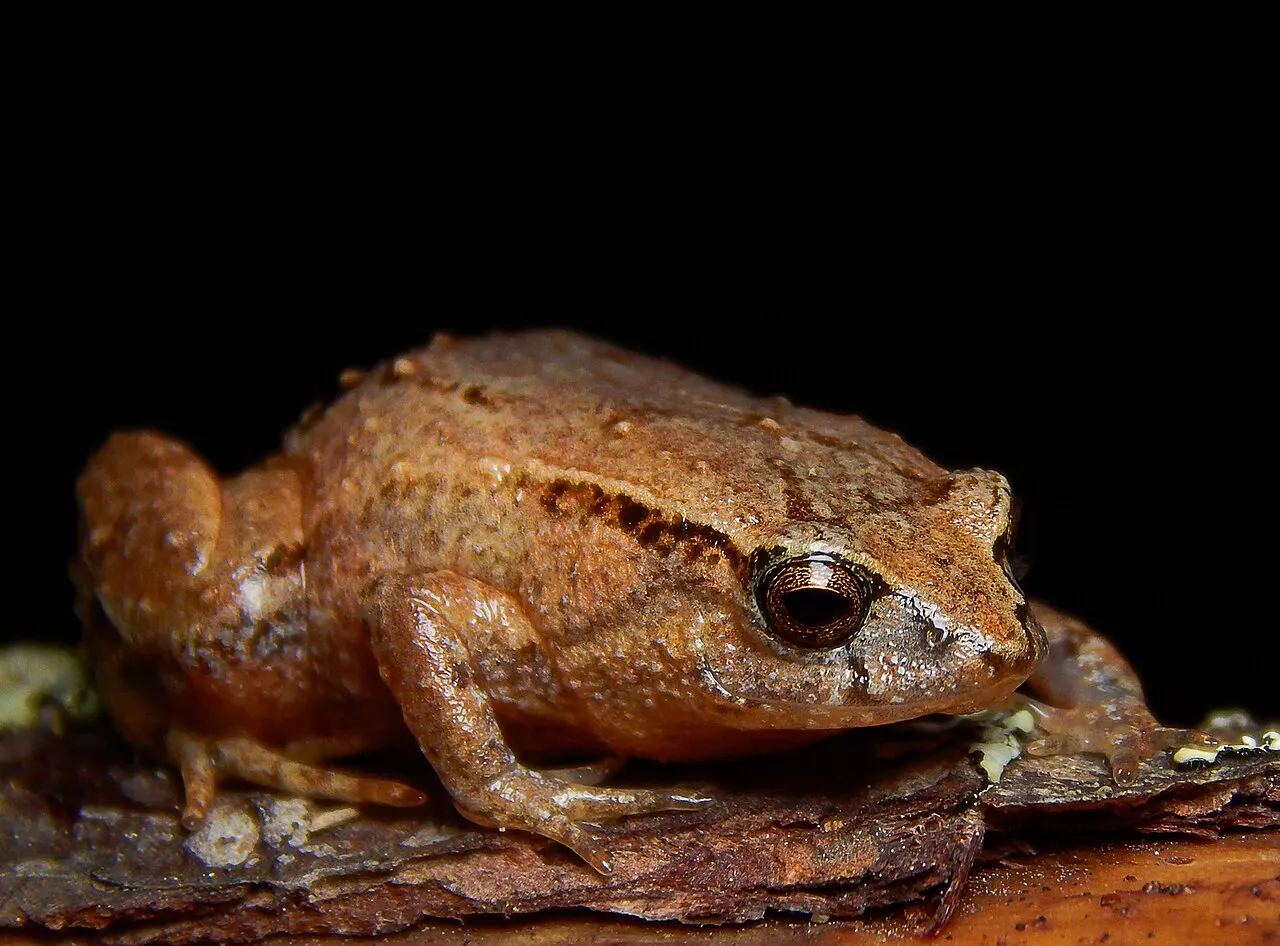
Walker's Sierra frog (Geobatrachus walkeri) is a tiny frog from the Sierra Nevada de Santa Marta in northern Colombia, the only species in its genus. It lives in mountain forest and leaf litter, and the IUCN assessed it as Endangered in 2017, with farming and grazing the listed threat.
How to recognise it
This is a very small leaf-litter frog. A 2014 study found that both males and females reach maturity at about 18 mm from snout to vent, so adults are tiny. Its place on the frog family tree is uncertain: it has been put in Craugastoridae, Brachycephalidae and Strabomantidae. It is the only member of the genus Geobatrachus, which Ruthven described in 1915.
Where it lives
It is endemic to the Sierra Nevada de Santa Marta, an isolated mountain range on Colombia's Caribbean coast. The IUCN gives an elevation range of 1,400 to 3,900 m and counts 2 to 9 locations. Habitats listed include moist montane forest, high-altitude shrubland and grassland, and plantations.
The 2014 field study took place at San Lorenzo, on the north-western side of the range, at 2,300 to 2,500 m. That site gets about 2,600 mm of rain a year, with a dry season from December to March. The frog has also been recorded at about 3,500 m in high-altitude paramo.
Pins are Wikidata “endemic to” fields. Orange dots, when present, are GBIF occurrence tiles — survey bias included.
How it lives
In that study, frogs were found mostly in the leaf litter of a pine plantation: of 157 frogs recorded in 2010 and 2011, only four came from secondary native forest. They were active by day and by night, and researchers heard choruses of six to ten calling males in every month sampled. An earlier survey found a clutch of 23 eggs in pine litter.
Breeding looks continuous: adults were reproductively active in all sampling months, and young frogs entered the population several times a year. The dry season does slow things down. Frogs of all ages were far less abundant as the dry months advanced, and sperm production in males dropped late in the dry season.
Why it is in trouble
The IUCN lists agro-industry, grazing, ranching and farming as the threat to this frog's habitat. Even so, the 2017 assessment records the population trend as stable and describes the population as not severely fragmented, and the fact that frogs live in pine plantation litter shows some tolerance of altered habitat.
Its listing as Endangered comes from a small range and decline in habitat quality, under criterion B1ab(iii).
What is being done
The assessment lists site and area management, and resource and habitat protection, as conservation actions. No dedicated programme for the frog has been described.
Sources
Written for this catalog in our own words from the sources below, checked against them on 12 November 2026. Population figures are estimates and carry the year they were made. Status and assessment year: IUCN. 2026. The IUCN Red List of Threatened Species. Version 2026-1. iucnredlist.org.




