Endangered
Genoways's yellow bat
Rhogeessa genowaysi
Genoways's yellow bat (Rhogeessa genowaysi) is a tiny, yellow-furred vesper bat found only in the Pacific lowlands of southern Chiapas, Mexico. The IUCN Red List classed it as Endangered in 2016 because its range is small, broken up and shrinking. It looks almost identical to a close relative, so scientists tell them apart by chromosomes.
How to recognise it
This is a very small bat. Adults weigh about 5 grams and have a forearm 27.8 to 30.5 millimetres long, with yellowish fur, small rounded ears and a hairless membrane between the hind legs. Females are larger than males.
It is hard to identify in the hand. It is a cryptic species, nearly identical to the black-winged little yellow bat (Rhogeessa tumida), which lives in the same area. When Robert J. Baker described it in 1984, he reported that it would not have been recognised as distinct without karyotypes, the chromosome sets of the animals.
Ears are reportedly a little shorter, about 11 millimetres against nearly 13 in the black-winged little yellow bat. Genoways's yellow bat has 42 chromosomes, a count reportedly not shared by those relatives.
Where it lives
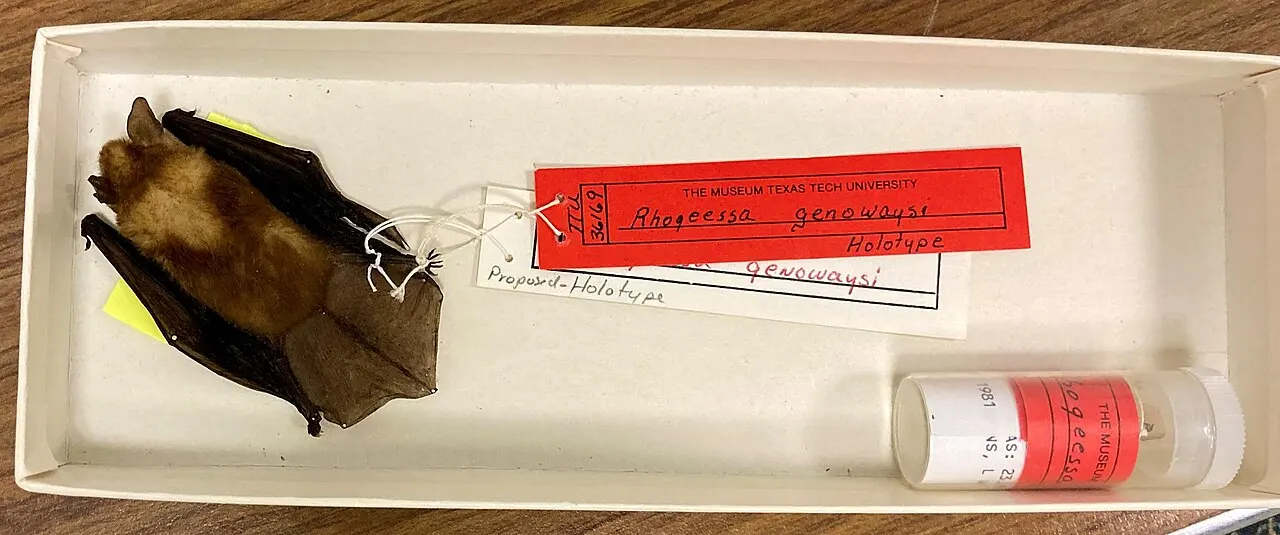
The species is known only from Mexico, in the Pacific lowlands of southern Chiapas. The original specimen, collected in 1981, came from Mexican Highway 200, about 38 kilometres by road northwest of Huixtla. The holotype is held at the Museum of Texas Tech University.
It has been caught beneath the canopy of mature and regrowing tropical forest at 20 to 50 metres above sea level. The Red List counts its habitat as lowland moist and dry subtropical or tropical forest, estimates its extent of occurrence at only 919 square kilometres, and treats the bat as occupying a single location. The global biodiversity database GBIF holds just 23 occurrence records, and all 18 that name a country are from Mexico.
Pins are Wikidata “endemic to” fields. Orange dots, when present, are GBIF occurrence tiles — survey bias included.
How it lives
Little has been published about its daily life. It is an aerial insectivore, meaning it catches flying insects on the wing. No published account describes its diet, roosts, breeding or lifespan.
Why it is in trouble
The Red List rates the population as decreasing and severely fragmented, with a continuing decline in the area it occupies. Habitat loss to agriculture is the main threat reported. Storms and flooding are also listed as an ongoing threat to a species with so small a range.
Its status has worsened over time. It was Near Threatened in 1996, Vulnerable in 2000, and Endangered in both 2008 and 2016. It is reportedly also listed by the Alliance for Zero Extinction among species in danger of imminent extinction.
What is being done
The Red List records that the bat occurs in at least one protected area, and site protection is the conservation action listed for it. No captive population or species-specific recovery programme appears in the assessment.
Sources
Written for this catalog in our own words from the sources below, checked against them on 12 November 2026. Population figures are estimates and carry the year they were made. Status and assessment year: IUCN. 2026. The IUCN Red List of Threatened Species. Version 2026-1. iucnredlist.org.
- IUCN Red List API, assessment 21989676 (Rhogeessa genowaysi, 2016)
- IUCN Red List API, taxon record (assessment history)
- Genoways's yellow bat (reference article)
- Baker 1984, A sympatric cryptic species of mammal, Systematic Zoology 33(2) (abstract)
- Mammal Diversity Database, Rhogeessa genowaysi
- GBIF occurrence API, Rhogeessa genowaysi




