Endangered
Gabela Helmetshrike
Prionops gabela
The Gabela helmetshrike (Prionops gabela) is a dark, red-eyed woodland bird found only in western Angola, on and below the escarpment near Gabela. The IUCN Red List assessed it as Endangered in 2025, putting the population at roughly 1,000 to 4,500 mature individuals and still declining.
How to recognise it
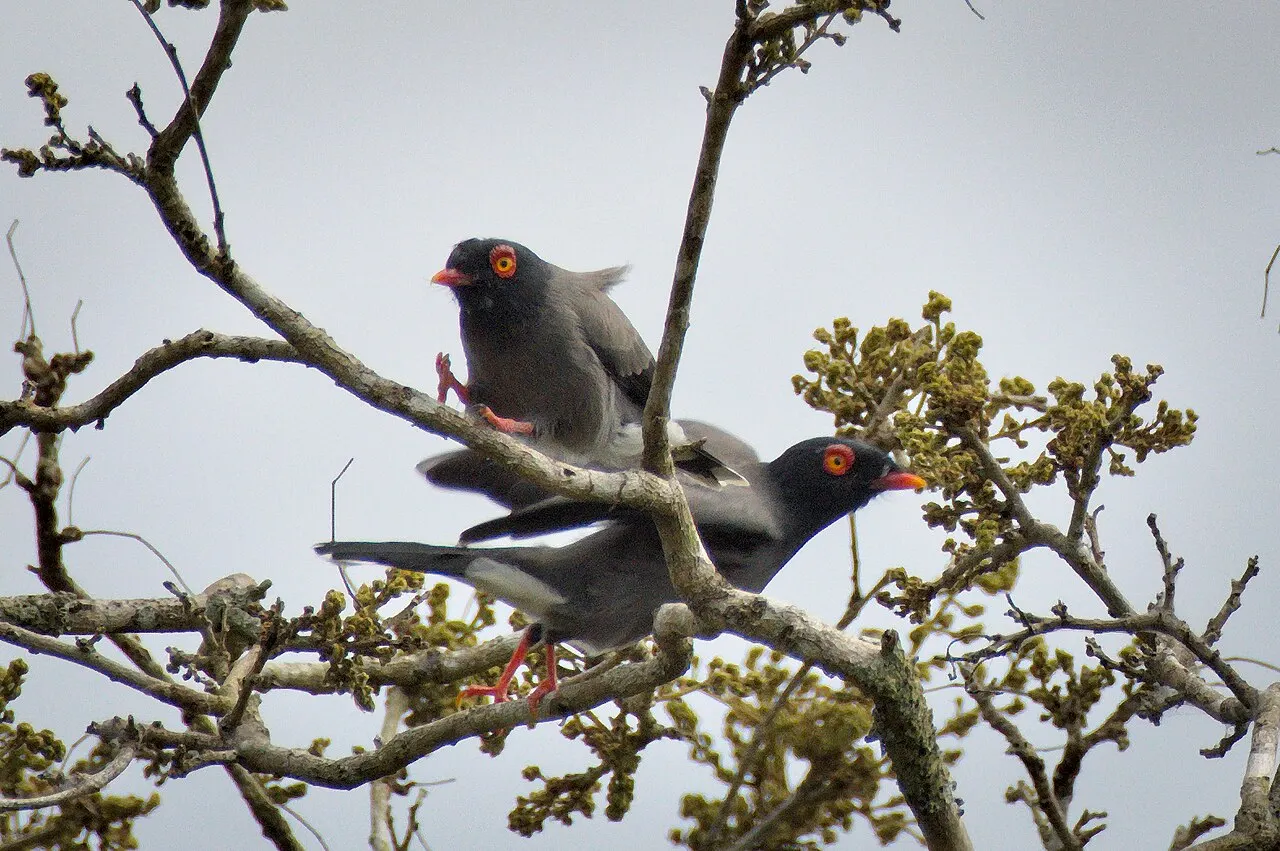
It is a bird about 19 cm long, dark overall with a slate-grey body, white tips on the tail and a paler belly and vent. The eyes, the wattles around them and the bill are red. Its calls are churring and clicking notes, similar to those of Retz's helmetshrike. Birds have been seen in groups, and one 2003 survey found a flock of eight.
Where it lives
The species occurs only in Angola, in the escarpment zone of Cuanza Sul province. The IUCN gives its elevation as 100 to 900 m and its extent of occurrence as 19,300 to 80,000 square kilometres, treating all birds as a single subpopulation. It does not migrate. The assessment lists lowland moist forest, dry forest, dry shrubland and plantations as habitat.
The 2003 team did not find it inside the scarp forest at Kumbira. They saw it in open woodland about 10 km beyond Kumbira, on the road to the foot of the escarpment, and noted that this kind of habitat is widespread, especially at low elevations. It has also been photographed near Conda and in Kissama National Park.
Pins are Wikidata “endemic to” fields. Orange dots, when present, are GBIF occurrence tiles — survey bias included.
Unseen for about three decades
Austin Rand described the species in 1957. Its last records for a long time date from the mid 1970s, and it was rediscovered in 2003. A team that included Peter Ryan made the first significant ornithological visits to the Gabela area since 1974 that year, and found the helmetshrike among the threatened birds. Reports of landmines kept them from reaching sites further south.
Why it is in trouble
The IUCN names small-holder farming and wood harvesting at subsistence scale as the pressures, affecting more than half of the population and causing slow but significant declines. The area it occupies and its number of locations are both shrinking. A 2003 survey in Bird Conservation International heard that forest at Kumbira had shrunk considerably over 40 years, mostly through wood-cutting soon after independence, and that one large forest patch nearby had vanished. Wood-cutters were at work in small forest remnants, and in other parts of Angola the survey found woodland stripped for firewood, timber and charcoal.
The Endangered rating rests on criterion C2a(ii): a small population with all birds in one subpopulation, and a continuing decline.
What is being done
Conservation sites have been identified across its whole range, and it occurs in at least one protected area. The 2025 assessment records no recovery plan, monitoring scheme, captive breeding or awareness programme. It suggests promoting ecotourism as a supplement to farming, surveys of the bird's distribution and numbers, and a conservation strategy for the escarpment. The 2003 survey's priority was to map the forest that remains, then plan protection of the key habitat blocks.
Sources
Written for this catalog in our own words from the sources below, checked against them on 12 November 2026. Population figures are estimates and carry the year they were made. Status and assessment year: IUCN. 2026. The IUCN Red List of Threatened Species. Version 2026-1. iucnredlist.org.
- IUCN Red List assessment, Prionops gabela (2025)
- Ryan et al. 2004, Bird Conservation International 14: 247-260
- Gabela helmetshrike (encyclopedia entry)
- African Bird Club, Gabela Helmet-shrike photo entry
- Recently Extinct Species database, Prionops gabela
- Birds of the World, Gabela Helmetshrike (public part)




