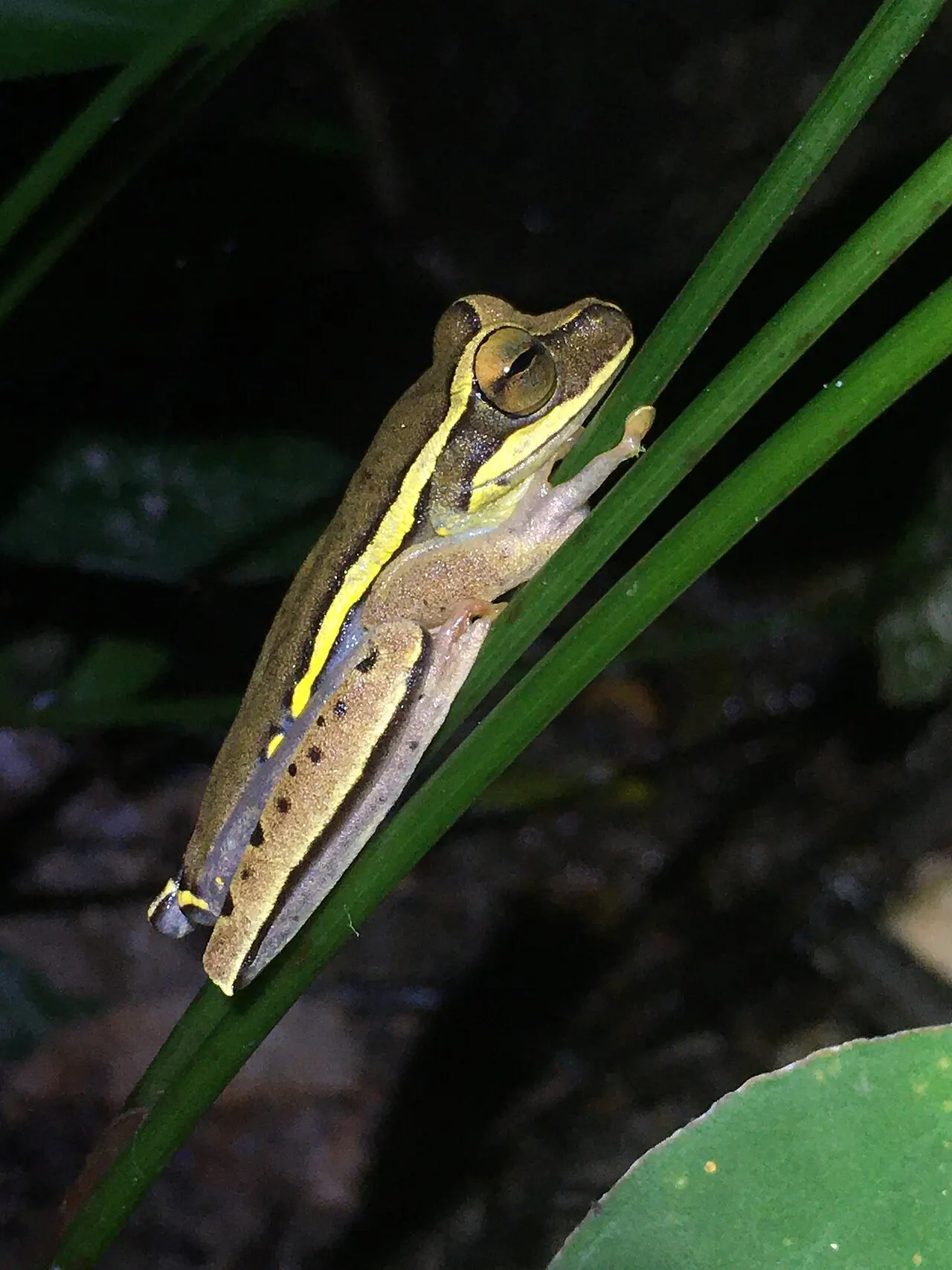
Endangered
Frei Caneca tree frog
Hypsiboas freicanecae
The Frei Caneca tree frog (Boana freicanecae) is a medium-sized tree frog of streams in Atlantic Forest in northeastern Brazil, known from Pernambuco and Alagoas. The IUCN Red List assessed it as Endangered in 2023, with an extent of occurrence of only about 2,220 square kilometres.
What it is
It's a tree frog in the family Hylidae and belongs to the Boana pulchella group. Males measure about 37 to 42 mm from snout to vent. Carnaval and Peixoto described it in 2004 as Hyla freicanecae. It was later placed in Hypsiboas and is now Boana, which is why older sources use different names.
Little has been published about its natural history. A 2020 paper in Zootaxa by Marinho and colleagues described the advertisement call from two populations and noted that much of the frog's biology is poorly known.
Where it lives
The species is endemic to Brazil. It was first known only from its type locality at Serra do Quengo, in the municipality of Jaqueira in Pernambuco. Later records came from Lagoa dos Gatos in Pernambuco and from Murici in neighbouring Alagoas, where it has been photographed at the Murici Ecological Station.
It lives in Atlantic montane and moist lowland forest and is tied to streams. The IUCN gives an elevation range of roughly 250 to 700 m, while the Zootaxa paper gives 450 to 750 m.
Pins are Wikidata “endemic to” fields. Orange dots, when present, are GBIF occurrence tiles — survey bias included.
Why it is in trouble
The assessment describes a decreasing population in severely fragmented habitat, with continuing decline in the area and quality of forest. The pressures it lists are housing and urban expansion, small-holder farming and grazing, and small and large-scale harvest effects that are not detailed.
Brazil's national assessment rated the frog Data Deficient in 2018, so the global and national verdicts differ, and the data behind both are limited.
What is being done
The species occurs in at least one protected area. Site and area protection, resource and habitat protection and site management are the actions listed. The assessment does not record a frog-specific recovery plan. Further surveys along streams in the remaining forest would help show how many populations survive.
Sources
Written for this catalog in our own words from the sources below, checked against them on 12 November 2026. Population figures are estimates and carry the year they were made. Status and assessment year: IUCN. 2026. The IUCN Red List of Threatened Species. Version 2026-1. iucnredlist.org.




