Endangered
Fernwren
Oreoscopus gutturalis
The fernwren (Oreoscopus gutturalis) is a small rainforest bird found only in the mountains and gullies of northeastern Queensland, Australia. The IUCN Red List moved it from Least Concern to Endangered in 2022, citing a rapid population decline linked to climate-driven habitat shifting.
How to recognise it
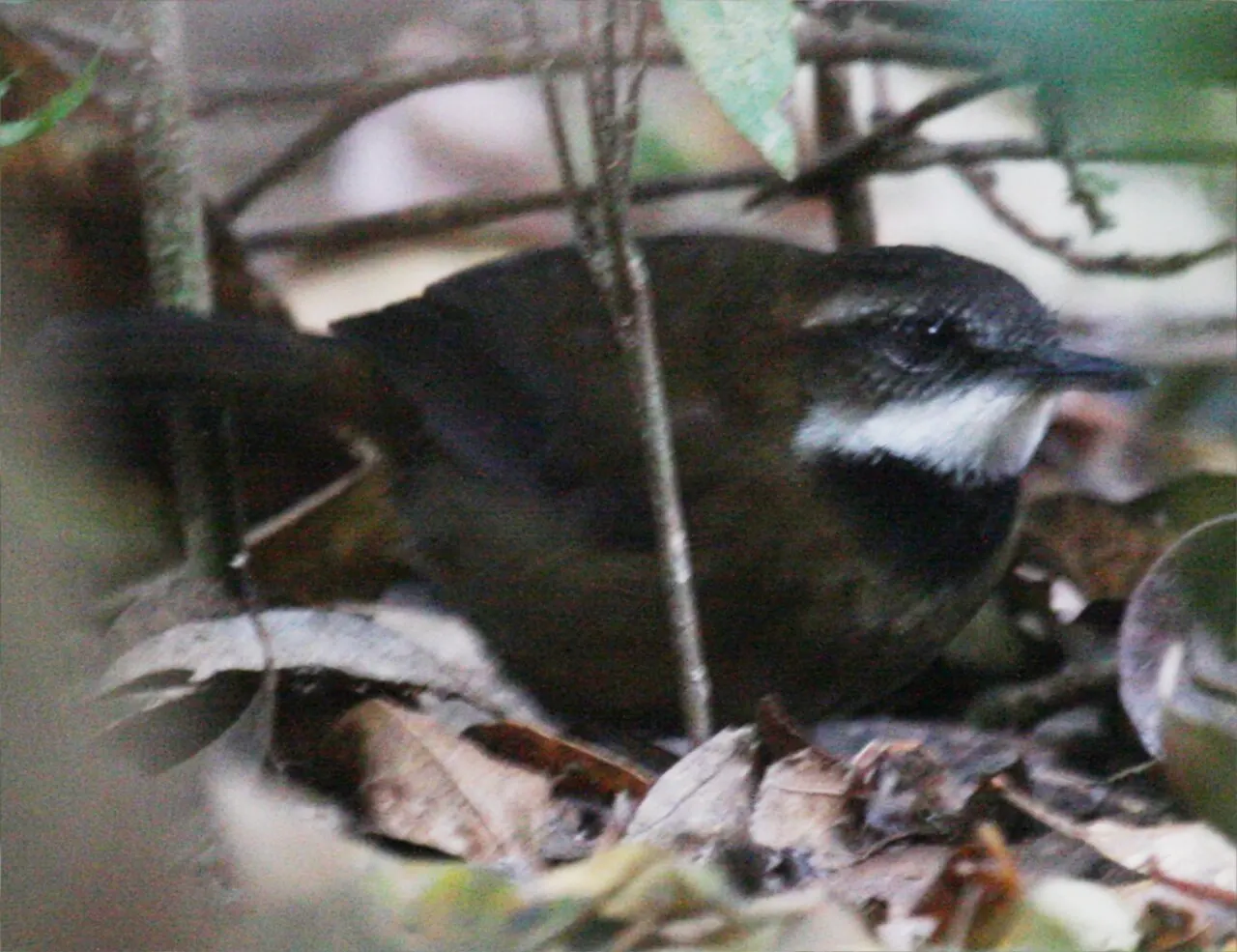
The fernwren is a small, plain bird, 12 to 14 cm long, with dark olive-brown upperparts and paler underparts. The face is dark brown, set off by a white eyebrow and white throat, with a black bib below. The bill is long and slender. Males and females look much alike, while young birds are dark brown and lack the white facial markings.
Its calls include high squeaks and whistles, a softer chattering run and a buzzing, scolding note.
Where it lives
It is found nowhere outside Australia, and within Australia only in the rainforests of northeastern Queensland, from the Paluma Range near Townsville and Tully Gorge National Park north to Cape Tribulation. It doesn't migrate.
The species lives between about 300 and 1,500 m, though it is more often found above 650 m, especially in shady upland gullies. The IUCN counts lowland forest as its main habitat, with montane forest also used, and records three or four subpopulations.
Pins are Wikidata “endemic to” fields. Orange dots, when present, are GBIF occurrence tiles — survey bias included.
How it lives
The fernwren forages in damp leaf litter among ferns and dense undergrowth, often bowing its head and flicking its short tail as it searches. It eats arthropods and small skinks.
Breeding runs from July to January, mostly in October and November. Both parents build a domed nest of twigs, rootlets, moss and lichen, often under an overhanging bank, a fallen log or in a small cave among ferns. The female lays two glossy white eggs and incubates for about 29 days. Both parents then feed the nestlings for 21 to 23 days.
Why it is in trouble
The fernwren was rated Least Concern in every IUCN assessment from 2004 to 2016. The 2022 assessment moved it to Endangered under criteria for past and future population decline (A2bc+3c+4bc). It lists one threat, habitat shifting and alteration, which affects more than 90 percent of the population and is scored as high impact, with rapid declines. The assessment records a past reduction of 50 to 60 percent.
The population is still sizeable, estimated at 450,000 to 1,000,000 birds with a central figure of 660,000, but it is decreasing, and habitat area is continuing to shrink. Regional monitoring points the same way. A 2021 preprint by Stephen Williams and Alejandro de la Fuente of James Cook University followed 42 Wet Tropics rainforest bird species from 2000 to 2016 and found local abundance down about 12 percent overall, and about 44 percent among 13 upland specialists.
What is being done
The fernwren occurs in at least one protected area, and conservation sites have been identified across its whole range. The IUCN calls for strategies to maintain the remaining populations and for adaptation measures where needed. Research priorities are to understand what limits its numbers and survival, why it is sensitive to climate change, and how that could be countered, and to keep monitoring population size. At the time of the assessment there was no recovery plan or systematic monitoring scheme.
Sources
Written for this catalog in our own words from the sources below, checked against them on 12 November 2026. Population figures are estimates and carry the year they were made. Status and assessment year: IUCN. 2026. The IUCN Red List of Threatened Species. Version 2026-1. iucnredlist.org.




