Endangered
Minervarya greenii
Fejervarya greenii
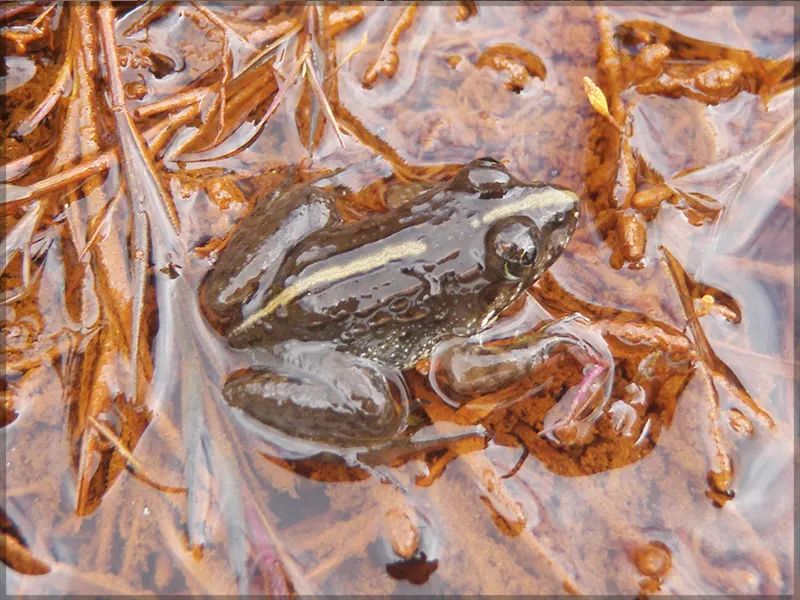
Fejervarya greenii, now called Minervarya greenii, is a small frog of the central hills of Sri Lanka, known as the montane frog or Sri Lanka paddy field frog. It lives in pools, marshes and streams in montane moist forest and is rated Endangered (2020 assessment).
A frog with a changing name
The frog was first described in 1905 by George Albert Boulenger as Rana greenii. Since then it has been placed in other genera and has been called Fejervarya greenii and Zakerana greenii. The accepted name today is Minervarya greenii. All of these names refer to the same animal, so older literature and some databases use a different one from the Red List.
Where it lives
It is endemic to Sri Lanka, in the central hills. The Red List records it at elevations of about 1,200 to 2,135 m, from 2 to 5 locations, with an extent of occurrence of about 1,267 square kilometres. At least some of its range is protected, and Horton Plains National Park is a site where it has been studied in the field.
Its habitats include small permanent freshwater pools, bogs, marshes and swamps, montane moist forest, and streams and waterfalls.
Pins are Wikidata “endemic to” fields. Orange dots, when present, are GBIF occurrence tiles — survey bias included.
How it lives
A study at five still-water bodies in Horton Plains National Park, with fieldwork over 2016, tracked the frogs through the day. Individuals tended to rest in the early morning, were moderately active from 09:00 to noon, and were mostly inactive from noon to 15:00, which the researchers linked to avoiding the hottest hours. They were most active in the evening, between 18:00 and 20:00.
Every behaviour was recorded on submerged plant cover, and calling and courtship happened only there. Swimming was confined to open water, and gravel and rocks were not used. Calling and courtship were seen in every month, which suggests the frog breeds throughout the year. That ties it closely to ponds with plenty of aquatic vegetation.
Why it is in trouble
The assessment lists a long run of ongoing pressures. They include droughts, farming (both small-holder and agro-industry), more frequent and intense fires, recreation, habitat shifting and alteration, acid rain, rubbish, pesticides and herbicides, and unintended effects of small-scale harvest. The area it occupies is shrinking and the population is decreasing.
Predation by introduced rainbow trout is reportedly an additional threat.
What is being done
The frog occurs in at least one protected area. Recorded conservation actions are site and area protection, site management and resource and habitat protection.
Sources
Written for this catalog in our own words from the sources below, checked against them on 12 November 2026. Population figures are estimates and carry the year they were made. Status and assessment year: IUCN. 2026. The IUCN Red List of Threatened Species. Version 2026-1. iucnredlist.org.
- IUCN Red List assessment
- Minervarya greenii, encyclopedia article
- GBIF species record (Fejervarya greenii, synonym)
- Prabhath, Jayasekara and Mahaulpatha, poster on diurnal behaviour and substrate use of the frog in Horton Plains National Park (fieldwork 2016; Uva Wellassa University symposium proceedings, 2018)




