Endangered
Chinese fanray
Platyrhina sinensis
The Chinese fanray (Platyrhina sinensis) is a flat, fan-shaped ray that lives on shallow sandy and muddy seabeds off China and Viet Nam. The IUCN Red List rated it Endangered in 2021. It is caught mostly by accident in trawls and nets, and its numbers are falling.
How to recognise it
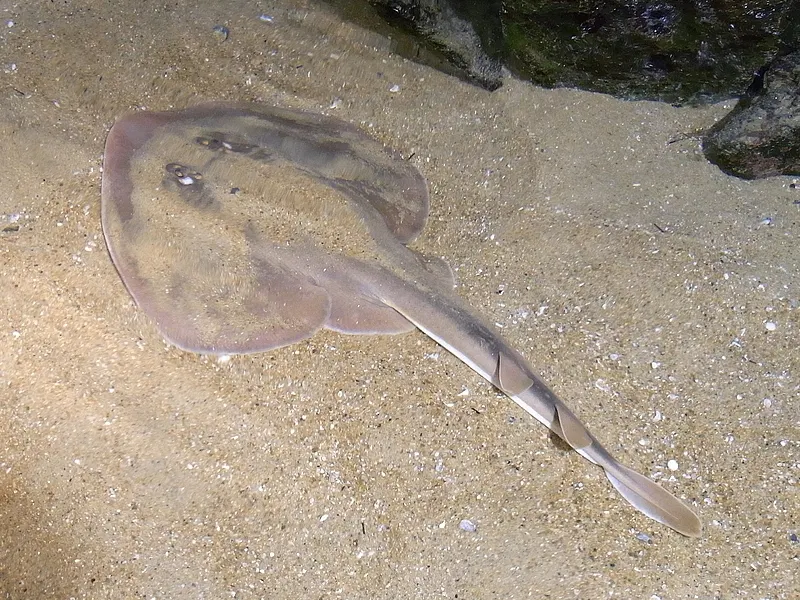
Descriptions give a flattened, rounded body, brown above and white below with a yellowish rim. The snout is short, the eyes are small, and the upper side carries small thorny scales.
Most reported adults are around 50 cm long. FishBase lists a maximum of 86.3 cm, while another account gives 68 cm, so the record varies. In a sample of trawl-caught fish from the southern Taiwan Strait, growth curves levelled off at about 44 cm for males and 51 cm for females.
Where it lives
The IUCN lists China and Viet Nam. FishBase describes a range from the Chinese coast of the Taiwan Strait and South China Sea to northern Vietnam, and treats Japan, South Korea and Taiwan as uncertain. A related species, Platyrhina tangi, was described from southern Japan in 2011.
The fanray lives on the bottom over sandy, sandy-mud and muddy seabed in shallow water. The IUCN gives a depth of 0 to 50 m, and FishBase says it stays inshore above 60 m.
Pins are Wikidata “endemic to” fields. Orange dots, when present, are GBIF occurrence tiles — survey bias included.
How it lives
Little is known. FishBase calls the biology poorly known and rates the ray's resilience as low, with a minimum population doubling time of 4.5 to 14 years. It lists the ray as harmless to people.
A 2026 preprint studied 511 fish caught in bottom trawls in the southern Taiwan Strait between August 2021 and October 2022. Ages read from vertebrae ran to 8 years in males and 10 in females, half the fish were mature at about 2 years, and the estimated upper longevity was 11.5 years for males and 14.2 for females. The IUCN uses a generation length of 12 years.
Why it is in trouble
Chinese fanrays are caught unintentionally in trawls and gillnets. Every fish in the Taiwan Strait study came from commercial bottom trawling as incidental catch. The IUCN also lists targeted harvest, large and small scale, among the ongoing threats, along with coastal housing and industrial development.
The assessment estimates a past reduction of 50 to 79 percent and rates the trend as decreasing. The IUCN records use as human and animal food within countries. Trawling is reportedly behind a known decline in the East China Sea, though the overall population size is unknown.
What is being done
Little protection exists. The IUCN assessment records no recovery plan, no systematic monitoring and no harvest management plan for this ray, and it is not covered by international trade controls. It lists site protection, species recovery, trade management and harvest management as actions that are needed.
Sources
Written for this catalog in our own words from the sources below, checked against them on 12 November 2026. Population figures are estimates and carry the year they were made. Status and assessment year: IUCN. 2026. The IUCN Red List of Threatened Species. Version 2026-1. iucnredlist.org.




