Endangered
Fabulous Green Sphinx Moth
Tinostoma smaragditis
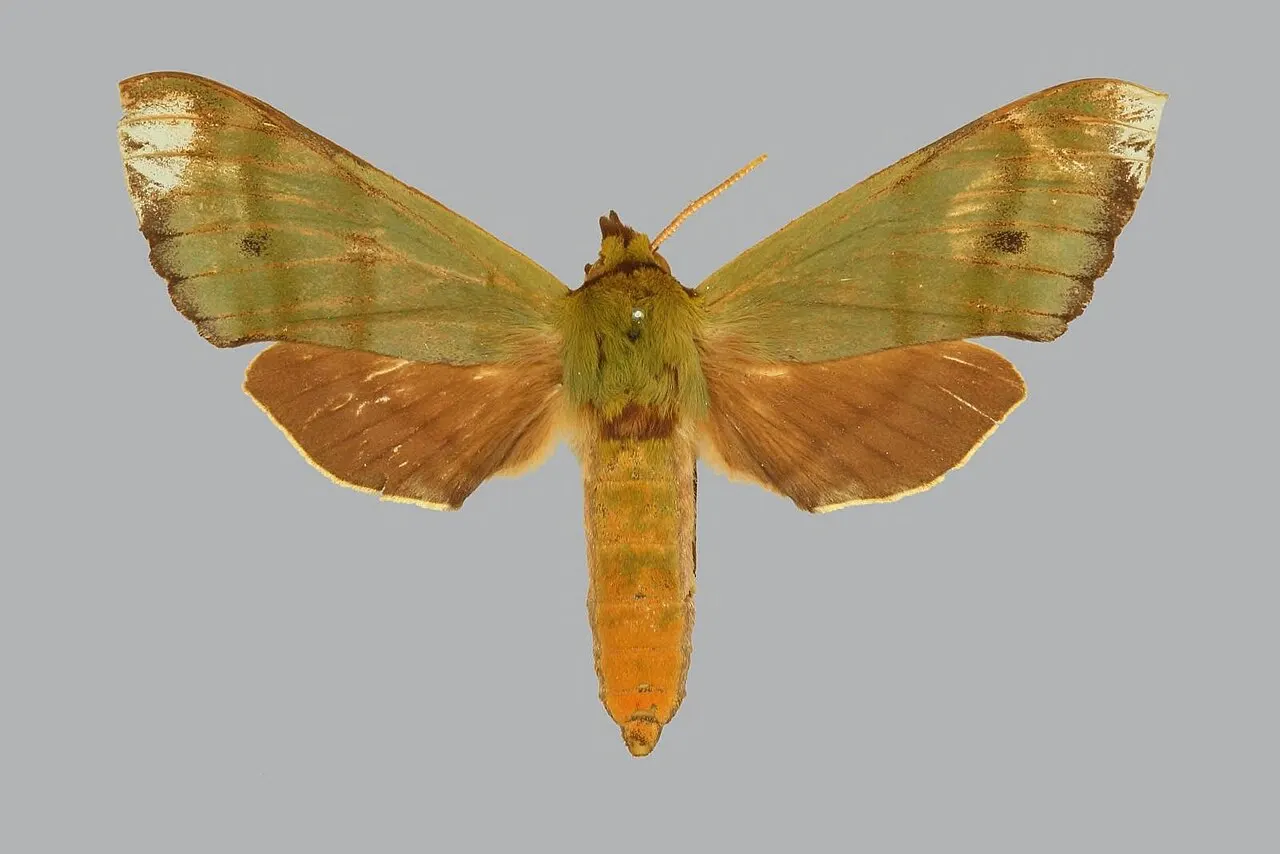
The fabulous green sphinx (Tinostoma smaragditis) is a green hawk moth found only on the Hawaiian island of Kauai. It was known from a single specimen for more than 60 years, then a second in 1961, and it was reportedly rediscovered in 1998. The IUCN Red List assessed it as Endangered in 2004.
A moth that went missing
The first specimen was taken more than 65 years before 1961 by women of the Gay family at their mountain home at Makaweli, Kauai, and passed to the collector R. C. L. Perkins. Edward Meyrick described it in 1899. The moth was damaged, missing an antenna, part of the other, and both hind legs, so Meyrick could not place it in a genus. Walter Rothschild and Karl Jordan later gave it a genus of its own, Tinostoma, in 1903, and the single specimen is kept in the Natural History Museum in London.
Collectors tried to find more. B. Preston Clark, whose sphingid collection lacked only a few described species, employed J. August Kusche to search. Kusche worked the area from Kokee to Kaholuamano in 1919 and again in April 1920 and caught none. As late as 1928 Clark was still offering 100 dollars for a good specimen.
A second moth finally turned up on 7 July 1961, when Kenneth Gouveia, who had been watching for the species for years, spotted a greenish-winged sphinx resting on a garbage can lid beside the Kokee Road, near Halemanu.
How to recognise it
It is a green-winged sphinx moth. The 1890s type specimen has a dark spot on each forewing and a purplish ochre underside, and its abdomen is purple-brown with traces of orange on top. The 1961 moth differed in detail. It lacked the dark forewing spots, had green undersides apart from a purplish blotch at the base of the forewing, and had a green abdomen.
Where it lives
It is endemic to Hawaii and has been recorded only from Kauai. The IUCN lists dry forest and lowland moist forest as its habitats. The two early specimens came from Makaweli and from the Kokee area near Halemanu.
Pins are Wikidata “endemic to” fields. Orange dots, when present, are GBIF occurrence tiles — survey bias included.
Why it is in trouble
The 2004 assessment, under criterion B1ab(iii), reflects a small range and ongoing decline in habitat quality. The population trend is listed as unknown. Recorded threats include storms and flooding, housing and urban development, and effects of named species, and the stresses named are conversion and degradation of its forest habitat plus direct mortality.
The IUCN history for the moth shows how little was known. It was listed as Extinct in 1996, then Data Deficient in 2002, then Endangered in 2004. The IUCN record lists no conservation actions in place.
Sources
Written for this catalog in our own words from the sources below, checked against them on 12 November 2026. Population figures are estimates and carry the year they were made. Status and assessment year: IUCN. 2026. The IUCN Red List of Threatened Species. Version 2026-1. iucnredlist.org.




