Endangered
King Dwarfgoby
Eviota raja
The king dwarfgoby (Eviota raja) is a coral reef fish about 2.5 cm long at most, known only from Indonesia and named for the Raja Ampat Islands. It was assessed as Endangered on the IUCN Red List in 2020, mainly because of its tiny range and declining reef habitat.
How to recognise it
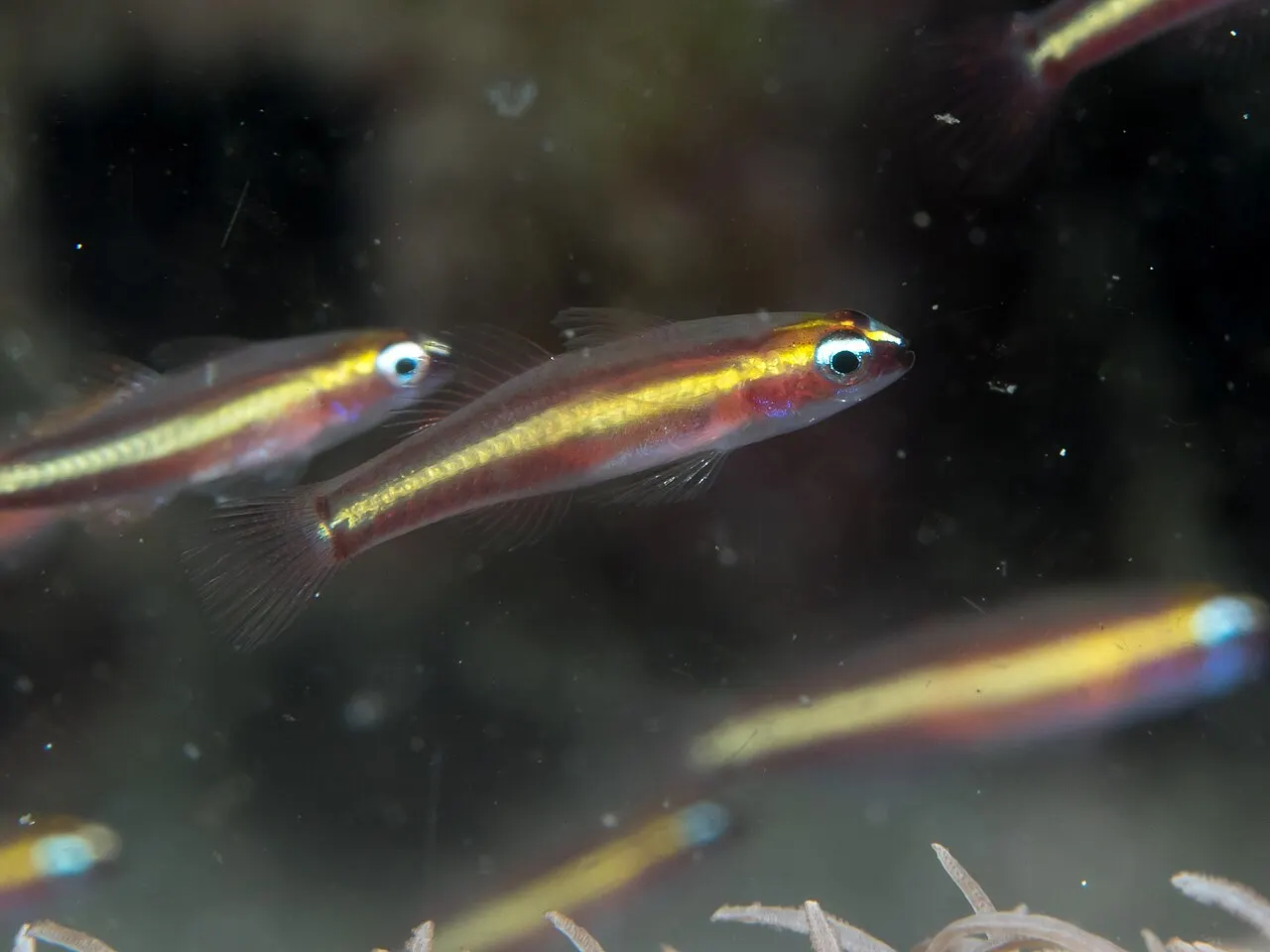
The king dwarfgoby is tiny. FishBase gives a maximum length of 2.4 cm (standard length, which leaves out the tail fin), and an aquarium-trade profile says about 2.5 cm. The rear rays of the second dorsal fin and the anal fin are drawn out, which gives the fish a lance-like outline. The first few spines of the front dorsal fin are also long and thread-like in both sexes.
Its head has a single, very large sensory pore (the AITO pore), and the lower tail stalk is dusky with a pair of tall black spots at the base of the tail fin. In mature adults the two spots often nearly meet.
Where it lives
The species was described by G. R. Allen in 2001, and its name refers to the Raja Ampat Islands in Indonesia, its type locality. FishBase and aquarium references treat it as known only from that island group.
The IUCN assessment lists Indonesia as its only country and counts just two locations. It lives on sheltered reef slopes, usually at depths of 4 to 12 m, and the assessment records a depth range of 0 to 12 m.
Pins are Wikidata “endemic to” fields. Orange dots, when present, are GBIF occurrence tiles — survey bias included.
How it lives
Adults gather in loose groups of about 10 to 20 fish among branching coral. Little else has been published about this particular species. Many fish in the genus Eviota are short-lived, with life cycles reportedly as brief as 3.5 weeks in the tropics. FishBase rates the species' resilience as high, with a population doubling time under 15 months (a preliminary estimate).
Why it is in trouble
Its range is small and tied to coral reef. The 2020 assessment lists run-off and habitat shifting and alteration as threats, and records a continuing decline in the area its habitat covers. It qualifies as Endangered under criteria B1ab(iii)+2ab(iii), which cover a small range, few locations and ongoing loss of habitat quality.
The population trend is listed as unknown, and the assessment names no conservation actions aimed at this species.
Sources
Written for this catalog in our own words from the sources below, checked against them on 12 November 2026. Population figures are estimates and carry the year they were made. Status and assessment year: IUCN. 2026. The IUCN Red List of Threatened Species. Version 2026-1. iucnredlist.org.




