Endangered
Oaxaca hummingbird
Eupherusa cyanophrys
The Oaxaca hummingbird (Eupherusa cyanophrys) is a small, shimmering green hummingbird found only in the Sierra Madre del Sur of southern Oaxaca, Mexico. The IUCN Red List assessed it as Endangered in 2018, with a decreasing population estimated at 600 to 1,700 mature birds. A 2026 BirdLife review has proposed a lower category.
How to recognise it
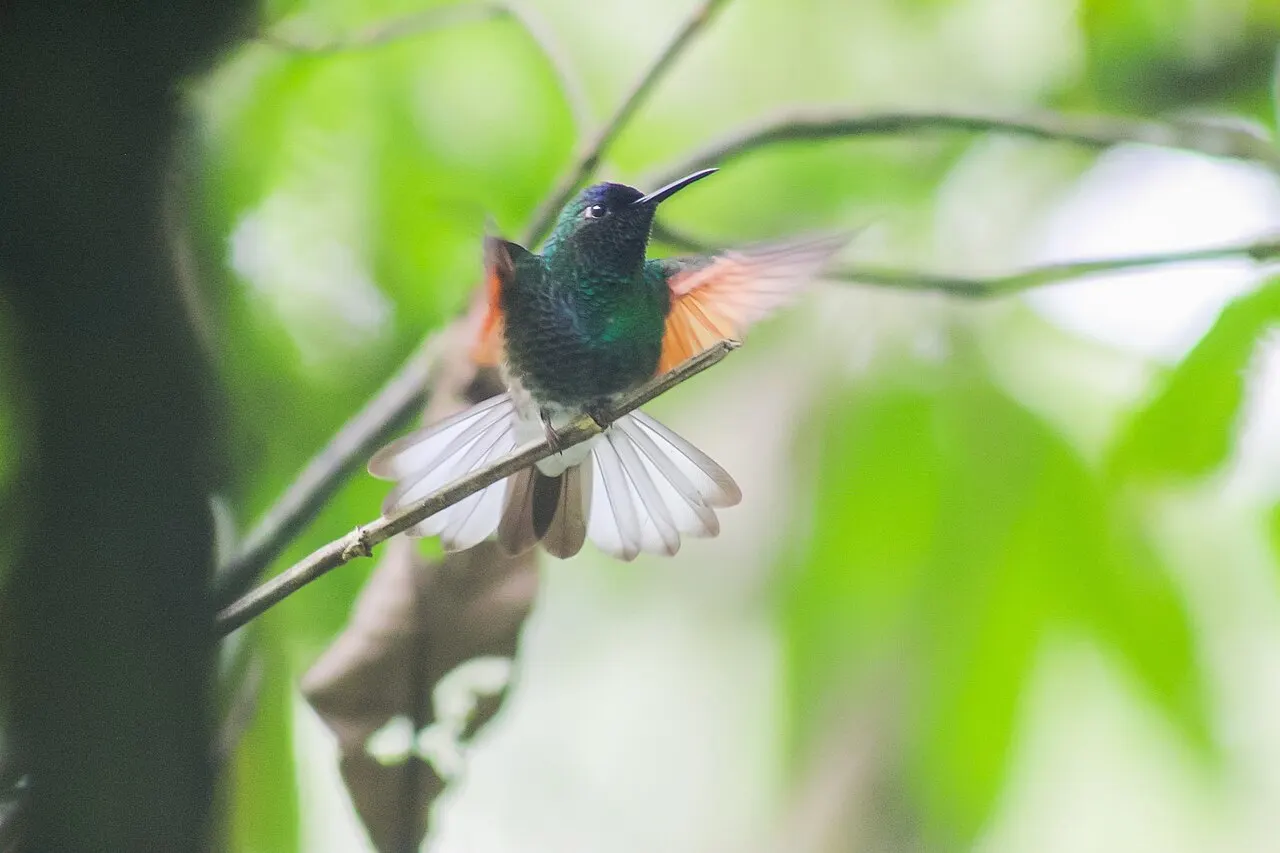
It is a small bird, 10 to 11 cm long and weighing 4.1 to 5.4 g, with a straight black bill. The male has a violet-blue forehead, a turquoise crown, emerald green upperparts and glittering green underparts. His central tail feathers are green and the outer ones whitish. The female is green above and pale grey below, with white and dusky green in the tail.
The male's song is a high, rapid warble, a little jerkier and less hurried than that of the closely related white-tailed hummingbird. Some authors have treated it as a subspecies of that bird or of the stripe-tailed hummingbird, but it is generally listed as a species of its own. It is also called the blue-capped hummingbird.
Where it lives
The species is endemic to Mexico and is confined to the Pacific slope of the Sierra Madre del Sur, also called the Sierra de Miahuatlan, in southern Oaxaca. It lives in humid montane forest, including edges and interior, and also in pine-oak woodland. The IUCN gives an elevation range of 1,300 to 2,500 m, while other accounts list 700 to 2,600 m, with the birds most common below about 1,800 m.
The 2018 assessment counted two locations. In BirdLife's 2026 review, observers reported birds on the northern (Miahuatlan) slope, at San Jose del Pacifico and along a new highway between the two areas, and BirdLife's Red List team said the records point to a wider, probably continuous distribution.
Pins are Wikidata “endemic to” fields. Orange dots, when present, are GBIF occurrence tiles — survey bias included.
How it lives
It feeds on nectar at all levels of the forest and has been recorded at the flowers of Inga, Lobelia, Malvaviscus and Psittacanthus. It probably takes small arthropods as well. The IUCN lists it as not a migrant, though it may shift up and down the mountain with the seasons, which has not been worked out.
Breeding is poorly known. Active nests have been found in May, October and November. They are cups of moss lined with plant down, set 1.2 to 5.4 m above the ground, and the clutch is two eggs.
Why it is in trouble
Much of the forest in its range has been cleared, and most of what remains is reportedly being converted to agriculture. The IUCN lists agricultural clearing as an ongoing threat across the whole range, causing slow but significant decline, and storms as a past threat likely to return.
The numbers behind the Endangered listing are shaky. The 600 to 1,700 estimate used in 2018 relied on poor data. In 2026 BirdLife's Red List team proposed Near Threatened, describing it as a correction based on new information rather than a real change in the bird's status, because population size is unknown. Final 2026 categories are due for publication in November 2026.
What is being done
The IUCN records no protected area covering the species, no recovery plan and no monitoring scheme. It lists site and area protection as the action needed, and research on population size, distribution and trends. The species is on CITES Appendix II.
Sources
Written for this catalog in our own words from the sources below, checked against them on 12 November 2026. Population figures are estimates and carry the year they were made. Status and assessment year: IUCN. 2026. The IUCN Red List of Threatened Species. Version 2026-1. iucnredlist.org.




