Endangered
Eua zebrina
Eua zebrina
Eua zebrina is a small tree snail found only in American Samoa, mainly on the island of Tutuila, with a second population on Ofu. The IUCN Red List assessed it as Endangered in 2022 and lists its numbers as decreasing. It was once so common that its shells were used to decorate hotel chandeliers.
How to recognise it
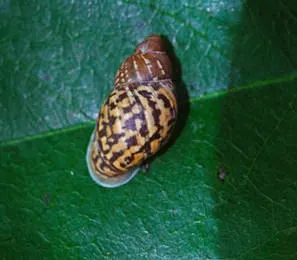
This is a tree snail in the family Partulidae. Adult shells measure roughly 18 to 21 mm tall and 11 to 13 mm wide on Tutuila. Colour varies a lot, from almost white through pale brown to dark brown or purplish, and some shells carry a zebra-like pattern of flecks and lines while others are plain.
Compared with the related genus Samoana, its shell tends to show transverse patterning and a more flared opening.
Where it lives
The species is known only from American Samoa. Historically it was recorded only from Tutuila, where collectors made 927 collections between the 1920s and 1960s, some with hundreds of specimens. It was first seen on Ofu, in the Manua Islands, during a 1998 survey. The IUCN counts three locations, at elevations from about 50 to 366 m, in lowland moist forest.
The snails live scattered on understory plants beneath intact native forest canopy. Early collectors found them mostly on leaves, but also on trunks, branches and in leaf litter. They are rarely recorded in disturbed habitat. In the 1998 survey, the best-populated sites on Tutuila were mostly in the central part of the National Park of American Samoa.
Pins are Wikidata “endemic to” fields. Orange dots, when present, are GBIF occurrence tiles — survey bias included.
How it lives
Partulid snails are mostly nocturnal tree dwellers that feed on plants. This species eats partly decayed and fresh plant material, and individuals have been seen eating other living snails that are not partulids.
Why it is in trouble
The species was considered widespread and common until 1975, then declined sharply. A survey in 1993 found only 34 live snails, at 2 of 9 Tutuila sites. A fuller survey in 1998 found live snails at 30 of 87 Tutuila sites and 1 of 58 Manua sites, with 1,102 snails counted on Tutuila and 88 on Ofu. Most of the Tutuila snails were at a handful of sites. The US Fish and Wildlife Service knew of no systematic survey after 1998 when it reviewed the species in 2015, though field biologists still saw the snails from time to time.
Predators are a major problem. The rosy wolf snail (Euglandina rosea) was released on Tutuila in 1980 to control giant African snails, and by 2001 it was widespread within the national park. It had not reached Ofu or Olosega at the time of the 2015 review, which makes the Ofu population especially valuable. A second introduced predatory snail, Gonaxis kibweziensis, has been recorded only on Tutuila. The New Guinea flatworm (Platydemus manokwari) was found on Tutuila by 2004, and shells with damage typical of rat attacks turned up at several Tutuila sites. The IUCN names the rosy wolf snail and the flatworm as ongoing threats.
Habitat loss adds to the pressure. Agriculture and development cover about 24 percent of Tutuila, and farms have been moving up into steep forest. Feral pigs damage the understory, introduced plants alter native forest, and the 1993 survey found no snails in forest areas badly damaged by hurricanes in 1987, 1990 and 1991. Thousands of shells were also collected for decoration, and a website was advertising the species for sale in 2015.
What is being done
The US Fish and Wildlife Service proposed listing the snail as endangered under the Endangered Species Act in 2015 and finalised the listing on 22 September 2016, effective 24 October 2016. About 1,025 hectares of Tutuila forest within the national park are managed under a long-term lease with the American Samoa Government and villages.
The IUCN lists captive breeding and species recovery as needed actions, but records no recovery plan, no systematic monitoring scheme and no invasive species control for the species.
Sources
Written for this catalog in our own words from the sources below, checked against them on 12 November 2026. Population figures are estimates and carry the year they were made. Status and assessment year: IUCN. 2026. The IUCN Red List of Threatened Species. Version 2026-1. iucnredlist.org.




