Critically Endangered
Turquoise-throated puffleg
Eriocnemis godini
The turquoise-throated puffleg (Eriocnemis godini) is a hummingbird from the Andes of Ecuador, known only from a handful of 19th-century museum skins. The IUCN Red List rated it Critically Endangered (Possibly Extinct) in 2020. It has not been verifiably recorded alive for well over a century.
How to recognise it
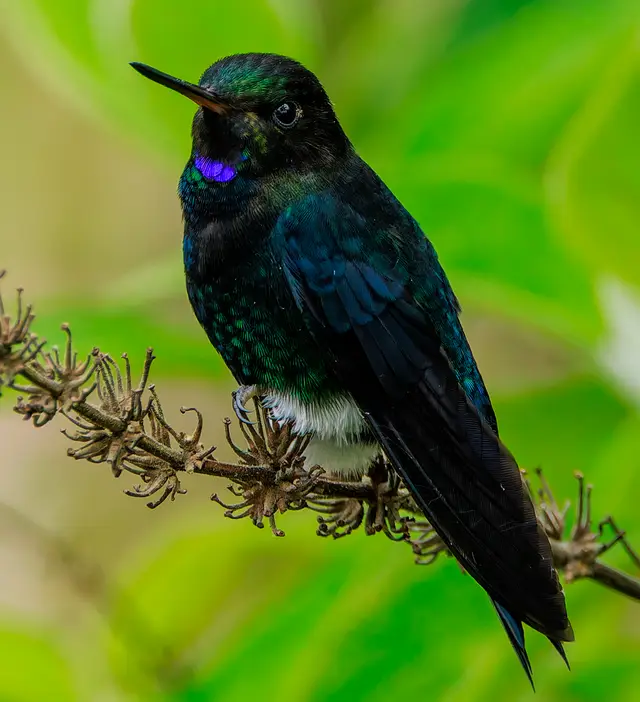
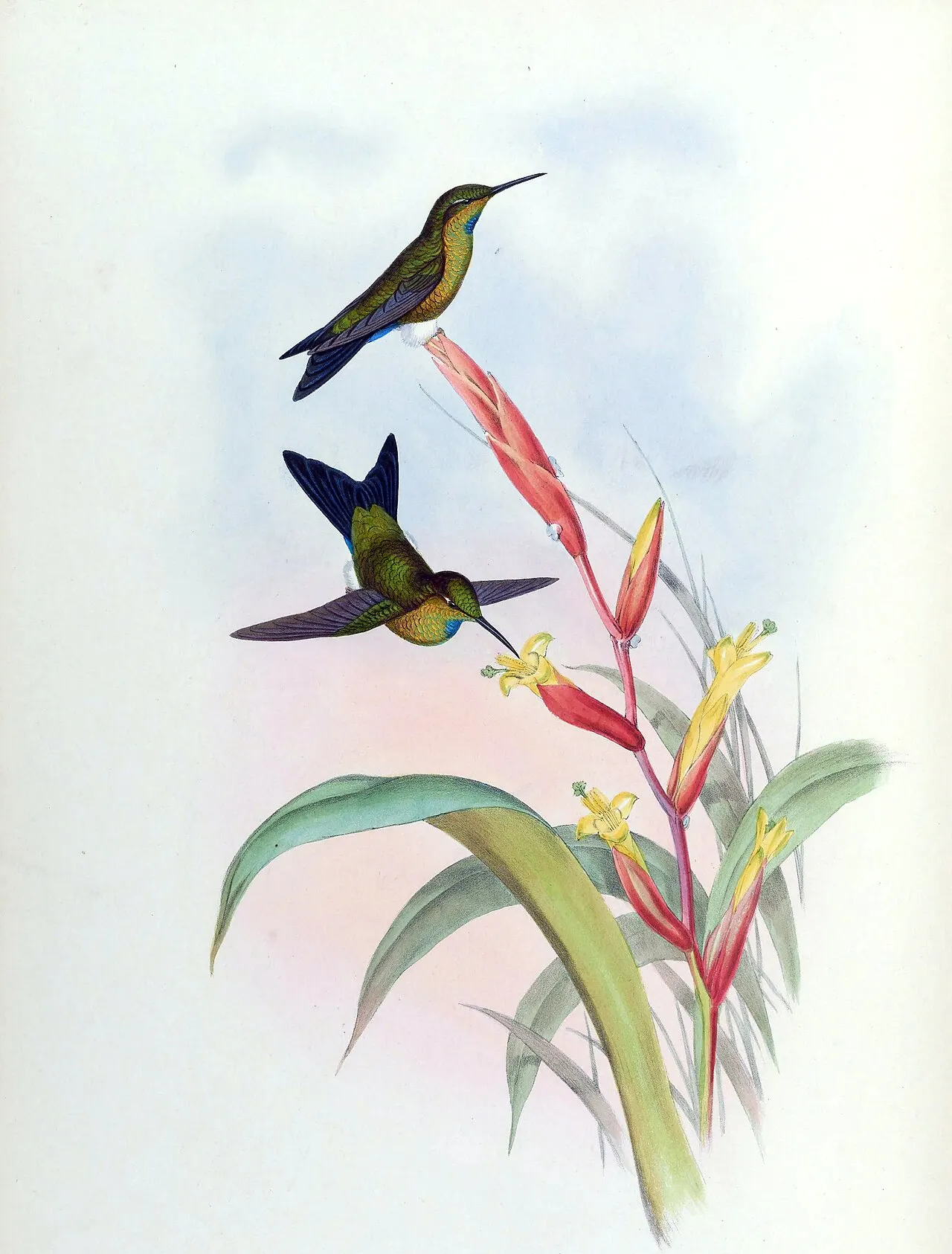
It's a small hummingbird, about 10 to 11 cm long, with a straight black bill and the white downy leg tufts that give pufflegs their name. The male is shining golden green above and over most of the underparts, with a bluish-green rump and a blue-black, slightly forked tail. His throat carries a faint blue to violet-blue patch, and both sexes have violet undertail coverts.
The female lacks the throat patch and is duller, with a more golden belly. Within its range the male's blue throat is distinctive. A female glowing puffleg (Eriocnemis vestita) is a similar bird, but it has a lot of cinnamon-buff on the throat and breast.
Where it lived
The type specimen was collected around 1850 and described by Jules Bourcier in 1851. It is the only skin with reliable locality data. One account gives the place as the Chillo valley on the Guayllabamba plains, another as a site south of Perucho in Pichincha province, both in the dry inter-Andean valleys of northern Ecuador. The elevation recorded is 2,100 to 2,300 m.
Two further skins are labelled only 'Bogota', a common trade label in that era that says little about where a bird was actually taken. One suggestion is a source near Pasto in southwestern Colombia, but that is speculation. The IUCN lists Ecuador as a native country and Colombia as a country of uncertain origin, with the species possibly extinct in both.
Sources disagree on how many specimens exist. One gives six, another counts four records. All are skins in museums abroad, and nothing is known of the bird's diet, nesting or voice.
Pins are Wikidata “endemic to” fields. Orange dots, when present, are GBIF occurrence tiles — survey bias included.
Why it is in trouble
Almost all the presumed habitat at the type locality has been cleared. Small remnants of vegetation survive in steep stream cuts in the arid upper Guayllabamba drainage. The IUCN names small-holder farming as a threat.
An unverified sighting in the Chillos valley in 1976 prompted a search in 1980 that found nothing. Several expeditions to forest remnants in the Guayllabamba valley, the latest in 2010, also failed, as did searches near Pululahua volcano and the Blanco River. The 2020 assessment still allows for a tiny population, putting the number of mature individuals at somewhere between 1 and 49, with an extent of occurrence of about 100 km2 and a single location. The population trend is listed as unknown.
There is also a question of whether it is a true species. In 1996 Graves suggested it might be a hybrid between the glowing puffleg and another, undetermined puffleg, and in 2001 Ridgely suggested it could be a subspecies of the glowing puffleg. The few skins have not settled the matter.
What is being done
Protection on paper is thin. The IUCN records that conservation sites have been identified over its whole range and that it occurs in at least one protected area, but there is no recovery plan, no monitoring scheme and no captive population. The only action it lists is protecting any remaining habitat. The bird is reportedly on CITES Appendix II.
Researcher Tatiana Santander, who has joined several of the searches, has said growing birdwatching interest in the region gives her hope of a sighting, noting that other birds have reappeared after 50 to 80 years unseen.
Sources
Written for this catalog in our own words from the sources below, checked against them on 12 November 2026. Population figures are estimates and carry the year they were made. Status and assessment year: IUCN. 2026. The IUCN Red List of Threatened Species. Version 2026-1. iucnredlist.org.