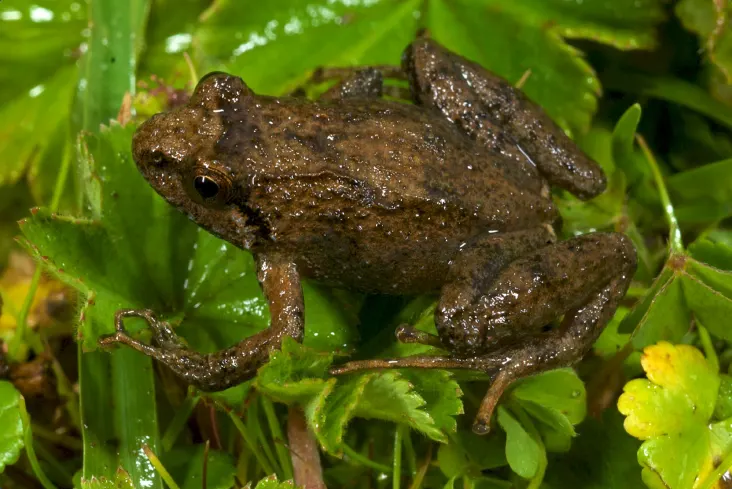
Critically Endangered
Ericabatrachus baleensis
Ericabatrachus baleensis
The Bale Mountains frog is a tiny stream frog found only in the Bale Mountains of Ethiopia, the sole member of its genus and, since 2021, of its own family. It has been rated Critically Endangered on the IUCN Red List since 2013, because its range is extremely small and its stream habitat is being degraded.
How to recognise it
This is a very small frog. Adult males measure about 19 to 22 mm from snout to vent, and females are a little larger at 23 to 27 mm. The fingers have no webbing, and the toes have only a trace of it. Adult males carry well-defined glands on the thigh.
Its place in the frog family tree has shifted. It was first placed among the petropedetid frogs, and molecular work backed that placement. In 2021 researchers Dubois, Ohler and Pyron moved it into a family of its own, Ericabatrachidae, which holds just this one species.
Where it lives
M. J. Largen described the species in 1991. The type locality is a stream at Tulla Negesso, about 12 km north of Katcha in the Bale Mountains, at 3,200 m. The frog is known only from the Bale Mountains and occurs in Bale Mountains National Park.
It lives on grassy banks beside small, fast-flowing streams, in giant heath woodland and the neighbouring Astropanax and Hagenia forest.
Pins are Wikidata “endemic to” fields. Orange dots, when present, are GBIF occurrence tiles — survey bias included.
How it lives
Very little is known about its daily life. The published survey data are about where and how often it is found, not about how it breeds, and researchers have called for basic ecological work, especially on reproduction.
What the surveys do show is a link to relatively undisturbed habitat. The few frogs found since 1986 all came from intact ground.
Why it is in trouble
A 2013 paper in Oryx led by David Gower analysed 15 field trips made between 1971 and 2009. After 1986, only three Bale Mountains frogs were found, all in undisturbed habitat east of the original site. None turned up at Tulla Negesso or at Katcha, so the frog is probably extinct or rare at both places.
The Tulla Negesso stream had changed between 1999 and 2006 from a swift mountain torrent into a boggy, muddy, slow channel. Cattle trample it, people wash clothes in it, and part of the water has been diverted. The surrounding heath forest has fewer trees and less leaf litter, partly because wood is taken for fuel and fencing, and a settlement lies nearby. The human population of the park rose from about 2,500 in 1986 to over 40,000 in 2003.
Chytrid fungus is a further worry. In 2008 and 2009, 42 percent of 72 frogs of 11 species tested positive, including this species. No sick or dead frogs were seen, so the fungus's role in the declines is unclear.
What is being done
Part of the frog's range lies inside the national park, but its streams are still being damaged. The Oryx authors called for the species' Red List assessment to be reviewed, for more surveys away from roads and in untouched habitat, for protection of key habitats and for an end to damaging use of parts of the Harenna Forest.
In 2014 the Rufford Foundation funded a project in the park, led by Yared Debebe Desta, to survey this frog and a second Critically Endangered Bale species, Balebreviceps hillmani. The plan included testing for chytrid, community awareness programs and training for rangers. The project page lists the plan but not its results.
Sources
Written for this catalog in our own words from the sources below, checked against them on 12 November 2026. Population figures are estimates and carry the year they were made. Status and assessment year: IUCN. 2026. The IUCN Red List of Threatened Species. Version 2026-1. iucnredlist.org.




