Critically Endangered
Eremias pleskei
Eremias pleskei
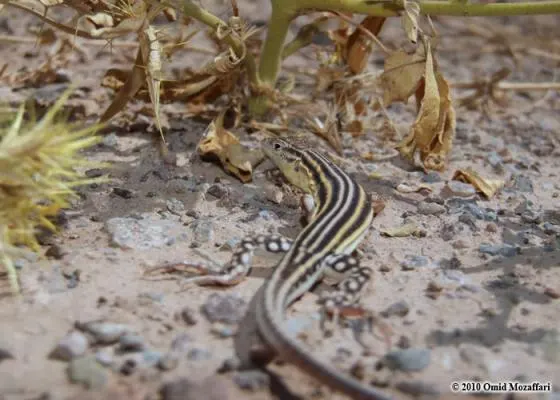
Pleske's racerunner (Eremias pleskei), also called the trans-Caucasian racerunner, is a lizard of hot desert and semi-desert on the Armenian plateau, in Armenia, Azerbaijan, Iran and Turkey. The IUCN Red List classed it as Critically Endangered in 2009, with a decreasing population, mostly because farming has taken its habitat.
Where it lives
Pleske's racerunner is a lacertid, a member of the family of wall lizards and racerunners. It was described by Nikolsky in 1905. The type locality is Nakhichevan, in Azerbaijan, and the Reptile Database gives its range as Armenia, Nakhichevan, north-eastern Turkey, north-western Iran and Azerbaijan. The IUCN lists it as resident in all four countries.
The IUCN classes its habitat as hot desert, at elevations of about 500 to 1,700 m. In Armenia it belongs to the stony semi-desert of the Ararat Valley, in the Araks River plain, some of the country's most fertile farmland.
Pins are Wikidata “endemic to” fields. Orange dots, when present, are GBIF occurrence tiles — survey bias included.
How it lives
Little has been published on its biology. It lays eggs. Surveyors in Armenia in 2012 and 2013 counted the target reptiles, this lizard among them, only in spring and met none from June to October, which they put down to the dry climate making many reptiles inactive in summer.
Why it is in trouble
The 2009 assessment records a decreasing, severely fragmented population. It is listed under criterion A2c, which covers a decline in range or habitat quality. The IUCN names agro-industry farming and rubbish dumping among the threats, and the stresses it records are ecosystem conversion and degradation.
The clearest picture comes from Armenia. A Yerevan State University team ran 23 expeditions across Armavir and Ararat provinces in 2012 and 2013 under a Rufford Foundation grant. Of four populations of this lizard known in Armenia, they found it at only one site, in Ararat Province. There it was abundant, at about 15 animals per hectare, but it occupied only around 120 hectares. The populations recorded in earlier literature from Armavir Province had been destroyed. Most of the semi-desert had been converted to agriculture, and heavy grazing by free-ranging livestock such as sheep added to the damage.
The team also named illegal collecting as a serious risk to small populations of the rare reptiles it studied, by commercial dealers, enthusiasts and some scientists. That was a general finding across three species, not a measured effect on this one.
What is being done
The IUCN lists site protection and site management as needed actions, and research on population size, life history, threats and trends. It records no conservation measures in place for the species in 2009. The Armenian project aimed to help set up new protected areas in the Ararat Valley, to keep land from being sold off for farming, and it produced a free wall calendar for local people and students.
Sources
Written for this catalog in our own words from the sources below, checked against them on 12 November 2026. Population figures are estimates and carry the year they were made. Status and assessment year: IUCN. 2026. The IUCN Red List of Threatened Species. Version 2026-1. iucnredlist.org.




